What is the Colmar outdoor escape game?
The Colmar outdoor escape game is an escape room played in the streets instead of a locked room: a puzzle sits at each landmark, you open it on your phone and crack it by observing the place and reasoning, without needing to know anything in advance. Reckon on about 2 hours, of which 33 minutes of walking across 2.7 km and 10 stops.
Puzzles are waiting under the tower of St Martin's Church, at the Unterlinden Museum, on the canal banks of Little Venice and the Quai de la Poissonnerie, in front of the Old Customs House and at the fountains carved by Auguste Bartholdi, who was born in the town. They are independent of one another, so no plot has to be followed, and three levels of hints are on hand. A centre this small and this full of timber-framed façades gives a puzzle plenty to work with.
- Durationabout 2 hours
- Walkingabout 33 min · 2.7 km
- Stops10
- LanguagesEnglish, German, French, Italian, Spanish, Dutch
What you do on the escape game
Crack the puzzle
Each landmark holds one puzzle, solved with observation and logic alone. No prior knowledge is required.
Read the façades
The clues are in carved beams, signs, dates above doorways, statues and the fountains.
Stroll between stops
Google Maps links the landmarks: 33 minutes of walking over 2.7 km in total.
No countdown
Time is on your side. Take a hint if you want, stop for a tarte flambée and continue later or another day.
See the route and attractions →
How it works
- Book online Choose the number of players. Your booking reference arrives by email straight away.
- Get the app Download the World City Trail app from the App Store or Google Play and enter your booking reference.
- Play when you like Start whenever you are ready, walk at your own pace and pause any time. No guide, no fixed schedule.
Who it suits
Friends
Every landmark starts a new argument about the answer, and nobody needs to have set foot in Colmar before.
Couples
A puzzle to solve together along the Lauch and through the lanes, with no clock in the way.
Colleagues
Teams of up to 5 play from their own phones, which makes it an easy outing to arrange for a small company.
Good to know
- Bring a charged smartphone with mobile data; a power bank helps.
- Best started in daylight, so you can see the details the puzzles ask about.
- No entry tickets needed: everything happens outside the buildings. Going inside is optional and paid separately.
- Family friendly; children must be accompanied by an adult.
- Not suitable for wheelchair users and difficult with strollers.
- Teams of up to 5 work best; bigger groups split into several teams, one ticket per player.
- Every purchase helps support stray cats and dogs in Greece.
Puzzle route: from St Martin's Church to the Bartholdi Museum
10 stops · about 33 min walking · start: St Martin's Church · finish: Bartholdi Museum
The first puzzle is at St Martin's Church and the last at the Bartholdi Museum, in the house where the sculptor was born. On the way you take on the Unterlinden Museum, the Municipal Theatre, the Parc du Champ de Mars, the Roesselmann Fountain, Little Venice, the Fishmongers' Quarter, the Old Customs House and St Matthew's Church. Begin in daylight, because every puzzle is read off the buildings and the water, and rain or wind makes that harder. Google Maps covers the short walks, the app lets you change the order, and the puzzles need no entry tickets.
Open the route map ↗
1St Martin's ChurchStart
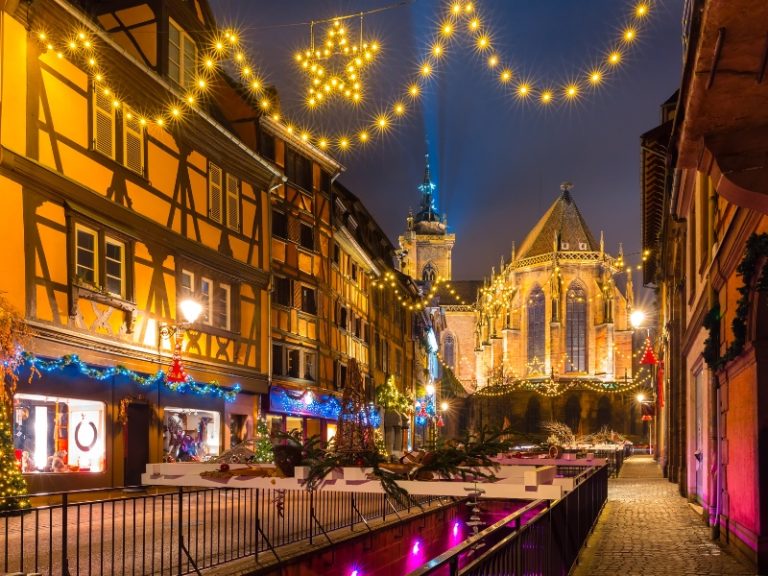
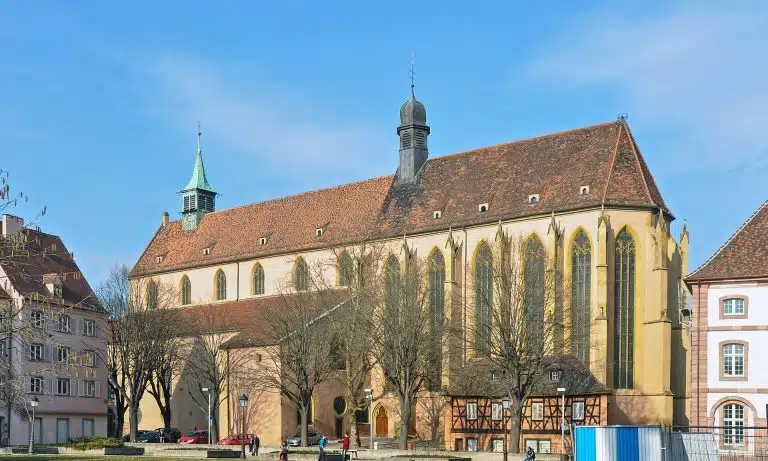
Colmar's largest church was built in Gothic style from 1234 to around 1365 and is often called the cathedral, although it is a collegiate church. Look up at its 71-metre tower: a fire in 1572 destroyed the spire, and the Renaissance cap added the following year is still there, above a roof of colourful tiles.
2Unterlinden Museum
The museum occupies a 13th-century convent of Dominican nuns and opened to the public in 1853. Its most famous work is the Isenheim Altarpiece, painted by Matthias Grünewald in 1512–1516, and since 2015 the museum has a new wing designed by the Swiss architects Herzog & de Meuron.
3Municipal Theatre
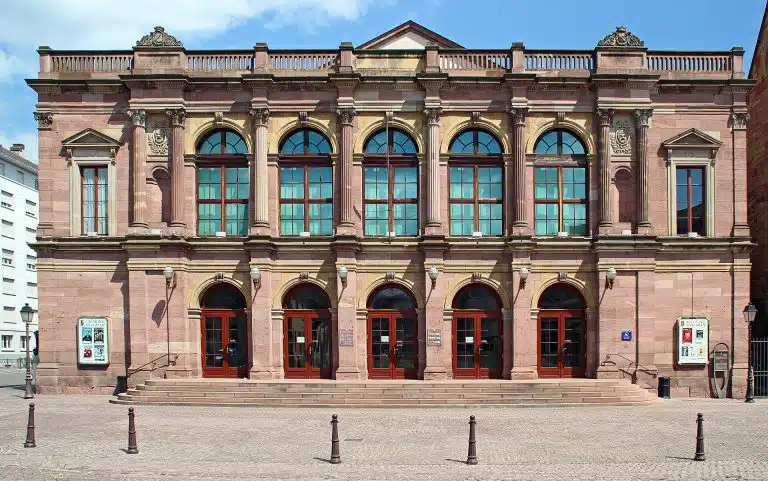
Colmar's municipal theatre was built in 1847–1849 by the architect Louis-Michel Boltz on part of the old Unterlinden convent and opened in March 1849. Behind its classical five-bay façade is a rounded auditorium with three tiers of galleries in the Italian tradition.
4Parc du Champ de Mars
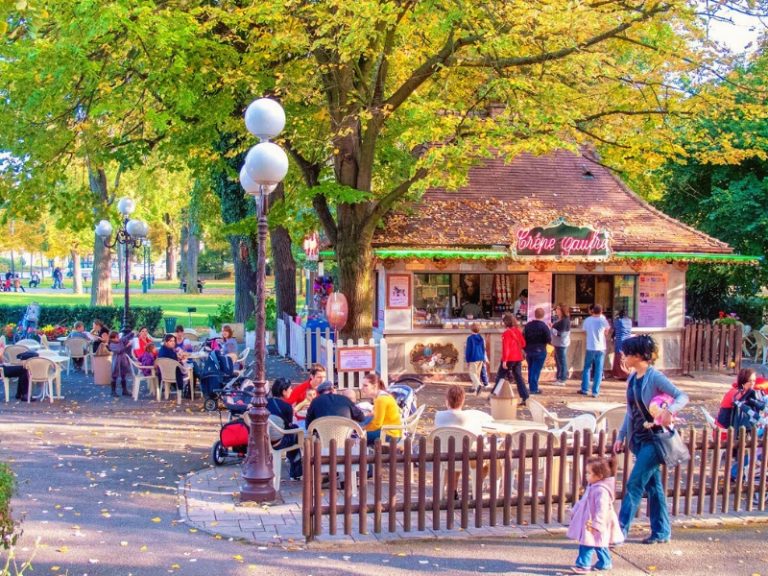
This large, shady park lies just outside the old town. In it stands the fountain of Admiral Armand Joseph Bruat, a naval officer born in Colmar, made by Auguste Bartholdi and inaugurated in 1864; its sandstone figures of the continents were destroyed in 1940, and the bronze admiral has stood on a new basin since 1958.
5Roesselmann Fountain
Auguste Bartholdi made this fountain on Place des Six Montagnes Noires, inaugurated in 1888, in honour of Jean Roesselmann, the provost who died defending Colmar in 1262. According to legend, Roesselmann slipped back into the town hidden in a barrel, and Bartholdi is said to have given him the face of the mayor of the time.
6Little Venice
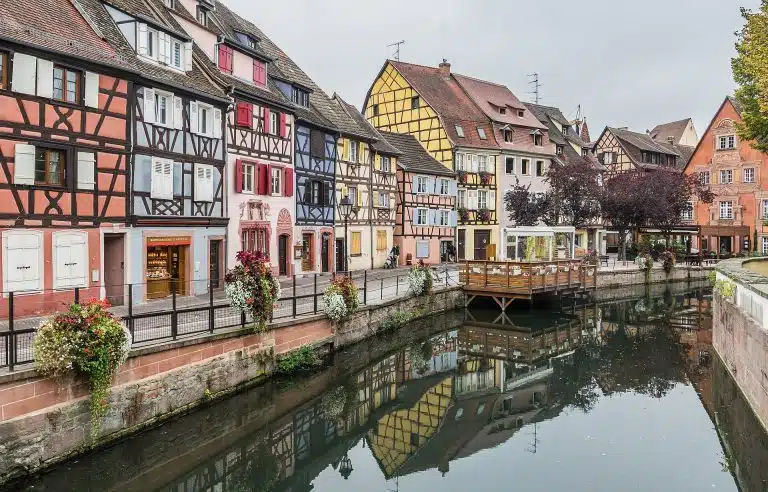
Little Venice (Petite Venise) is the stretch of the Lauch river where colourful half-timbered houses stand right at the water's edge. From the bridges you get the classic view of the houses reflected in the river, and small flat-bottomed boats take visitors along the water.
7Fishmongers' Quarter (Quai de la Poissonnerie)
The Quai de la Poissonnerie takes its name from the fishermen and boatmen who lived and worked here, organised in a powerful guild, and sold their catch beside the Lauch. Its timber-framed houses were restored in the late 20th century and are now among the most photographed in Colmar.
8Old Customs House (Koïfhus)
The Old Customs House, also called the Koïfhus, was built in 1480 as the place where goods passing through Colmar were checked and taxed. In front of it stands another Bartholdi fountain from 1898, honouring Lazarus von Schwendi, who according to legend brought the Tokay vine to Alsace.
9St Matthew's Church
St Matthew's Church is the only surviving part of a Franciscan convent from around 1290, with the wide, plain nave typical of the mendicant orders. It has been Protestant since 1575; in 1715 the choir was walled off for Catholic use, and the dividing wall was only removed in 1987.
10Bartholdi MuseumFinish
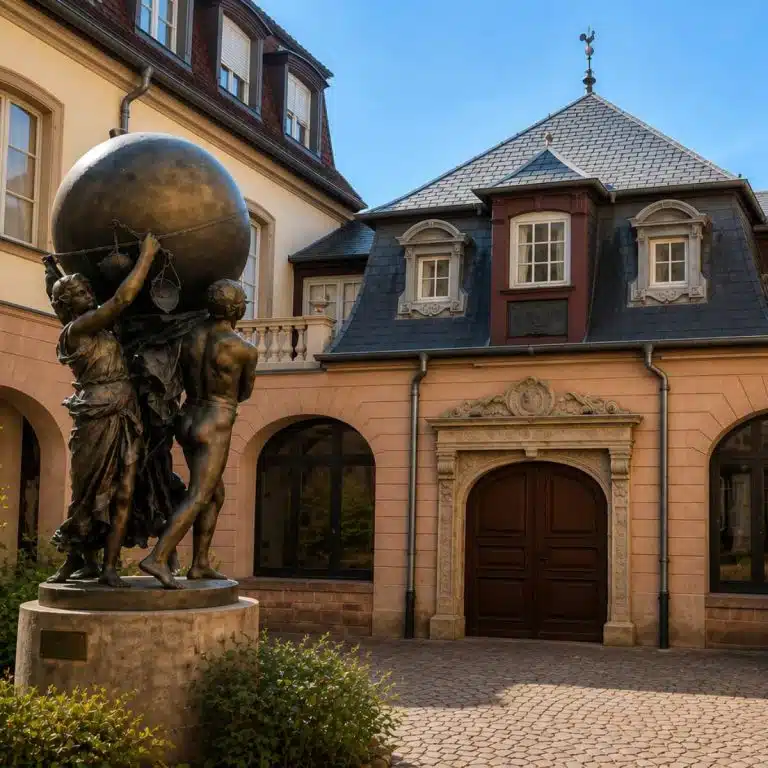
The museum occupies the house where Auguste Bartholdi, the sculptor of the Statue of Liberty in New York, was born in 1834. The family home was left to the town and opened as a museum in 1922, and in the courtyard stands his bronze group Les Grands Soutiens du monde.
Only logged in customers who have purchased this product may leave a review.









Germany –
Collected on GetYourGuide
Die 10 Stationen waren gut ausgew?hlt und die Informationen waren gut. Mir fehlte ein Hinweis in welche Richtung man gehen muss um die n?chste Aufgabe zu l?sen. Die Verlinkung nach Google Maps hat nicht geklappt.
France –
Collected on GetYourGuide
Tr?s belle activit?