What is the Parma self-guided walking tour?
The Parma self-guided walking tour puts a storyteller in your pocket and leaves the pace to you: the World City Trail app guides you between landmarks and, at each of the 10 stops, recounts the history, the legends and the odd surprising fact. Budget around 2 hours for the full route; the 1.9 km of walking take up only about 26 minutes of that time. Apart from crossing the river at the start, the route keeps to the level, largely car-free old town.
In the Parco Ducale the narration goes back to 1561, when Duke Ottavio Farnese had the gardens laid out, and at the Palazzo della Pilotta you learn that its name comes from pelota, a ball sport once practised in one of its courtyards, and why its brick walls look so bare. At the Teatro Regio the story turns to Marie Louise of Austria, Napoleon's second wife, who commissioned it, and at Santa Maria della Steccata to the wooden fence that once held back crowds of worshippers. The walk closes with Antelami's pink marble Baptistery, begun in 1196, and the cathedral dome where Correggio painted the Assumption of the Virgin between 1526 and 1530.
- Durationabout 2 hours
- Walkingabout 26 min · 1.9 km
- Stops10
- LanguagesEnglish, German, French, Italian, Spanish, Dutch
The walk, from first stop to last
Hear the story where it happened
As you reach each stop, the narration begins: who built the place and when, which legends grew up around it, and which small detail deserves a second look. If you would rather read, the same text appears on screen.
Let the map lead
Google Maps on your phone shows the next leg each time you set off again. Over 1.9 km that comes to about 26 minutes of walking, at whatever speed you like.
Break off, carry on later
A coffee, a museum or the rest tomorrow: the app keeps track of your progress, and the walk continues from that point.
Local tips on the way
Suggestions for places to eat and independent shops near the route are part of the narration. If the order does not suit you, change it in the app or begin at another stop.
See the route and attractions →
How it works
- Book online Choose the number of people. Your booking reference arrives by email straight away.
- Get the app Download the World City Trail app from the App Store or Google Play and enter your booking reference.
- Walk when you like Start whenever you are ready, walk at your own pace and pause any time. No guide, no fixed schedule.
Who the walk suits best
History lovers
Who built what, when and why: the narration fills in the background of every square, church and statue.
Couples and families
Legends keep younger listeners interested, the history holds the adults, and nobody hurries you along.
Second-time visitors
Streets you have walked before look different once you know what happened in them.
Good to know
- Bring a charged smartphone with mobile data; a power bank helps.
- No entry tickets needed: everything happens outside the buildings. Going inside is optional and paid separately.
- Family friendly; children must be accompanied by an adult.
- Not suitable for wheelchair users and difficult with strollers.
- Groups of up to 5 work best; larger groups split up, one ticket per person.
- Every purchase helps support stray cats and dogs in Greece.
Farnese gardens, opera and Romanesque stone
10 stops · about 26 min walking · start: Parco Ducale · finish: Parma Cathedral
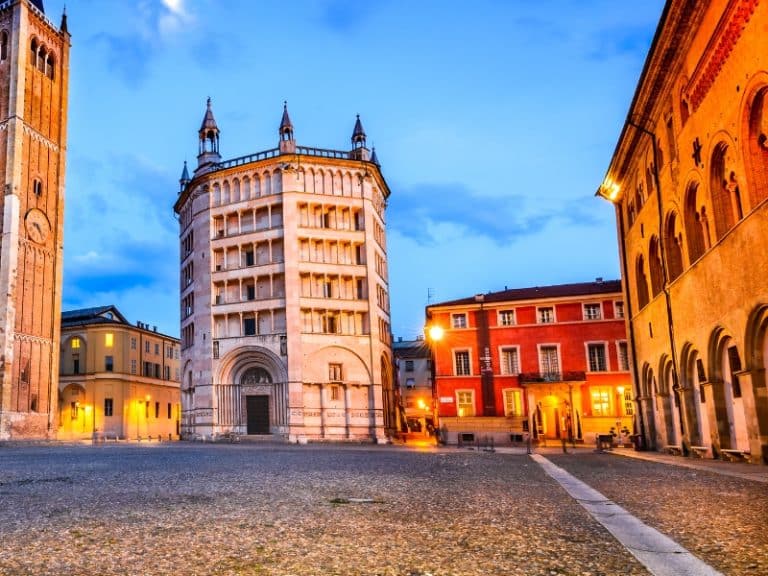
You begin in the Parco Ducale on the west bank of the Parma torrent and cross to the brick bulk of the Palazzo della Pilotta. The Verdi monument and the lawns of Piazza della Pace, redesigned by Mario Botta, come next, then the neoclassical colonnade of the Teatro Regio and the Basilica of Santa Maria della Steccata. On Piazza Garibaldi, laid out over the Roman forum, the clock tower of the Palazzo del Governatore watches over the square, and the last two stops share Piazza Duomo, first the Baptistery and then the cathedral. In the app you can set a different first stop, and none of the ten asks for an entry ticket.
Open the route map ↗
1Parco DucaleStart
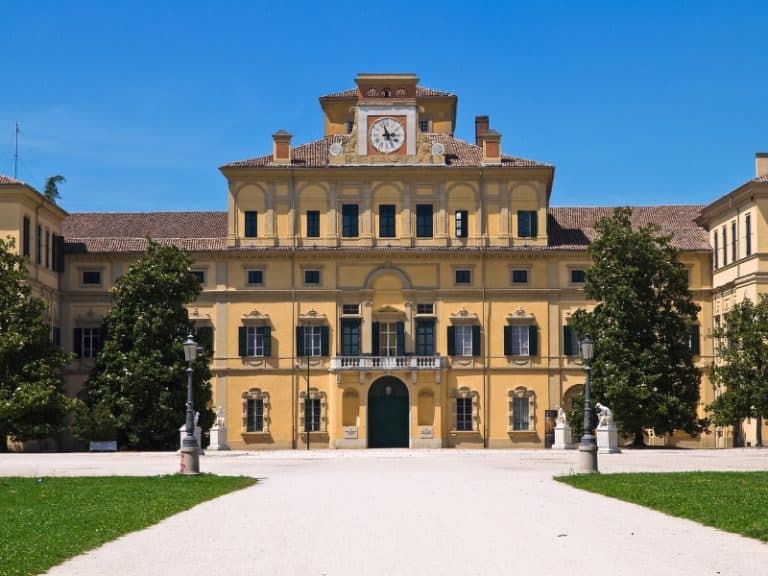
Duke Ottavio Farnese had these gardens laid out in 1561 on the west bank of the Parma torrent, around the Palazzo Ducale del Giardino. In the 18th century the French architect Ennemond Petitot redesigned them in French style, with long tree-lined avenues, statues and a large pond with a fountain on an island.
2Palazzo della Pilotta
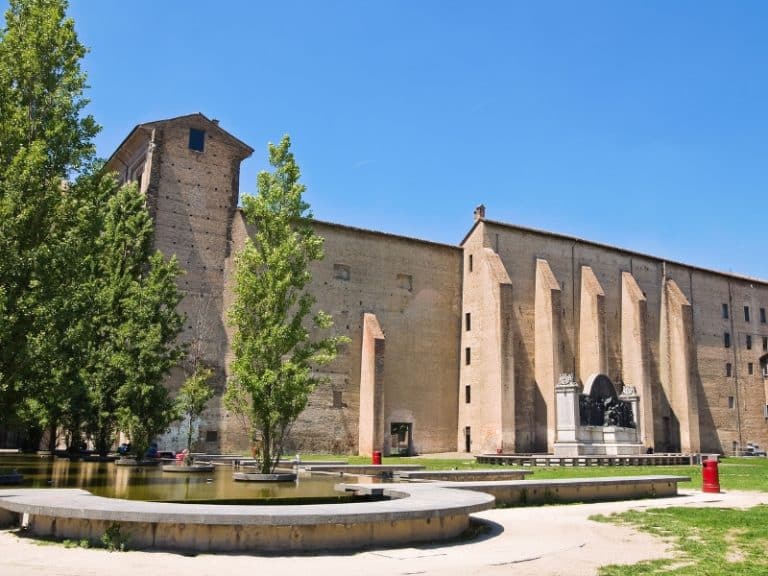
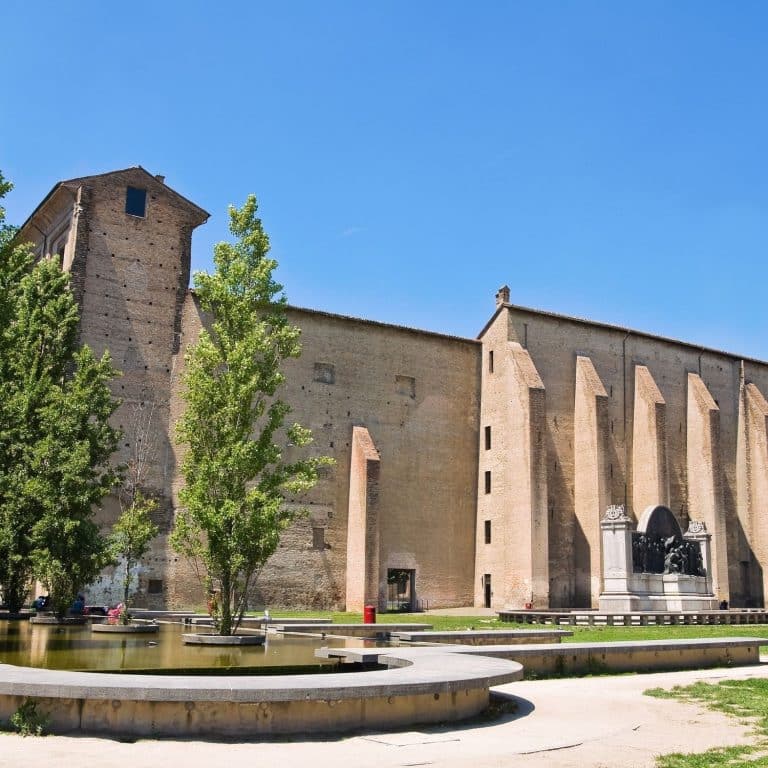
The Farnese dukes built this huge brick complex from the late 16th century, and it was never fully finished, which explains its bare walls. Its name comes from pelota, a ball game once played in one of its courtyards. Today it houses the National Gallery, the wooden Teatro Farnese of 1618 and the Palatine Library.
3Monument to Giuseppe Verdi
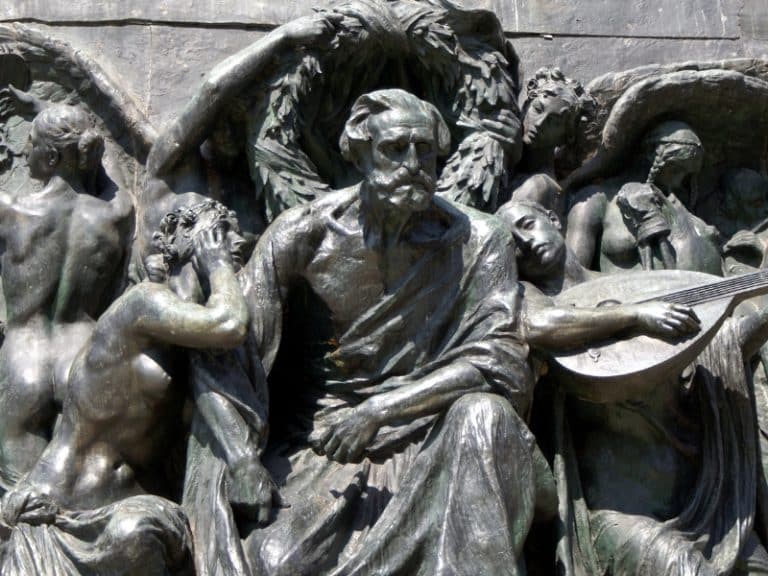
This monument honours Giuseppe Verdi, who was born in 1813 at Le Roncole near Busseto, in the province of Parma. The city has always claimed the composer as its own, and its opera lovers are known as some of the most demanding audiences in Italy.
Read the full story →
4Piazza della Pace
This wide square of lawns between the Pilotta and the Palazzo della Provincia took shape where buildings had been destroyed by bombing in the Second World War. The Swiss architect Mario Botta later redesigned it, opening a clear view of the long brick walls of the Pilotta.
5Teatro Regio
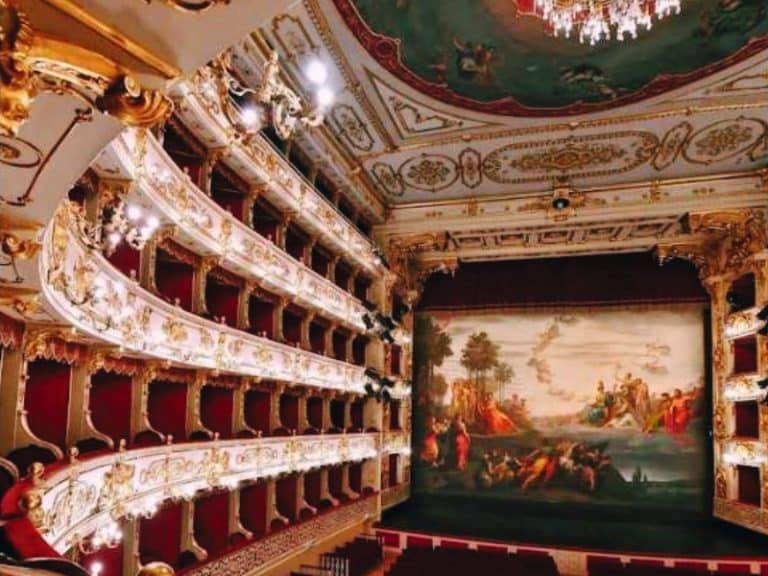
The Teatro Regio was commissioned by Duchess Marie Louise of Austria, Napoleon's second wife, and opened in 1829 to designs by Nicola Bettoli. Behind its neoclassical colonnade lies one of Italy's most respected opera houses, home of the Verdi Festival held in autumn.
6Basilica of Santa Maria della Steccata
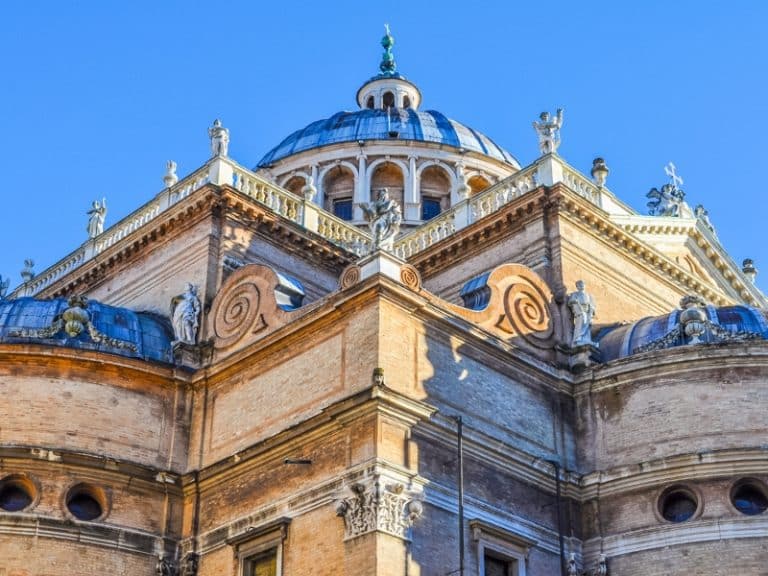
This Renaissance basilica was begun in 1521 to house an image of the Virgin venerated by the people of Parma. Its name comes from the steccato, the wooden fence once set up to hold back the crowds of worshippers, and its crypt holds tombs of the Farnese and Bourbon dukes.
7Palazzo del Governatore
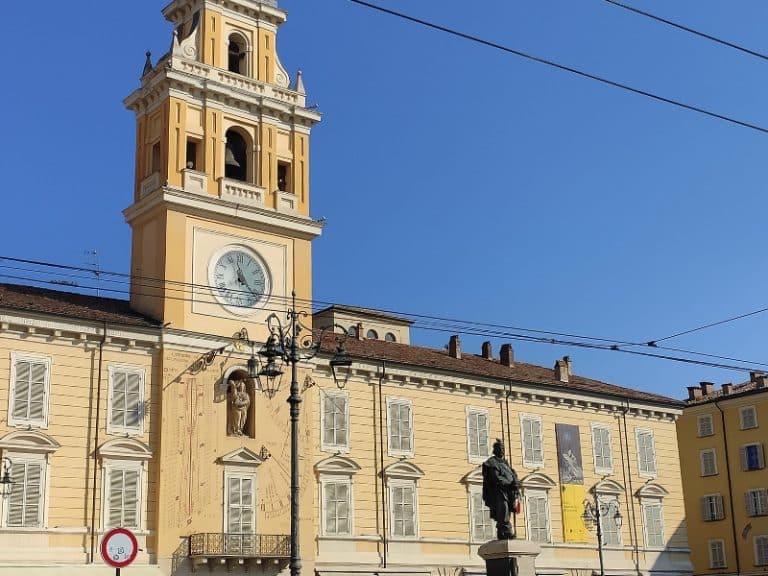
The Governor's Palace closes the north side of Piazza Garibaldi and goes back to the 13th century, although its façade was remodelled in the 18th century. Look up at its tall central tower with the clock, which has long given the time to the square below.
8Piazza Garibaldi
Piazza Garibaldi lies on the site of the Roman forum, where the Via Emilia crossed the main north-south street of Roman Parma. Today it is the city's main meeting place, framed by the Governor's Palace and the Town Hall, with a statue of Giuseppe Garibaldi.
Read the full story →
9Baptistery of Parma
Benedetto Antelami began this octagonal baptistery in 1196, building it in pink Verona marble, and it is one of the most important Romanesque buildings in Italy. Its three portals are decorated with reliefs by Antelami, and inside are sculptures of the months and seasons.
Read the full story →
10Parma CathedralFinish
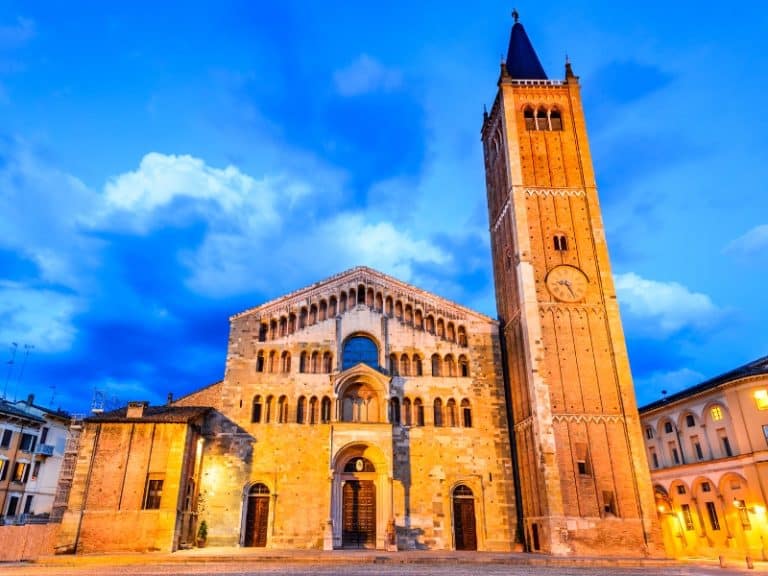
Parma Cathedral was consecrated in 1106 and is a leading example of Romanesque architecture in the Po valley, with stone lions guarding the main portal. Inside, Correggio painted the dome with the Assumption of the Virgin between 1526 and 1530, a swirl of figures rising into the sky.
Read the full story →
Only logged in customers who have purchased this product may leave a review.





Reviews
There are no reviews yet.