
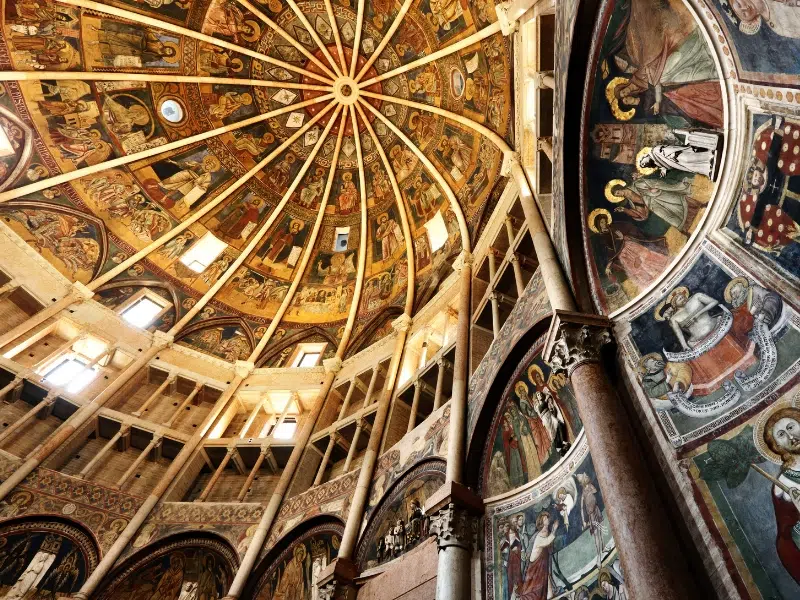
The Baptistery of Parma is an octagonal tower of pink Verona marble on the Piazza del Duomo, next to Parma Cathedral. Begun in 1196 by the sculptor and architect Benedetto Antelami, it marks the shift from Romanesque to Gothic, and inside, a dome painted in the 13th century rises above sixteen painted niches.
Parma Baptistery at a glance
- Where: on the Piazza del Duomo in the centre of Parma, beside the cathedral.
- Built: begun in 1196 and consecrated by 1270, after a long pause in the work.
- By: Benedetto Antelami, who also carved many of its sculptures.
- What it is today: the baptistery of Parma Cathedral, open to visitors as part of the cathedral complex.
- Time needed: 30 to 45 minutes, enough to walk round the outside and take in the dome.
Built in stone from Verona
The date is carved on the lintel of the north door, in a Latin verse that says a man named Benedetto began the work in 1196. By 1216 the walls had only reached the second row of galleries and were covered with a temporary flat roof. Supplies of the pink Verona marble then stopped because of political conflict with Ezzelino da Romano, the lord of Verona, and building only resumed in 1249.
The baptistery was finished and solemnly consecrated by 1270, apparently still following Antelami's original design. Its parts are Romanesque, but the tall, tower-like shape, the rhythm of its open galleries and its carefully planned proportions already point towards Gothic, which is why it is seen as a key building of the transition between the two styles.
What to look for
- The octagon: eight sides of pink marble, with four tiers of open galleries and eight small turrets on top. The octagon was a symbol of eternity.
- The zooforo: the band of 75 carved panels running round the lower walls, with real and fabulous animals such as centaurs, mermaids, sea monsters and unicorns.
- The three doors: the Portal of the Virgin facing the cathedral square, with the Adoration of the Magi; the Portal of Judgment facing west, with Christ enthroned; and the Portal of Life facing south, with a man eating honey in a tree.
- The dome: about 23 metres across, divided into sixteen segments by ribs of pink marble and painted in six circles, from a red sky at the top to the apostles, prophets and scenes from the life of John the Baptist.
- The niches: sixteen arches line the inside, most painted with saints and votive scenes from the 13th and 14th centuries, including Saint George killing the dragon.
- The fonts: a large octagonal basin of Verona marble in the middle, made for baptism by immersion, and a smaller font used since the 14th century.
The man in the tree
The lunette above the south door shows one of the strangest scenes in medieval art: a man sitting in a tree, eating honey, while a dragon waits below and two rodents, for day and night, gnaw at the roots. It illustrates an old moral tale that came to Europe in the story of Barlaam and Josaphat: the man is humanity, enjoying the sweetness of life while time eats away beneath him and death waits. On either side of the tree, the Sun and the Moon drive their chariots, a reminder of passing time.
Tips for your visit
- Stand in the middle of the floor and look straight up to see the dome as one painted wheel.
- Walk all the way round the outside before going in, to follow the carved animals of the zooforo.
- Morning light is best for the pink marble; in the late afternoon the stone takes on a warmer tone.
- Combine the baptistery with the cathedral next door, whose dome was painted by Correggio.
Nearby
- Parma Cathedral: the Romanesque cathedral beside the baptistery, famous for Correggio's dome fresco of the Assumption.
- San Giovanni Evangelista: the Benedictine church just behind the cathedral, with another dome painted by Correggio.
- Palazzo della Pilotta: the Farnese palace complex with the National Gallery and the wooden Teatro Farnese, about ten minutes' walk away.
- Teatro Regio: Parma's opera house, closely tied to Giuseppe Verdi, a short walk from the Pilotta.
See Parma with World City Trail
Our Parma scavenger hunt turns the old town into a game you play on your phone. The route takes around 2 hours, with about 26 minutes of walking. You can play in English, German, French, Italian, Spanish or Dutch.
If you prefer a different format, there is also a self-guided walking tour of Parma and an outdoor escape game in the city.
Play the Parma scavenger hunt →
Take the self-guided walking tour of Parma →
Play the outdoor escape game in Parma →
Facts checked in October 2026.