
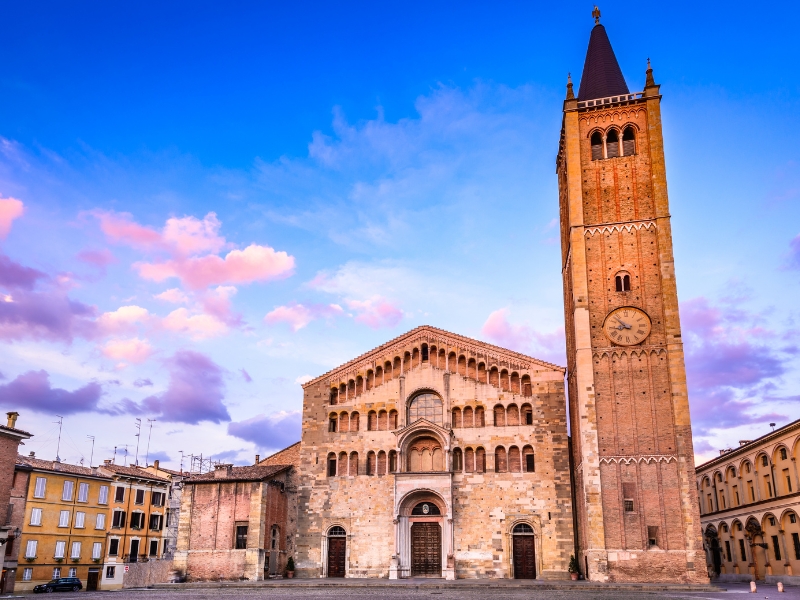
Parma Cathedral is the Romanesque church on Piazza del Duomo, standing side by side with the city's pink marble Baptistery. It was consecrated in 1106, and inside it holds two high points of Italian art four centuries apart: Benedetto Antelami's carved Deposition of 1178 and Correggio's dizzying fresco of the Assumption in the dome.
Parma Cathedral at a glance
- Where: Piazza del Duomo, in the old centre of Parma, next to the Baptistery and the Bishop's Palace.
- Built: begun in the second half of the 11th century and consecrated in 1106 by Pope Paschal II; the Gothic bell tower was added in 1284–1294.
- By: the dome fresco is by Antonio Allegri, known as Correggio (1526–1530); the Deposition relief is by Benedetto Antelami.
- What it is today: the cathedral of the Diocese of Parma, dedicated to the Assumption of the Virgin, and still used for daily worship.
- Time needed: 30–45 minutes, longer if you add the Baptistery next door.
Earthquake, rebuilding and a Renaissance dome
After a fire in 1058 destroyed the earlier cathedral, Bishop Cadalo started a new church on a different site. Pope Paschal II consecrated it in 1106, but only eleven years later, in 1117, an earthquake damaged it badly and it had to be restored. The sandstone façade with its three rows of loggias dates from the 12th century. In 1178 Benedetto Antelami signed and dated his relief of the Deposition from the Cross, originally part of the pulpit, and in 1281 Giambono da Bissone carved the two marble lions at the main door. The Gothic bell tower, topped by a gilded copper angel, followed in 1284–1294.
In the 16th century the interior was covered in frescoes. Between 1526 and 1530 Correggio painted the Assumption of the Virgin in the dome: Mary rises through spiralling clouds crowded with angels and saints, seen from below as if the roof had opened. Lattanzio Gambara and Bernardino Gatti then frescoed the nave, and Girolamo Mazzola Bedoli painted Christ in Glory in the apse (1538–1544). The cathedral kept its Romanesque shell, so today you see a medieval building lined almost entirely with Renaissance painting.
What to look for
- The two lions at the main portal, carved in 1281, carrying the columns of the porch on their backs.
- The façade's three tiers of small arched loggias, typical of the Romanesque style of the Po valley.
- Correggio's dome: stand under the crossing and look up into the swirl of legs, clouds and wings, with the Virgin rising towards the light.
- Antelami's Deposition in the right transept: a long marble panel with Christ being lowered from the cross, Roman soldiers casting dice for his robe, and the signature and date 1178.
- The nave frescoes by Lattanzio Gambara, which cover the walls above the arches with scenes from the life of Christ.
- The crypt, with fragments of ancient floor mosaics found under the church and the 16th-century monument to Saint Bernard degli Uberti, Parma's patron saint.
A hash of frogs
A story often told in Parma says that when Correggio's dome was unveiled, a canon of the cathedral dismissed it as a hash of frogs, because of the tangle of legs seen from below. It is an anecdote passed down by later writers, not a recorded fact, but it captures how strange the fresco looked to people used to calm, flat ceilings. Later painters, from Lanfranco to the Baroque masters, studied it closely.
Tips for your visit
- Come on a bright morning: the dome is high and dim, and natural light helps you read the figures. A small pair of binoculars is useful.
- It is a working cathedral: dress modestly, keep quiet and do not walk around during Mass.
- Step back to the far side of the square for a photo of the façade, the bell tower and the Baptistery together.
Nearby
- Baptistery of Parma: the octagonal tower of pink Verona marble designed by Antelami and begun in 1196, with carved portals and painted vaults inside.
- San Giovanni Evangelista: the Benedictine church just behind the cathedral, where Correggio painted his first dome, the Vision of Saint John.
- Diocesan Museum: on the same square, with sculptures from the cathedral and remains of the early Christian buildings found below it.
- Palazzo della Pilotta: the vast Farnese palace a few minutes' walk away, home to the wooden Teatro Farnese and the National Gallery.
See Parma with World City Trail
Our Parma scavenger hunt turns the old town into a game you play on your phone. The route takes around 2 hours, with about 26 minutes of walking, and leads you to the main sights of the centre. You can play in English, German, French, Italian, Spanish or Dutch.
If you prefer a different format, there is also a self-guided walking tour and an outdoor escape game in Parma.
Play the Parma scavenger hunt →
Take the self-guided walking tour of Parma →
Play the outdoor escape game in Parma →
Facts checked in October 2026.