
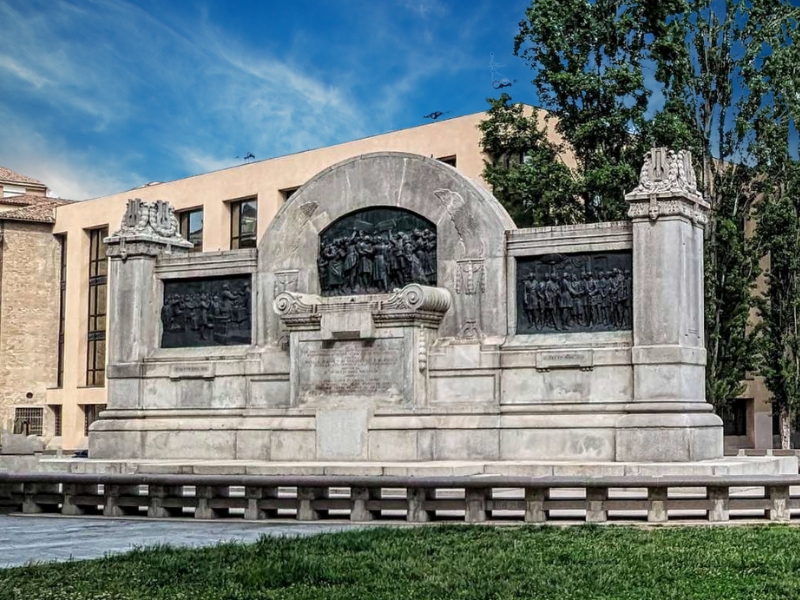
The Verdi Monument in Parma is a granite altar covered in bronze reliefs, standing in Piazzale della Pace beside the brick buttresses of the Palazzo della Pilotta. What you see is only a fragment: when it was inaugurated in 1920, the monument was a colonnade about 90 metres wide with a triumphal arch and 28 statues, one for each of Verdi's works. It was damaged by bombing in 1944 and taken down after the war, and only the altar was kept.
The Verdi Monument at a glance
- Where: Piazzale della Pace in central Parma, next to the Palazzo della Pilotta and a short walk from the Teatro Regio.
- Created: commissioned for the centenary of Verdi's birth in 1913 and inaugurated on 22 February 1920.
- By: the sculptor Ettore Ximenes from Palermo, who made the bronzes and statues, and the architect Lamberto Cusani, who designed the structure.
- What it is today: the surviving altar (ara) of the original monument, in granite with bronze high reliefs, protected by the Italian state since 1989 and the place where Parma honours Verdi in October.
- Time needed: 10–15 minutes; combine it with the Pilotta or the Teatro Regio.
From a 90-metre colonnade to a single altar
Giuseppe Verdi was born in 1813 at Le Roncole, a village near Busseto in the province of Parma, and the city wanted a grand tribute for his centenary. The project was promoted by Mayor Giovanni Mariotti and a citizens' committee. The design was huge: a semi-elliptical hemicycle about 90 metres across, with 20 pillars in a double row, a curved wall pierced by 18 arches and, in the centre, a triumphal arch crowned by a figure of Glory drawn by four lions. Between the columns stood 28 stone statues by Ximenes, each personifying one of Verdi's works, from his first opera, Oberto, to his last, Falstaff, with the Requiem among them. Lines from Verdi's operas were carved on the pillars.
Work began in 1913 but was slowed by the First World War, and the monument was only inaugurated on 22 February 1920. It stood for little more than two decades. An Allied air raid damaged the complex in 1944, and after the war it was dismantled rather than repaired. The granite altar with its bronze reliefs was saved and now stands in Piazzale della Pace. Nine of the opera statues also survived and were taken to Roccabianca, a small town in the province of Parma, while Ximenes's preparatory drawings for the others are kept at Parma's Academy of Fine Arts.
What to look for
- The main relief: Verdi sits deep in thought, surrounded by allegorical female figures, usually read as the Muses or as Symphony and Melody.
- The other side: bronze panels with episodes from Verdi's life and scenes from his operas. Look for the 1859 plebiscite and his journey to Turin, where he was one of the Parma delegates who presented the vote for union to King Victor Emmanuel II.
- The contrast of dark cast bronze against the pale granite block: the figures are in high relief and stand far out from the stone.
- The scale: try to picture the altar as the centrepiece of a 90-metre curve of columns, with an arch and four stone lions rising behind it.
- The setting: the massive bare-brick buttresses of the Palazzo della Pilotta, the Farnese palace complex begun in the late 16th century, form the backdrop.
Viva Verdi and the Club of 27
A popular story from the Risorgimento says that patriots chalked 'Viva Verdi' on walls because the letters could also be read as 'Vittorio Emanuele Re d'Italia', a way of cheering the future king under the noses of the Austrians. Historians argue about how widely the slogan was really used, so take it as a legend. Parma's attachment to Verdi, on the other hand, is well documented: the Club dei 27, a local association, has 27 members, each named after one of Verdi's works, and every October the Teatro Regio stages the Festival Verdi. On the composer's birthday the city holds a tribute at this monument, with the mayor and the theatre's choirs singing 'Va, pensiero' from Nabucco.
Tips for your visit
- Come in October, during the Festival Verdi, if you want to see the monument in use: the birthday tribute is held right beside the altar.
- Walk all the way round: the two long sides tell different stories, and many visitors only look at the front.
- Morning or late-afternoon light falls across the bronze and brings out the faces; at midday the reliefs look flat.
Nearby
- Palazzo della Pilotta: the Farnese palace complex next door, with the Galleria Nazionale, the Biblioteca Palatina and the wooden Teatro Farnese, built in 1618.
- Teatro Regio: Parma's opera house, opened in 1829, a few minutes' walk away; it is the home of the Festival Verdi.
- Monumento al Partigiano: the 1956 bronze partisan in the same square, Parma's memorial to the Resistance.
- Parco Ducale: the former ducal gardens across the river, reached over the Ponte Verdi, with tree-lined paths and the Palazzo del Giardino.
See Parma with World City Trail
Our Parma scavenger hunt turns the old town into a game you play on your phone. The route takes around 2 hours, with about 26 minutes of walking, and leads you through the historic centre with riddles and challenges along the way. You can play in English, German, French, Italian, Spanish and Dutch.
If you prefer a different format, there is also a self-guided walking tour and an outdoor escape game in Parma.
Play the Parma scavenger hunt →
Take the self-guided walking tour of Parma →
Play the outdoor escape game in Parma →
Facts checked in October 2026.