
Rome has been at the centre of things for more than two and a half thousand years: capital of an empire, seat of the popes, and capital of Italy since 1871. Ancient temples, Baroque squares and everyday life are stacked on top of each other here, sometimes in the very same building. Here are the facts and stories that make the city special.
10 fun facts about Rome
- A birthday in April: by tradition, Romulus founded Rome on 21 April 753 BC, and the city still celebrates its birthday, the Natale di Roma, on that date every year.
- An arena for 50,000: the Colosseum, opened in AD 80, could hold around 50,000 spectators, who watched gladiator fights and animal hunts there.
- A stadium turned square: Piazza Navona keeps the long shape of the Stadium of Domitian, built in the 1st century AD, which stood exactly here. Its central Fountain of the Four Rivers was completed by Bernini in 1651.
- A tomb that became a fortress: Castel Sant'Angelo was built as the mausoleum of Emperor Hadrian. In 1527, during the Sack of Rome, Pope Clement VII fled to it from the Vatican along the Passetto, a raised corridor on top of a wall.
- A country inside the city: Vatican City, an independent state since 1929, is the smallest country in the world.
- SPQR everywhere: the ancient motto Senatus Populusque Romanus, the Senate and People of Rome, is still stamped on the city's manhole covers and public buildings.
- Free water on every corner: Rome has around 2,500 nasoni, cast-iron drinking fountains with a curved spout, first put up in the 1870s. Block the spout with a finger and the water shoots up from a small hole on top.
- Where Caesar fell: Julius Caesar was murdered in 44 BC in the Curia of Pompey, whose remains lie in the sunken ruins of Largo di Torre Argentina, today also home to a colony of stray cats.
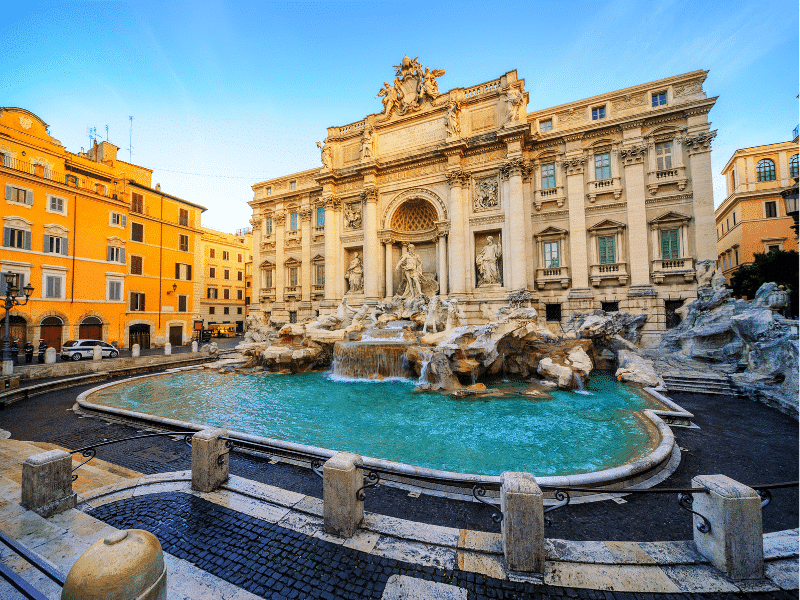
- Coins for charity: the coins thrown into the Trevi Fountain are collected and given to the Catholic charity Caritas. Tradition says that if you toss one over your shoulder, you will come back to Rome.
- A statue that talks back: Pasquino, a battered ancient statue near Piazza Navona, has been used since the 16th century as a place to post anonymous satirical verses about popes and politicians.
The legend of Romulus and Remus
According to legend, the twins Romulus and Remus were the sons of the god Mars and Rhea Silvia, a princess forced to become a Vestal Virgin by her uncle, King Amulius. Fearing they would one day claim his throne, he ordered the babies to be drowned in the Tiber, but their basket washed ashore below the Palatine Hill. There a she-wolf found them and fed them until a shepherd, Faustulus, took them in. As young men they decided to found a city, but quarrelled over where. Romulus began building walls on the Palatine; when Remus mockingly jumped over them, Romulus killed him and gave the new city his own name. You can see the famous bronze she-wolf in the Capitoline Museums: the twins beneath her were added in the Renaissance.
The Pantheon, explained
The Pantheon as it stands today was built under Emperor Hadrian around AD 125, although the inscription on the front names Marcus Agrippa, who built an earlier temple on the site. Its dome is still the largest unreinforced concrete dome in the world, 43.3 metres across, exactly the same as its height from the floor to the oculus, the open hole at the top. When it rains, the water falls straight in and drains through small holes in the marble floor. In 609 the temple became a church, which is why it survived so well. The painter Raphael and the first two kings of united Italy are buried inside.
What to eat in Rome
- Cacio e pepe: pasta tossed with pecorino romano and lots of black pepper, simple and hard to get right.
- Carbonara: pasta with guanciale, egg yolk, pecorino and black pepper. In Rome there is no cream.
- Supplì: a fried rice croquette with tomato sauce and a melting heart of mozzarella, the classic Roman street snack.
- Carciofi alla giudia: whole artichokes fried until crisp, a speciality of the old Jewish Ghetto, best in spring.
- Maritozzo: a soft sweet bun split open and filled with whipped cream, eaten for breakfast.
Good to know before you go
- Book timed tickets for the Colosseum and the Vatican Museums in advance. Queues for both can be very long.
- To enter St Peter's and many other churches, your shoulders and knees need to be covered.
- On the Aventine Hill, look through the keyhole of the gate of the Knights of Malta for a perfectly framed view of St Peter's dome.
- Ostia Antica, the ruins of Rome's ancient port, is an easy half-day trip by local train and much quieter than the Forum.
Explore Rome with World City Trail
Our Rome scavenger hunt turns these sights into a game you play on your phone. The route links 10 stops and takes around three hours, with about 70 minutes of walking, past places including Castel Sant'Angelo, Piazza Navona and the Pantheon.
At each stop you solve a puzzle and hear a short story, at your own pace. You can start whenever you like.
Play the Rome scavenger hunt →
Facts checked in October 2026.