
Rotterdam is the Dutch city that had to start again. After its centre was bombed in May 1940, it chose not to copy the old town but to try new ideas, and it has kept experimenting ever since. The result is a skyline of striking modern architecture around one of the world's great ports. Here are the facts and stories that make it special.
10 fun facts about Rotterdam
- Europe's largest port: the Port of Rotterdam is the biggest in Europe, and its docks run all the way from the city to the North Sea.
- Erasmus was born here: the humanist Desiderius Erasmus was born in Rotterdam in the 1460s. His bronze statue near the Laurenskerk, made in 1622, is the oldest public statue in the Netherlands.
- A medieval survivor: the Laurenskerk, completed in 1525, is the last great medieval building in the city centre. It was badly damaged in 1940 and restored after the war.
- A City Hall that came through: the Stadhuis on the Coolsingel was built between 1914 and 1920 and survived the 1940 bombing almost undamaged.
- A skyscraper from 1898: the Witte Huis, about 43 metres tall, was one of the first high-rise office buildings in Europe, and it also survived the bombing.
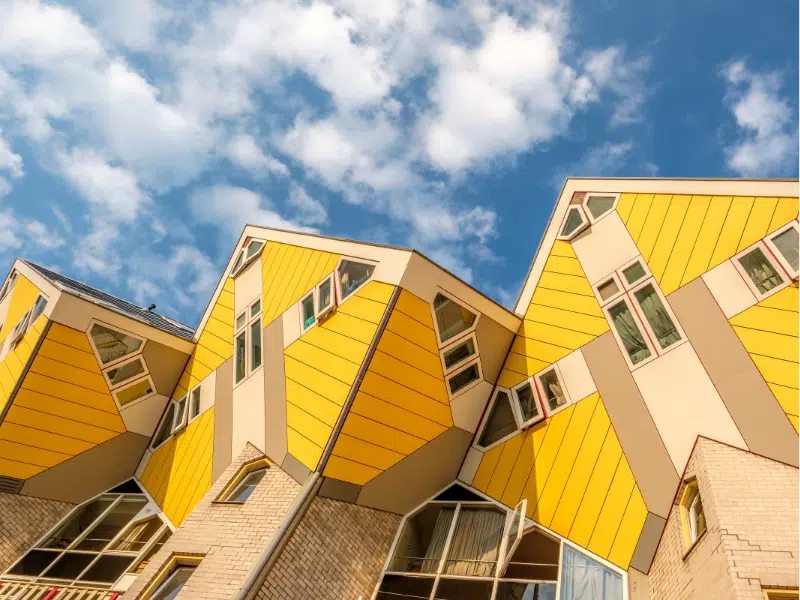
- Houses tipped on their corners: Piet Blom's Cube Houses, finished in 1984, are cubes tilted on pillars, each meant to be a tree in an abstract forest.
- A market under a giant mural: the Markthal, opened in 2014, is a horseshoe-shaped arch of flats over a food hall, and its ceiling is covered by a vast artwork called Horn of Plenty.
- The Swan: the Erasmus Bridge, opened in 1996 and designed by Ben van Berkel, is nicknamed the Swan for its white, bent pylon.
- A pioneer of car-free shopping: the Lijnbaan, opened in 1953, is often described as the first purpose-built pedestrian shopping street in Europe.
- A museum store you can visit: Depot Boijmans Van Beuningen, a mirrored, bowl-shaped building opened in 2021, lets visitors walk through the stored collection of a major art museum.
14 May 1940: the day the centre disappeared
On 14 May 1940, during the German invasion of the Netherlands, German bombers attacked the centre of Rotterdam. Fires spread through the old town, hundreds of people were killed and tens of thousands lost their homes, and the Dutch army surrendered soon afterwards. Instead of rebuilding the old streets, the city cleared most of the ruins and planned a new, open centre, which is why so much of Rotterdam looks modern today. Near the Maritime Museum, Ossip Zadkine's sculpture The Destroyed City, unveiled in 1953, shows a figure with a hole where its heart should be.
Kop van Zuid and Hotel New York
Across the Erasmus Bridge, the Kop van Zuid was once an area of docks and warehouses. At its tip stands Hotel New York, the former head office of the Holland America Line, whose ships carried many thousands of emigrants from Rotterdam to North America. Today it is a hotel and restaurant, surrounded by towers such as De Rotterdam, designed by Rem Koolhaas's office and completed in 2013.
What to eat in Rotterdam
- Kapsalon: fries topped with shawarma, melted cheese and salad, invented in a Rotterdam snack bar in 2003 and named after the Dutch word for a hair salon, because the first one was made for a hairdresser.
- Herring: raw herring with onions, eaten by holding it by the tail. It is best in early summer, when the new season's Hollandse Nieuwe arrives.
- Bitterballen: crisp fried balls of meat ragout served with mustard, the classic Dutch bar snack.
- Surinamese and Cape Verdean food: Rotterdam has large communities from both, so look for roti and broodje pom, a sandwich with a baked chicken and root-vegetable filling.
- Stroopwafel: two thin waffles glued together with caramel syrup, best eaten warm from a market stall.
Good to know before you go
- The windmills of Kinderdijk, a UNESCO World Heritage Site since 1997, are an easy trip by waterbus from the Erasmus Bridge area.
- Water taxis are a quick way to cross the Maas and see the skyline from the river.
- For the view from the top, go up the Euromast, opened in 1960, or head up to the roof terrace of the Depot.
- Delft and The Hague are both a short train ride away.
Explore Rotterdam with World City Trail
Our Rotterdam scavenger hunt turns these sights into a game you play on your phone. The route links 10 stops and takes around two hours, with about 54 minutes of walking, and includes City Hall and the Laurenskerk.
At each stop you solve a puzzle and hear a short story, at your own pace. You can start whenever you like.
Play the Rotterdam scavenger hunt →
Facts checked in October 2026.