
Zagreb grew out of two rival hilltop towns, a church town and a merchants' town, that only merged in 1850. Today Croatia's capital pairs the gas-lit lanes of the Upper Town with the Habsburg-era squares and parks of the Lower Town. Here are the facts and stories that make the city special.
10 fun facts about Zagreb
- A cannon that tells the time: every day at noon a cannon fires from the Lotrščak Tower in the Upper Town, a tradition kept since 1 January 1877.
- One of the world's shortest funiculars: the Zagreb funicular, opened in 1890, links the Lower and Upper Town on a track just 66 metres long.
- Lit by hand: the gas lamps of the Upper Town are still lit and put out by hand by lamplighters every day.
- Where the necktie comes from: the word cravat goes back to Croatian soldiers in 17th-century France, whose knotted neckscarves became a Paris fashion. Croatia celebrates Cravat Day on 18 October.
- A museum of heartbreak: the Museum of Broken Relationships, started by Olinka Vištica and Dražen Grubišić after their own break-up, shows objects donated by former couples, each with its story. In 2011 it won the Kenneth Hudson Award for innovation from the European Museum Forum.
- A roof with coats of arms: the tiled roof of St Mark's Church shows the arms of the Kingdom of Croatia, Slavonia and Dalmatia on one side and the arms of Zagreb on the other.
- A painting that survived the flames: when a great fire swept through the Upper Town in 1731, the Stone Gate burned, but a painting of the Virgin Mary inside it survived. The gate is now a shrine where candles burn day and night.
- Two earthquakes, one cathedral: after an earthquake in 1880 damaged Zagreb Cathedral, Hermann Bollé rebuilt it in neo-Gothic style with two spires about 108 metres high. Another earthquake in March 2020 broke off the top of one spire, and restoration has continued since.
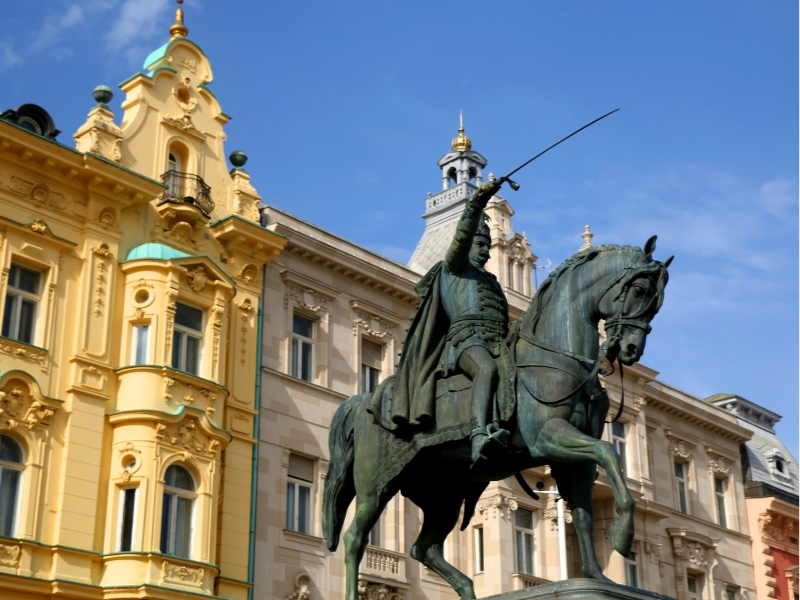
- A statue that came back: the equestrian statue of Ban Josip Jelačić was unveiled on the main square in 1866, removed by the communist authorities in 1947 and put back in 1990.
- The mechanical pencil: the engineer Slavoljub Penkala patented a mechanical pencil in 1906 and went on to make pens and pencils in his own Zagreb factory.
The legend of Manda and the spring
Legend says that a ban, a Croatian governor, came back from a long ride hot and thirsty and asked a girl called Manda to scoop him some water from a spring: 'Zagrabi, Mando!', or 'Scoop it up, Manda!'. From zagrabiti, to scoop, the city got its name, and the spring was called Manduševac. Historians have other theories about the name, but the story stuck. The spring still has a fountain on Ban Jelačić Square, and people throw coins into it for luck.
The Green Horseshoe, explained
In the late 19th century, Zagreb laid out a U-shaped chain of squares and parks across the Lower Town, now named after the city engineer Milan Lenuci. It includes Zrinjevac, with its plane trees and music pavilion, the Botanical Garden, founded in 1889, and the square of the Croatian National Theatre, whose yellow building by the Viennese architects Fellner and Helmer opened in 1895 in the presence of Emperor Franz Joseph. Walking the whole horseshoe is the best way to see the Habsburg side of the city.
What to eat in Zagreb
- Štrukli: thin dough filled with fresh cheese, boiled or baked with cream. It comes from the Zagorje region north of the city and is Zagreb's signature dish.
- Purica s mlincima: roast turkey with mlinci, thin dried flatbreads soaked in the roasting juices.
- Sir i vrhnje: fresh cottage cheese with sour cream, sold by farmers at Dolac market.
- Kremšnita: a custard slice. The most famous comes from Samobor, a small town just west of Zagreb.
Good to know before you go
- If you are near the Lotrščak Tower at noon, expect a bang: the cannon is loud.
- Dolac, the main market under its red umbrellas, has been there since 1930. Go in the morning, when it is busiest.
- In Advent the city fills with Christmas markets. Zagreb won the European Best Destinations vote for the best Christmas market in Europe three years running, from 2016 to 2018.
- Mirogoj Cemetery, designed by Hermann Bollé with long arcades and domes, is a short bus ride from the centre and one of the most beautiful parks in the city.
Explore Zagreb with World City Trail
Our Zagreb scavenger hunt turns these sights into a game you play on your phone. The route links 10 stops and takes around two hours, with about 42 minutes of walking. Stops include the Botanical Garden and the Croatian National Theatre.
At each stop you solve a puzzle and hear a short story, at your own pace. You can start whenever you like.
Play the Zagreb scavenger hunt →
Facts checked in October 2026.