
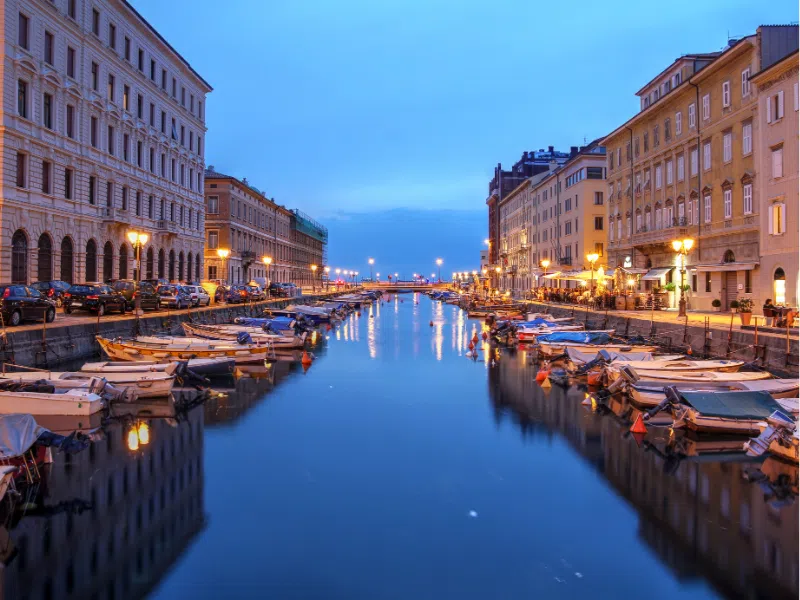
Trieste looks Italian but feels Central European. For more than five centuries it belonged to the Habsburgs and grew rich as the empire's port, and you can still see it in the grand squares, the Viennese-style cafés and the churches built by Greek and Serbian merchants. Here are the facts and stories that make Trieste special.
10 fun facts about Trieste
- Habsburg for over 500 years: Trieste placed itself under Habsburg protection in 1382 and stayed with Austria until the end of the First World War, when it became part of Italy.
- A free port that built a city: in 1719 Emperor Charles VI declared Trieste a free port, and it grew into the main seaport of the Habsburg Empire.
- A square open to the sea: Piazza Unità d'Italia is often said to be Europe's largest square facing the sea. Until after the First World War it was simply called Piazza Grande.
- James Joyce's other city: Joyce lived in Trieste from 1904 to 1920, with breaks, and wrote much of Dubliners and A Portrait of the Artist as a Young Man here. A bronze statue of him has stood on the Ponte Rosso since 2004.
- The world's largest sailing race: every October the Barcolana regatta fills the gulf with boats. On 14 October 2018, 2,689 boats took part, a Guinness World Record.
- A cave with a record-breaking hall: in the Grotta Gigante, on the Karst plateau above the city, the main chamber is 98.5 metres high. Guinness lists it as the tourist cave with the world's largest hall.
- A coffee city: Trieste is one of the Mediterranean's great coffee ports, and Francesco Illy founded the illycaffè company here in 1933.
- An opera house named overnight: the Teatro Verdi opened in 1801 as the Teatro Nuovo. Its auditorium is by Gian Antonio Selva, architect of La Fenice in Venice, and in January 1901 it was renamed after Giuseppe Verdi within hours of his death.
- A wind with its own reputation: the bora, a cold north-easterly, can blow in gusts of well over 100 km/h.
- A Roman arch with a royal legend: the Arco di Riccardo is a Roman gate from the 1st century BC. Legend links its name to Richard the Lionheart, said to have been held in Trieste on his way back from the Crusades, but there is no evidence for it.
Miramare and the curse of Maximilian
On a rocky point by the sea, Archduke Ferdinand Maximilian, younger brother of Emperor Franz Joseph and commander of the Austrian navy, built the white Castle of Miramare between 1856 and 1860 for himself and his wife Charlotte of Belgium. In 1864 he accepted the crown of Mexico and set sail from Miramare. Three years later he was captured by Mexican republicans and executed by firing squad at Querétaro. Charlotte, who had returned to Europe to seek help, suffered a breakdown and lived the rest of her long life in seclusion. Legend says the castle carries a curse: anyone who sleeps there will die far from home. Today Miramare is a museum, and its park runs along the shore.
Borgo Teresiano and the Canal Grande, explained
The grid of streets north of Piazza Unità is the Borgo Teresiano, named after Empress Maria Theresa and built in the 18th century on former salt pans. The Canal Grande was dug through the middle so that ships could unload right in the district, and the Ponte Rosso crosses it halfway along. At its far end stands the neoclassical church of Sant'Antonio Taumaturgo, and just beside the canal rise the blue domes of the Serbian Orthodox church of San Spiridione, a reminder of the many communities that the free port drew to Trieste.
What to eat in Trieste
- Coffee, Trieste style: order a nero for an espresso, a capo for a macchiato, and a capo in b if you want it in a small glass.
- Buffet triestino: boiled pork, sausages and ham sliced at the counter and served with mustard, grated horseradish and sauerkraut.
- Jota: a thick soup of beans, sauerkraut and potatoes, perfect on a day when the bora blows.
- Presnitz and putizza: spiralled pastries filled with nuts, raisins and spices.
- Sardoni impanai: large Adriatic sardines, breaded and fried.
Good to know before you go
- Walk out along the Molo Audace at sunset. The pier is named after the Italian destroyer Audace, which docked there on 3 November 1918.
- If the bora is forecast, hold on to hats and umbrellas.
- The Risiera di San Sabba, a former rice mill that the Nazis used as a camp, is now a national monument and museum.
- Visits to the Grotta Gigante are guided and go deep below ground, so bring a jacket and good shoes.
Explore Trieste with World City Trail
Our Trieste scavenger hunt turns these sights into a game you play on your phone. The route links 10 stops and takes around two hours, with about 46 minutes of walking, and leads you past the Ponte Rosso and the Teatro Verdi.
At each stop you solve a puzzle and hear a short story, at your own pace. You can start whenever you like.
Play the Trieste scavenger hunt →
Facts checked in October 2026.