What is the Trieste self-guided walking tour?
The Trieste self-guided walking tour is a self-guided audio walk in the World City Trail app: your phone shows you the way and, at each stop, tells the story of the place you are standing in front of. Allow about 3 hours, of which 46 minutes are on foot, for a 4 km route with 10 stops. Habsburg squares, a Roman past and the open sea lie close together, with one climb up San Giusto hill at the end.
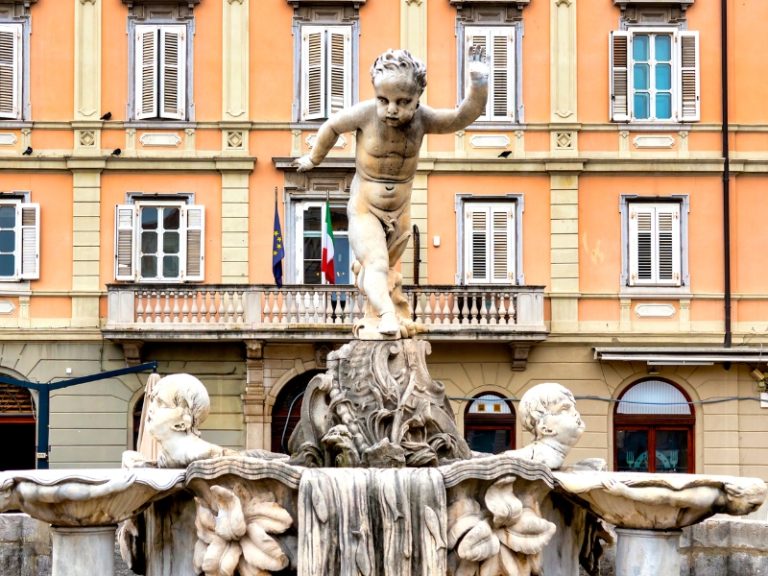
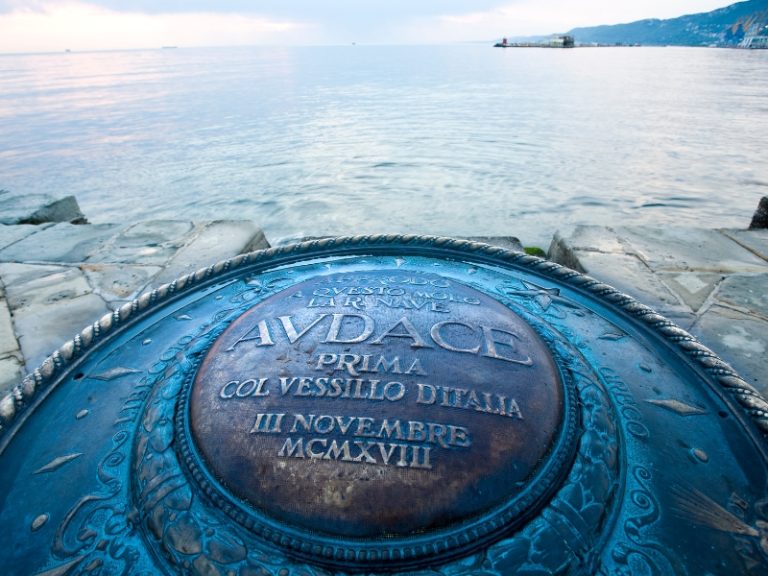
On the Ponte Rosso the narration introduces the bronze James Joyce, unveiled in 2004 a century after the writer arrived, and at the canal-side fountain you hear why locals call its little statue Giovannin. On the Molo Audace you learn that the pier is named after the first Italian ship to dock here, on 3 November 1918, and what the bora can do at well over 100 km/h. Piazza Unità d'Italia brings the bronze figures that strike the hours on the Town Hall, and the Roman Theatre the story of how it lay hidden under houses until the 1930s.
- Durationabout 3 hours
- Walkingabout 46 min · 4 km
- Stops10
- LanguagesEnglish, German, French, Italian, Spanish, Dutch
How the audio walk works
A story at every stop
Each stop has its own narrated chapter with history, local legends and curious facts, and the full text is there if you would rather read.
Directions on your phone
Between stops, Google Maps shows the way; the walking adds up to about 46 minutes over 4 km.
Your own timetable
Nobody waits for you and nothing starts without you. Drop into a café or a museum and resume later or the next day.
Food and shops nearby
The app recommends cafés, restaurants and shops close to the route, and lets you pick a different first stop or reorder the walk.
See the route and attractions →
How it works
- Book online Choose the number of people. Your booking reference arrives by email straight away.
- Get the app Download the World City Trail app from the App Store or Google Play and enter your booking reference.
- Walk when you like Start whenever you are ready, walk at your own pace and pause any time. No guide, no fixed schedule.
Who will get the most out of it
New to Trieste
In a few hours you see the main landmarks of the centre and learn why each one matters.
Not keen on group tours
Nobody holds up a flag and nobody checks the time: linger where something catches your eye and move on when you have seen enough.
Short on time
About 3 hours covers the centre, and the afternoon or evening stays yours.
Good to know
- Bring a charged smartphone with mobile data; a power bank helps.
- No entry tickets needed: everything happens outside the buildings. Going inside is optional and paid separately.
- Family friendly; children must be accompanied by an adult.
- Not suitable for wheelchair users and difficult with strollers.
- Groups of up to 5 work best; larger groups split up, one ticket per person.
- Every purchase helps support stray cats and dogs in Greece.
From the Canal Grande up San Giusto hill, stop by stop
10 stops · about 46 min walking · start: Ponte Rosso · finish: Cathedral of San Giusto
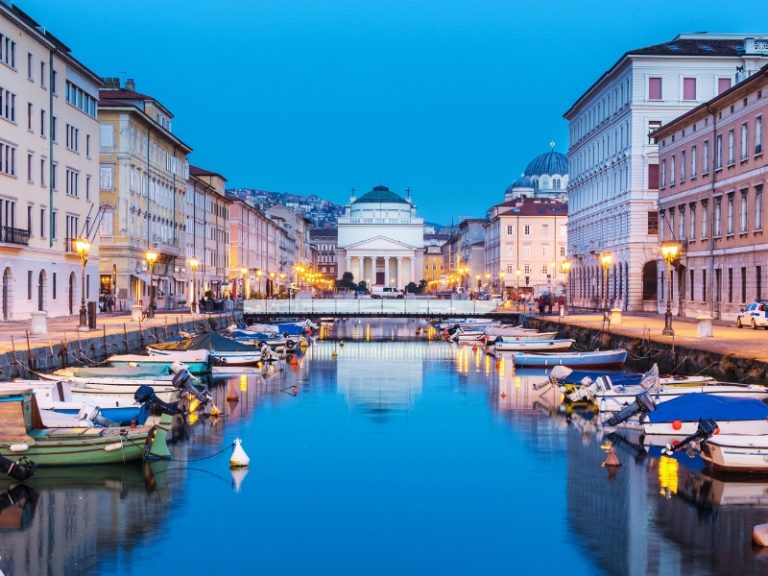
The Ponte Rosso over the Canal Grande is where you start, with Piazza del Ponterosso, the old market square, right beside it. The walk then goes out to the wind rose at the tip of the Molo Audace, back past the Teatro Lirico Giuseppe Verdi and onto Piazza Unità d'Italia, which opens straight onto the sea. Piazza della Borsa leads to the Roman Theatre, and from there the path climbs through the Parco della Rimembranza to San Giusto Castle and ends at the Cathedral of San Giusto. Stops can be reordered in the app, and none charges for entry.
Open the route map ↗
1Ponte RossoStart
This bridge crosses the Canal Grande, dug in the mid-18th century so that ships could unload their goods in the new Borgo Teresiano district. Halfway across stands a life-size bronze of James Joyce, who lived in Trieste for more than ten years from 1904. The statue was unveiled in 2004, a century after his arrival.
Read the full story →
2Piazza del Ponterosso
The square beside the canal has long been a market place for the Borgo Teresiano, the grid of streets laid out under Empress Maria Theresa. Its 18th-century fountain is topped by a small statue of a boy that locals call Giovannin. At the end of the canal rises the neoclassical church of Sant'Antonio Taumaturgo.
3Wind Rose on the Molo Audace
A bronze wind rose is set into the tip of the Molo Audace, the stone pier that reaches out into the Gulf of Trieste. The pier is named after the destroyer Audace, the first Italian ship to dock in Trieste, on 3 November 1918. The wind rose recalls the city's winds, above all the bora, which can blow at well over 100 km/h.
Read the full story →
4Teatro Lirico Giuseppe Verdi
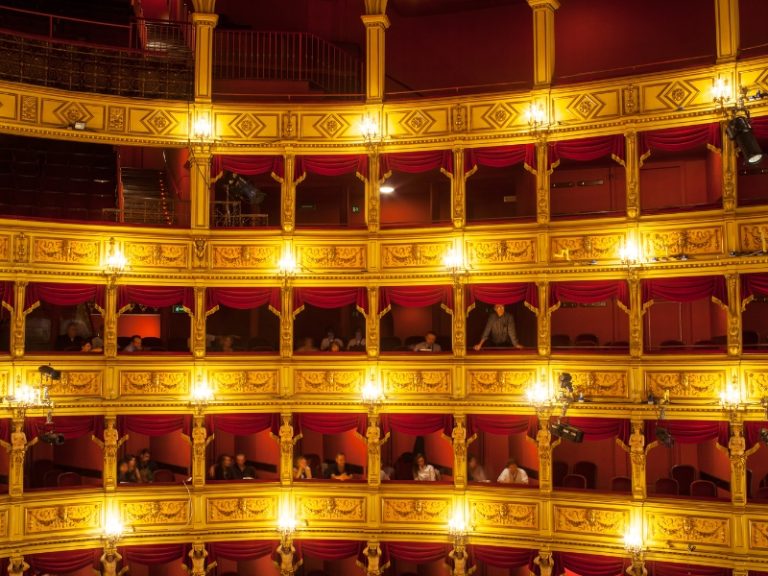
Trieste's opera house opened in 1801 as the Teatro Nuovo and took the name of Giuseppe Verdi in 1901, the year the composer died. Two of Verdi's operas, Il corsaro and Stiffelio, had their premieres here. Its façade on Piazza Verdi is often compared with La Scala in Milan.
5Piazza Unità d'Italia
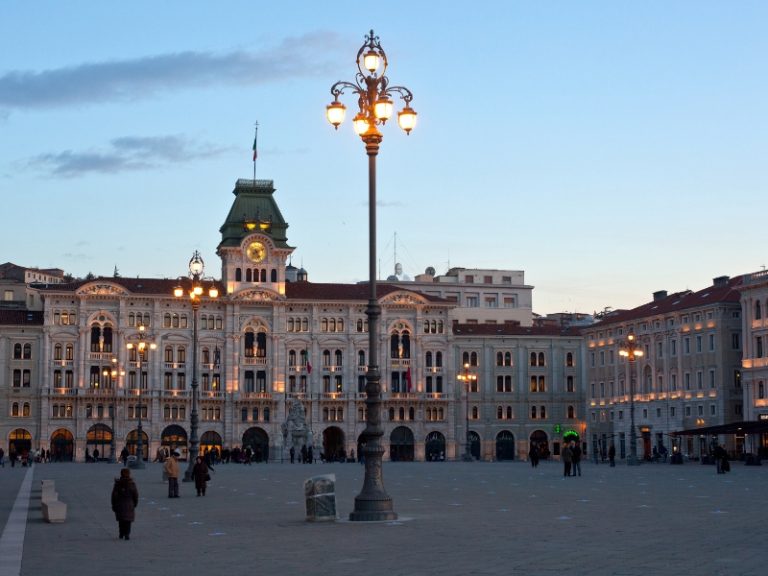
Opening straight onto the sea, this is often called the largest seafront square in Europe. Grand palaces from the Austrian era line three sides, among them the Town Hall of 1875, whose clock tower has two bronze figures that strike the hours. In front of it stands the 18th-century Fountain of the Four Continents.
Read the full story →
6Piazza della Borsa
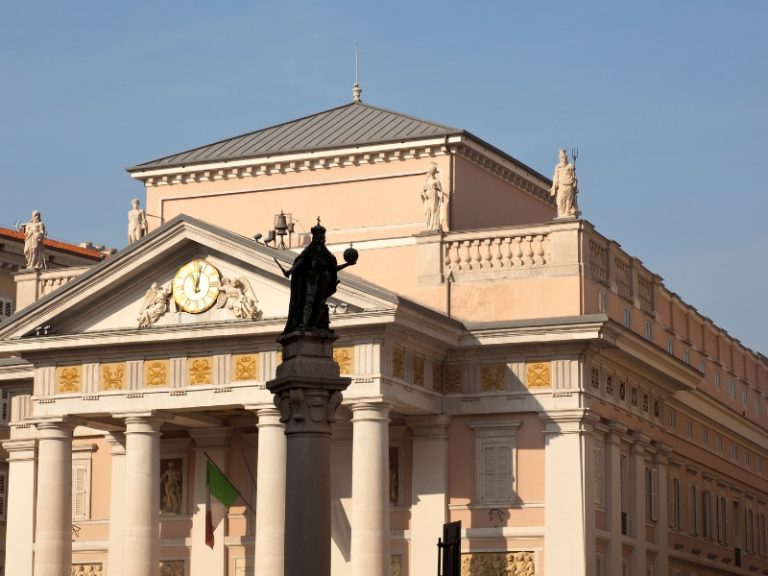
The square takes its name from the old stock exchange, a neoclassical building completed in 1806 to a design by Antonio Mollari. A column topped by Emperor Leopold I recalls his visit to the city in 1660. Trieste grew rich as the main seaport of the Habsburg Empire, and its merchants did business here.
Read the full story →
7Roman Theatre
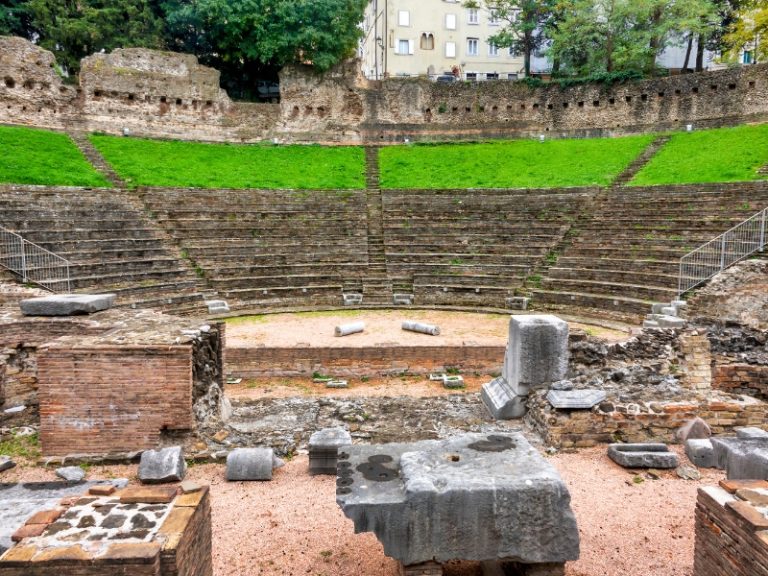
Built between the 1st and 2nd centuries AD, when the city was the Roman colony of Tergeste, the theatre once stood close to the shore. It lay hidden under houses until the 1930s, when the old quarter was cleared and it was uncovered. You can still see the curved rows of seats set into the slope of San Giusto hill.
Read the full story →
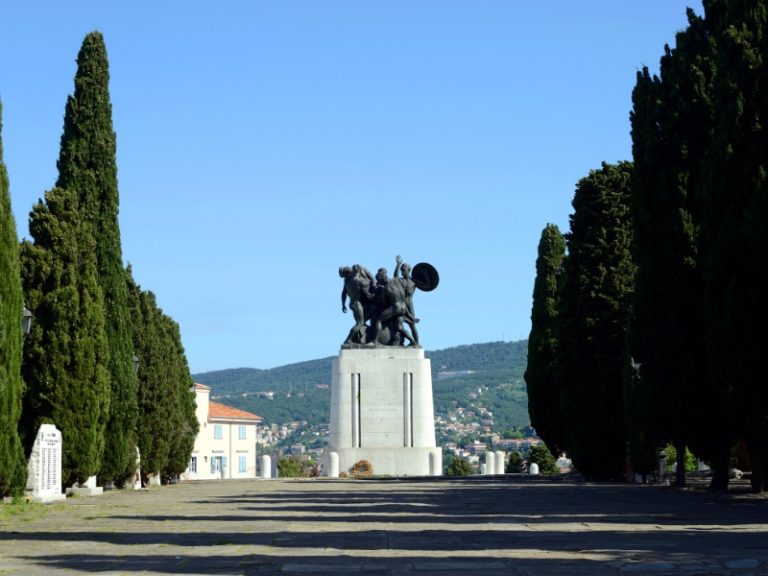
8Parco della Rimembranza
This park on the slopes of San Giusto hill was laid out in the 1920s in memory of the people of Trieste who died in the First World War. Small stone markers among the trees each carry a name. From its paths you look out over the rooftops towards the sea.
9San Giusto Castle
The Habsburgs began this fortress on top of San Giusto hill in the 15th century, and building went on into the 17th century. It stands where Roman Tergeste had its centre, right next to the cathedral. From its walls and bastions you look out over the city and the Gulf of Trieste.
Read the full story →
10Cathedral of San GiustoFinish
The cathedral took shape in the 14th century, when two older churches, one of them dedicated to the city's patron Saint Justus, were joined under one roof. Its plain façade has a large Gothic rose window, and the bell tower and doorway reuse Roman stones. Inside, mosaics from the 12th and 13th centuries decorate the apses.
Read the full story →
Only logged in customers who have purchased this product may leave a review.





Finland –
Collected on GetYourGuide
Germany –
Collected on GetYourGuide
Die Tour war exzellent ausgearbeitet und durchgeführt.
Sarah– Australia –
Collected on GetYourGuide
Super easy to use app. Purchased this after seeing the GuruWalk reviews for the local walks. We paused the tour a couple of times as we got distracted by other sites. Easy to get back on track
Germany –
Collected on GetYourGuide
Switzerland –
Collected on GetYourGuide
Sehr interessanter, kurzweiliger Rundgang duch Triest.