
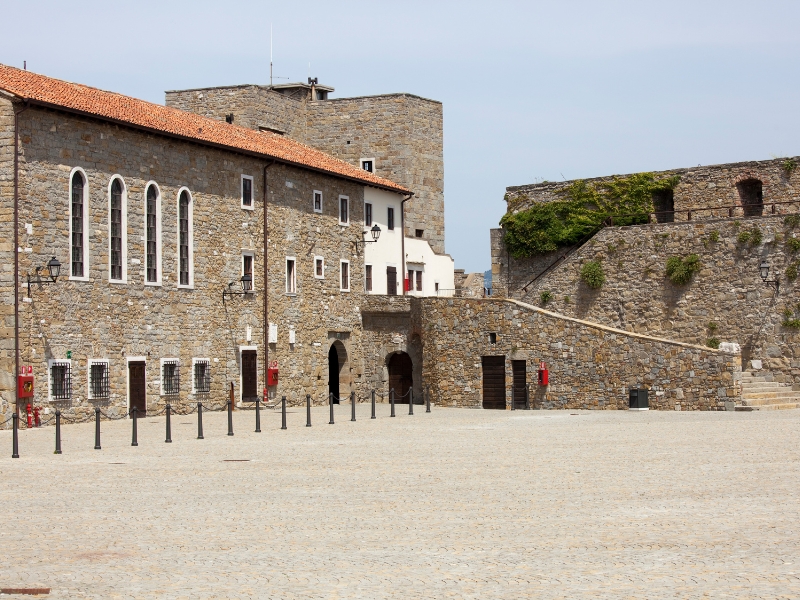
The Castello di San Giusto is the fortress on top of San Giusto hill, the highest point of Trieste's old town, right next to the cathedral. The hill is where the city began, first as a fortified settlement and then as Roman Tergeste. The castle was built in stages over more than 150 years under the Habsburgs and the Venetians, saw no serious fighting, and so survives almost intact, with ramparts you can walk along high above the city and the gulf.
Castello di San Giusto at a glance
- Where: on the summit of San Giusto hill, beside the Cathedral of San Giusto, above the old town (Città Vecchia).
- Built: begun around 1470 on the orders of Emperor Frederick III and completed with the last bastion in the 1630s.
- What it is today: a civic museum with an armoury, a collection of Roman stones, exhibition rooms and walkable ramparts.
- Time needed: about 1 to 2 hours for the ramparts, the courtyard and the museum.
From imperial outpost to city museum
In 1382 Trieste, worn down by its wars with Venice, placed itself under the protection of the Habsburg dukes of Austria. Nearly a century later, Emperor Frederick III ordered a fortified building with a tower on the hilltop, paid for by the citizens. It became the residence of the imperial captain, the official who represented the Habsburgs in the city, and this Casa del Capitano is still the core of the castle.
The triangular plan you see today grew around it. During a short Venetian occupation in 1508–1509, the Venetians added the round bastion beside the captain's house. Back under Austrian rule, the city added the polygonal Bastione Lalio in the mid-16th century and the Bastione Fiorito in the 1630s, which closed the triangle. Because the castle never had to withstand a major siege, it came through the centuries with little damage. Today it belongs to the city of Trieste and is run as part of its civic museums.
What to look for
- The three bastions: the round Bastione Rotondo, also called the Venetian bastion, the polygonal Bastione Lalio facing the cathedral, and the triangular Bastione Fiorito, which houses exhibition rooms.
- The rampart walkways that link the bastions above the Cortile delle Milizie, with wide views over the rooftops, the port and the Gulf of Trieste.
- The Lapidario Tergestino in the vaults under the Bastione Lalio: around 130 Roman stones, including gravestones, altars, urns and sarcophagi, many of them from the Roman basilica on the hill.
- The armoury in the captain's house, with weapons from the 12th to the 19th century, many of them halberds. Look out for the halberd on Trieste's coat of arms around the city: it is the symbol of San Giusto.
- Mikez and Jakez, the two 19th-century figures that once struck the hours on the Town Hall clock in Piazza Unità. The originals are kept at the castle; copies still ring the bell on the Town Hall.
- From June, the caper plants growing out of the old walls, covered in white and pink flowers.
Where Trieste began
The castle is only one layer of the hill. Next to it, between the castle and the cathedral, are the remains of the Roman basilica, a large public hall, and of a temple to the Capitoline Triad, the three main gods of Rome. The cathedral itself was formed in the Middle Ages by joining two older churches, and its bell tower dates from 1343. Standing on the ramparts, you are looking down on more than two thousand years of a city that has spread from this hilltop down to the sea.
Tips for your visit
- Walk up in the late afternoon: the light over the gulf is softer, and the view from the Bastione Lalio over the cathedral is at its best.
- Bring a jacket on windy days: the hill is exposed, and Trieste is known for the bora, a strong cold wind from the north-east.
- The climb from the old town is steep; take the stepped lanes slowly and wear good shoes.
- Combine the castle with the cathedral next door and the Roman remains, then walk down through the old town to the sea.
Nearby
- Cathedral of San Giusto: next to the castle, with an irregular façade, a large rose window and medieval mosaics inside.
- Roman basilica and temple remains: a few steps from the castle entrance, the oldest layer of the hill.
- Arco di Riccardo: a Roman gate in the lanes of the old town on the way down the hill.
- Roman theatre: at the foot of the hill, the remains of a theatre from Roman Tergeste, set right among the city's streets.
See Trieste with World City Trail
Our Trieste scavenger hunt turns the old town into a game you play on your phone. The route links 10 stops and takes around 2 hours, with about 46 minutes of walking. It includes the Ponte Rosso on the Canal Grande and the Teatro Verdi.
If you prefer a different format, there is also a self-guided walking tour and an outdoor escape game in Trieste.
Play the Trieste scavenger hunt →
Take the self-guided walking tour of Trieste →
Play the outdoor escape game in Trieste →
Facts checked in October 2026.