
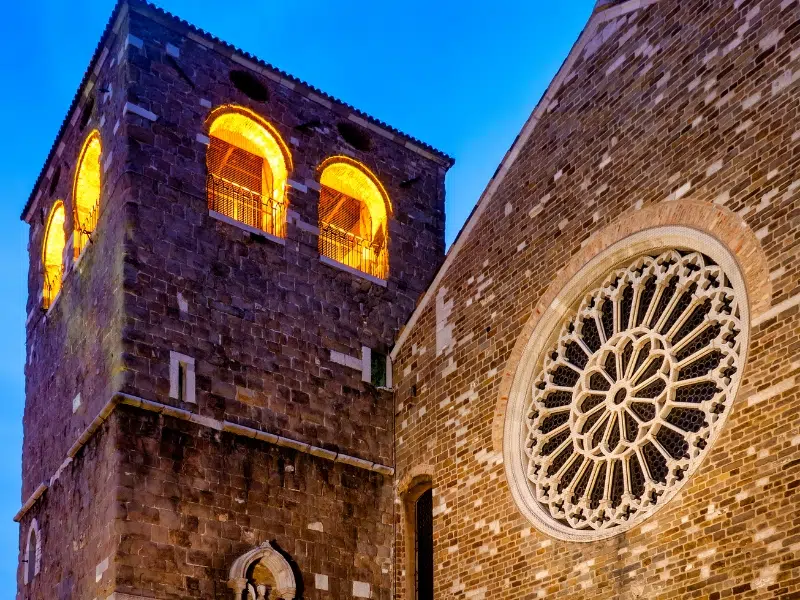
The Cathedral of San Giusto stands on top of San Giusto hill, above the old town of Trieste, next to the castle and the ruins of the Roman forum. Its plain, asymmetric front hides an unusual story: the church you enter is really two older basilicas that were joined together in the 14th century, and its walls and bell tower are studded with stones taken from Roman buildings.
San Giusto Cathedral at a glance
- Where: on the summit of San Giusto hill, the historic core of Trieste, beside the Castello di San Giusto.
- Built: two basilicas from the 9th–11th centuries, joined under one roof between about 1302 and 1320; the bell tower was finished in 1343.
- What it is today: the cathedral of the Bishop of Trieste, a minor basilica since 1899 and an Italian national monument since 1940.
- Time needed: 20–30 minutes inside, longer if you combine it with the castle and the forum.
From Roman temple gate to cathedral
The hill was the centre of Roman Tergeste. The first church here was built in the 6th century on top of a Roman monumental gateway, the propylaeum of a temple area, and parts of its mosaic floor are still set into today's pavement. That church was destroyed soon afterwards. Between the 9th and 11th centuries two basilicas rose side by side on the site: one dedicated to Our Lady of the Assumption and one to Saint Justus (San Giusto), a local martyr.
In the early 14th century Bishop Rodolfo Pedrazzani da Robecco had the two churches merged into one cathedral by demolishing an aisle of each and building a single new façade. That is why the interior has five aisles, with two apses at the sides that once belonged to separate churches. The bell tower was built around the old tower of Santa Maria; it was once taller, but in 1422 it was struck by lightning and cut down to its present height. Pope Leo XIII made the cathedral a minor basilica in 1899.
What to look for
- The large Gothic rose window in Karst stone, carved on site by stonemasons brought from Soncino, near Cremona, the bishop's home town.
- The Roman pieces built into the façade and bell tower: the main door frame was made from an ancient funerary monument, and Roman columns are visible at the base of the tower.
- The statue of San Giusto in a Gothic niche on the bell tower, holding a model of the city in one hand and a martyr's palm in the other.
- The mosaics in the side apses: a Virgin enthroned with archangels and the apostles below, made in the first half of the 12th century, and Christ between Saints Justus and Servolus from the early 13th century.
- The Chapel of Saint Charles Borromeo, burial place of the Carlist pretenders to the Spanish throne and their families.
The bell of San Giusto
The largest of the tower's five bells gave its name to La campana di San Giusto, a patriotic song written in 1915, when Trieste was still part of Austria-Hungary and many of its Italian-speaking citizens hoped to join Italy. The song became a classic, later recorded by singers including Luciano Pavarotti. In the square in front of the cathedral, an altar, a column and a monument to the dead of the First World War recall the same period.
Tips for your visit
- The hill is steep: walk up through the old town streets or take the long flight of steps, and save your energy for the castle walls.
- This is a working cathedral, so dress modestly and avoid visiting during services.
- Combine it with the Roman forum and the castle next door for an easy half-day on the hill.
Nearby
- Castello di San Giusto: the Habsburg-era castle next door, with walls to walk and wide views over the city and the Gulf of Trieste.
- Roman forum: the excavated remains of a Roman civic basilica beside the cathedral, with two columns re-erected.
- Roman Theatre: the ruins of a Roman theatre at the foot of the hill, near the old town.
- Piazza Unità d'Italia: the grand square opening onto the sea, a pleasant walk down the hill.
See Trieste with World City Trail
Our Trieste scavenger hunt turns the city centre into a game you play on your phone. The route links 10 stops and takes around two hours, with about 46 minutes of walking. It includes places such as Ponte Rosso on the Grand Canal and the Teatro Verdi.
If you prefer a different format, Trieste also has a self-guided walking tour and an outdoor escape game.
Play the Trieste scavenger hunt →
Take the self-guided walking tour of Trieste →
Play the outdoor escape game in Trieste →
Facts checked in October 2026.