
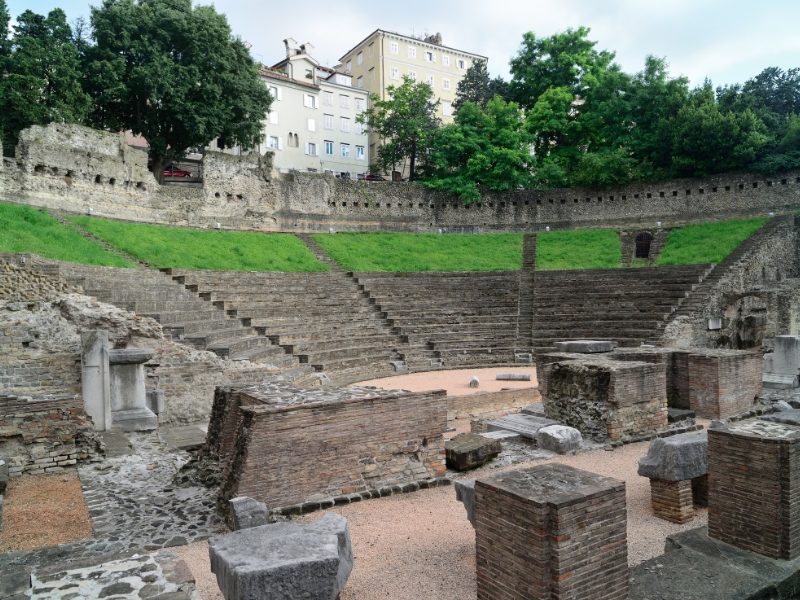
The Roman Theatre of Trieste is a half-circle of stone seats at the foot of San Giusto hill, right in the city centre, a few minutes from Piazza Unità d'Italia. Built around the end of the 1st century AD for the Roman town of Tergeste, it lay buried under houses for centuries and was only brought back to light in 1938, when the old quarter around it was demolished.
The Roman Theatre at a glance
- Where: on Via del Teatro Romano, between Piazza Unità d'Italia and the slope of San Giusto hill.
- Built: late 1st to early 2nd century AD, in the time of the emperors Domitian and Trajan.
- What it is today: an open-air archaeological site in the middle of the city, visible from the surrounding streets.
- Time needed: 10 to 15 minutes to walk around it and look down into the cavea.
From Tergeste to Rena Vecia
Trieste became a Roman colony in the 1st century BC, under the name Tergeste, and grew as a port on the road from Aquileia to Istria. Its theatre was built against the natural slope of the hill, as Greek and Roman theatres often were, with a cavea about 64 metres across. It held a few thousand spectators; the seating and walls were of masonry, while the stage was made of wood. The theatre was in use into the 3rd century, then fell into disuse, and over the centuries houses were built over and into its ruins.
Its memory survived only in a place name: the area was known as Rena Vecia, 'old arena', and in 1814 the architect Pietro Nobile guessed from that name that a Roman theatre lay beneath. He was right, but nothing could be seen until 1938, when the medieval quarter on the site was cleared as part of a large redevelopment of the old town. The excavations of 1938 to 1941 uncovered the cavea, the orchestra and parts of the stage building, together with statues and inscriptions.
What to look for
- The tiers of seats in the cavea, rising up the slope of the hill exactly as the Roman builders planned it.
- The semicircular orchestra at the bottom, where the most important spectators had their seats.
- The remains of the stage building (scaena) facing the seats, now only foundations and low walls.
- The contrast between the ancient stone and the 20th-century buildings around it, including the large Fascist-era police headquarters on the other side of the street.
- The way up San Giusto hill behind the theatre, which leads to the cathedral and castle on top.
Where the statues went
The excavations found marble statues and inscribed plaques that once decorated the stage. They are not on site any more: you can see them at the Civic Museum of History and Art and its Orto Lapidario, the garden of stone fragments on San Giusto hill. A visit there completes the picture of how richly decorated this modest provincial theatre once was.
Tips for your visit
- Walk all the way round the site: different angles show the shape of the cavea and stage much better than a single view.
- Come in the late afternoon, when the low sun brings out the texture of the stone seats.
- Combine it with the climb up San Giusto hill to the Roman forum, the cathedral and the castle.
- From the theatre, Piazza Unità d'Italia and the sea are only a few minutes' walk away.
Nearby
- Piazza Unità d'Italia: Trieste's grand square open to the sea, a few minutes' walk.
- Arco di Riccardo: a Roman gate from the 1st century BC, hidden in the lanes of the old town nearby.
- San Giusto Cathedral: the city's cathedral on the hilltop, with Byzantine-style mosaics inside.
- San Giusto Castle: the Venetian and Habsburg fortress on the hill, with views over the city and the gulf.
See Trieste with World City Trail
Our Trieste scavenger hunt turns the city centre into a game you play on your phone. The route links 10 stops and takes around two hours, with about 46 minutes of walking, and it includes places such as the Ponte Rosso and the Teatro Verdi.
If you prefer a different format, Trieste also has a self-guided walking tour and an outdoor escape game.
Play the Trieste scavenger hunt →
Take the self-guided walking tour of Trieste →
Play the outdoor escape game in Trieste →
Facts checked in October 2026.