
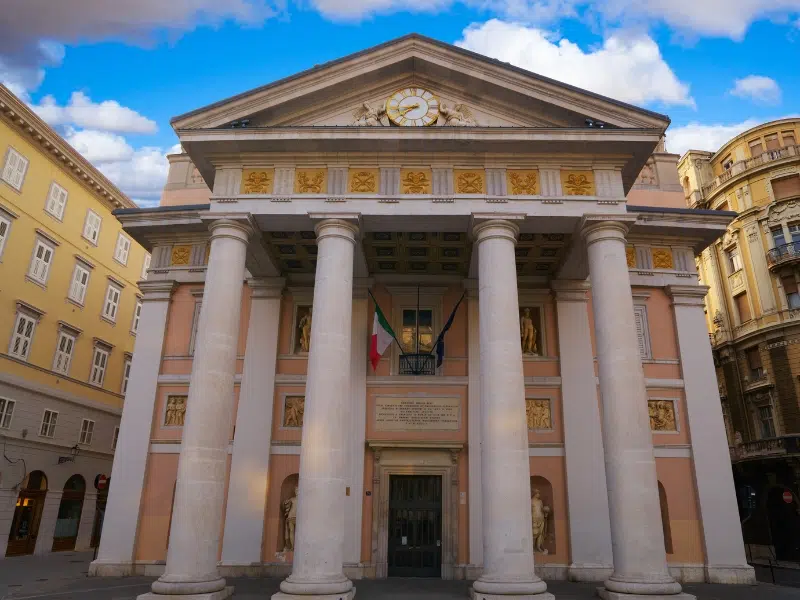
Piazza della Borsa is the long, slightly irregular square in the centre of Trieste where the old medieval town meets the grid of streets laid out under Maria Theresa. It takes its name from the Palazzo della Borsa, the Old Stock Exchange, a neoclassical building that looks like a Greek temple and was finished in 1806, when Trieste was the Habsburg Empire's main port.
Piazza della Borsa at a glance
- Where: in the city centre, between Piazza Unità d'Italia, Corso Italia and the Teatro Verdi, at the edge of the Città Vecchia (old town).
- Built: the square took shape in the 18th and 19th centuries; the Old Stock Exchange was built in 1802–1806.
- By: Antonio Mollari of Macerata (Old Stock Exchange); Francesco Bruyn (Palazzo del Tergesteo).
- What it is today: a pedestrian square lined with palazzi, banks and cafés; the Old Stock Exchange houses the Chamber of Commerce.
- Time needed: 15–20 minutes to walk around and look at the façades.
From the customs square to the city's trading floor
The square follows the line of the old city walls, which explains its irregular shape. It was once called Piazza della Dogana, the customs square, and it stood just outside the medieval centre, near one of the town gates. In 1660 a column was put up here to mark the visit of Emperor Leopold I, and in the 1750s the sculptor Giovanni Domenico Mazzoleni added the Neptune Fountain, a fitting symbol for a city that lived from the sea.
As Trieste boomed as a free port, its merchants needed a proper meeting place. The designs of Antonio Mollari were chosen through the Academy of Fine Arts in Parma, work began in 1802, and the new exchange opened on 6 September 1806. By 1844 trading had outgrown it and moved next door into the Palazzo del Tergesteo, built in 1840–1842 as a commercial centre with a covered arcade. The old building became the seat of the Chamber of Commerce, which it still is.
What to look for
- The Old Stock Exchange façade: a temple front with Doric columns. In the lower niches stand colossal statues of Europe, Asia, Africa and America, the continents Trieste traded with.
- The roofline of the exchange: on the balustrade, from left to right, the Danube, the Genius of Trieste, Minerva and Neptune; lower down, Vulcan and Mercury.
- The Neptune Fountain: the sea god with his trident, by Mazzoleni. It spent many years in Piazza Venezia before returning to its original place.
- The Leopold Column: the column honouring Emperor Leopold I, a reminder that Trieste was a Habsburg city for more than five centuries.
- The Tergesteo: on the façade facing the square, Pietro Zandomeneghi's group of Thetis, standing for Trieste, on a shell drawn by four horses, with Mercury, god of commerce. Walk through its cross-shaped glass-covered arcade.
- Casa Bartoli: the Art Nouveau house by Max Fabiani from 1905, with its tall decorated façade, one of his best-known buildings in Trieste.
A square of gods and continents
Look at the statues all around the square and a theme appears: Neptune twice, Mercury twice, the continents, the Danube. They were a sales pitch in stone. Trieste wanted to be seen as the place where the trade of the Danube lands met the shipping routes of the world, and the merchants who paid for these buildings made sure every façade said so.
Tips for your visit
- Come in the late afternoon, when the low sun lights up the façade of the Old Stock Exchange and the cafés around the square fill up.
- For the best view of the exchange and the fountain together, stand at the Corso Italia end of the square.
- Look for the Portizza, a narrow passage near Casa Prandi that leads straight into the lanes of the Città Vecchia.
Nearby
- Piazza Unità d'Italia: Trieste's grand seafront square, a couple of minutes' walk away, open on one side to the Adriatic.
- Teatro Verdi: the city's opera house, right behind the Tergesteo, whose rear façade faces it.
- Canal Grande and Ponte Rosso: the canal of the Borgo Teresiano, with boats moored in the middle of the city, a few minutes' walk north.
- Arco di Riccardo: a Roman gate from the 1st century BC, hidden in the lanes of the old town behind the square.
See Trieste with World City Trail
Our Trieste scavenger hunt turns the old town into a game you play on your phone. The route links 10 stops and takes around 2 hours, with about 46 minutes of walking. It includes the Ponte Rosso on the Canal Grande and the Teatro Verdi, just behind Piazza della Borsa.
If you prefer a different format, there is also a self-guided walking tour and an outdoor escape game in Trieste.
Play the Trieste scavenger hunt →
Take the self-guided walking tour of Trieste →
Play the outdoor escape game in Trieste →
Facts checked in October 2026.