
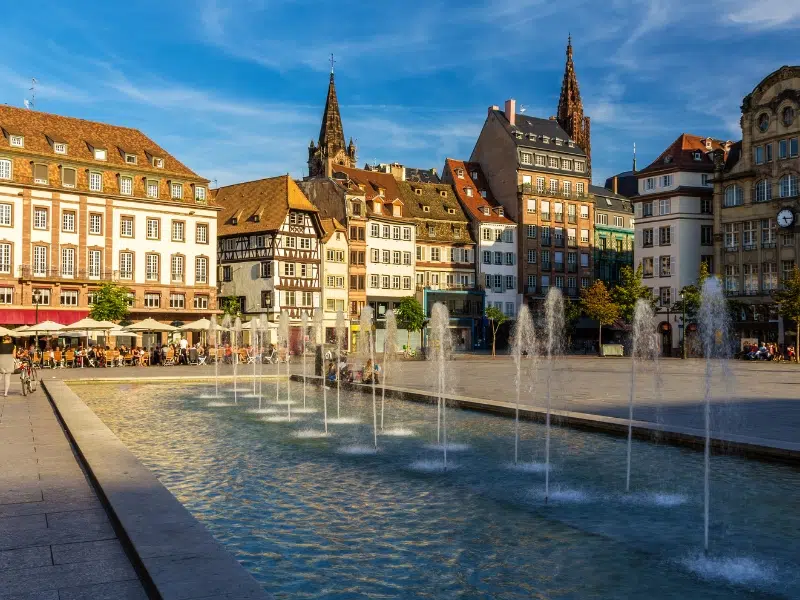
Place Kléber is the largest square in the centre of Strasbourg, a pedestrian space in the shopping district of the Grande Île. It is named after Jean-Baptiste Kléber, the Strasbourg-born general of the French Revolution, whose statue stands in the middle. His remains really are here: since 1838 they have rested in a vault beneath the monument.
Place Kléber at a glance
- Where: on the Grande Île, Strasbourg's historic centre, a short walk west of the cathedral; the nearest tram stop is Homme de Fer.
- Created: a parade ground from the 17th century; named Place Kléber on 24 June 1840, when the general's monument was inaugurated.
- By: the statue of Kléber is by the Alsatian sculptor Philippe Grass; the Aubette on the north side was designed by Jacques-François Blondel, architect to Louis XV.
- What it is today: a car-free square with planting and long water basins, used for markets, events, celebrations and, every winter, Strasbourg's giant Christmas tree.
- Time needed: 15–20 minutes, more if you visit the Aubette 1928 rooms.
From monastery square to Place Kléber
The square began as Barfüsserplatz, named after a Franciscan monastery that stood along it. In the 17th century it became the Waffenplatz, a parade ground for the garrison. In 1768 Jacques-François Blondel drew up a plan to modernise the city with a grand parade ground, but money ran short before the Revolution and only one building was finished: the Aubette, a long guardhouse closing the north side. Its name comes from the French word for dawn, the hour when the day's orders were given out.
Jean-Baptiste Kléber, born in Strasbourg in 1753, rose to general in the revolutionary wars and was left in command of the French army in Egypt when Napoleon sailed home. He was assassinated in Cairo on 14 June 1800. His body was brought back to France and, after a long wait at the Château d'If near Marseille, returned to Strasbourg in 1818. On 15 December 1838 he was buried in a vault under the site of his future statue, and on 24 June 1840 the monument was inaugurated and the square renamed. During the German occupation of 1940–1944 it was renamed after the Alsatian autonomist Karl Roos, then got its French name back.
What to look for
- Kléber's statue: the general stands holding a letter, the message from the British admiral Keith demanding the surrender of the French army in Egypt. Kléber's answer was to defeat the Ottoman army at Heliopolis in March 1800.
- The base of the monument: it is not just a pedestal but a tomb, where the general's remains have lain since 1838.
- The Aubette: the long classical building on the north side. Inside, in 1928, the artists Theo van Doesburg, Hans Arp and Sophie Taeuber-Arp created abstract interiors for a café, cinema and dance hall; they were covered over within a decade, and the restored rooms reopened to the public in 2006.
- The square itself: it was a tram hub from 1886 to 1960 and then a car park. Its present look, with greenery by the landscape designer Gilles Clément and long water basins edged in gneiss, dates from a redesign in 2007.
The Christmas tree
Every year during the Christkindelsmärik, Strasbourg's Christmas market, a fir about 30 metres tall from the Vosges mountains is put up in a corner of Place Kléber and decorated. It has become one of the best-known images of Christmas in the city. Around it, about fifty charities run the Village du Partage, the “village of sharing”, and people leave gifts for those in need at the foot of the tree.
Tips for your visit
- Come in December for the Christmas tree, but expect crowds: the square is one of the busiest spots of the market, especially in the evening.
- Look at the Aubette's façade from the middle of the square, then go inside to see the 1928 rooms, now part of the Strasbourg museums.
- Use the square as a starting point: the tram network meets at Homme de Fer next door, and the cathedral, Petite France and Place Gutenberg are all within walking distance.
Nearby
- Strasbourg Cathedral: the Gothic cathedral with its single spire, a short walk east, and one of the stops on our scavenger hunt.
- Place Gutenberg: the square with the 1840 statue of the printing pioneer Johannes Gutenberg, who worked in Strasbourg, a few minutes south-east.
- Place Broglie: the long square to the north-east with the opera house and the city hall, the traditional home of the Christkindelsmärik.
- Petite France: the old tanners' and millers' quarter with half-timbered houses and canals, about ten minutes' walk south-west.
See Strasbourg with World City Trail
Our Strasbourg scavenger hunt turns the old town into a game you play on your phone. The route links 10 stops and takes around 3 hours, with about 47 minutes of walking. It includes Strasbourg Cathedral, the Palais Rohan and the Ponts Couverts.
If you prefer a different format, there is also a self-guided walking tour and an outdoor escape game in Strasbourg.
Play the Strasbourg scavenger hunt →
Take the self-guided walking tour of Strasbourg →
Play the outdoor escape game in Strasbourg →
Facts checked in October 2026.