
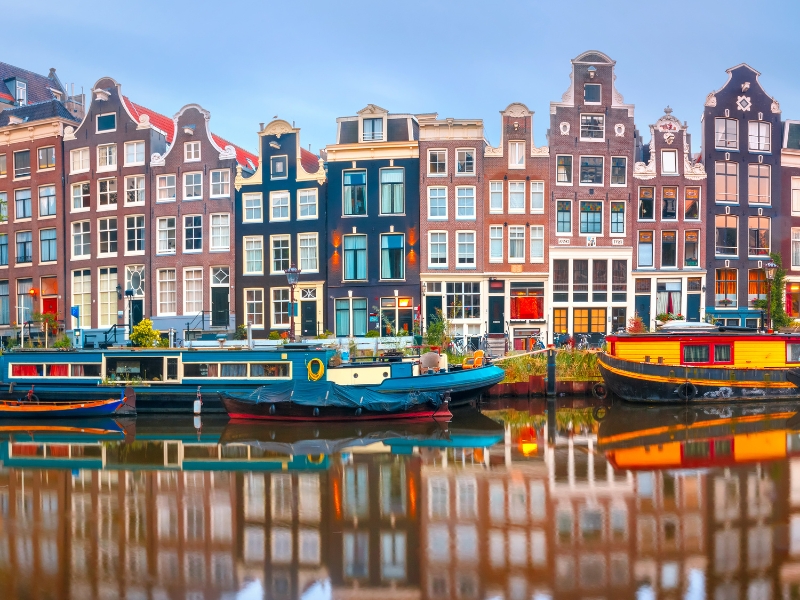
De 9 Straatjes, the Nine Streets, are nine short side streets that cross the canals between the Singel and the Prinsengracht in central Amsterdam. They are packed with independent shops, vintage stores and cafés, and their names, from Bear Street to Wolf Street, recall the tanners and hide traders who once worked here.
De 9 Straatjes at a glance
- Where: in the western canal ring, between Raadhuisstraat in the north and Leidsegracht in the south, crossing the Singel, Herengracht, Keizersgracht and Prinsengracht.
- Built: laid out with the canal ring expansion from around 1612; most houses date from the 18th century.
- What it is today: a shopping and café district inside the canal ring, a UNESCO World Heritage Site, with more than 140 listed monuments.
- The name: used only since the 1990s, when local shopkeepers founded an association to promote the area.
- Time needed: an hour for a slow walk, half a day if you like to browse.
From canal ring expansion to shopping district
Until the late 16th century Amsterdam ended at the Singel. Around 1612, during the Twelve Years' Truce with Spain, the city began a great expansion that created the Herengracht, Keizersgracht and Prinsengracht. The short streets that link these canals were part of that plan. Many of the trades along them worked with animal hides, which is why several of the streets are named after animals, and why one is called Runstraat: run was the ground oak bark used in tanning leather. Most of the original 17th-century houses were rebuilt in the 18th century.
For a long time the area had no shared name. In the 1990s a group of local shopkeepers decided to market the streets together, to give them the same appeal as the Jordaan next door. They founded the association De 9 Straatjes on 12 November 1996, and few people liked the name at first. It stuck, and the streets are now among the best-known shopping areas in the city.
What to look for
- The street names as you walk: from north to south, Reestraat, Hartenstraat and Gasthuismolensteeg; then Berenstraat, Wolvenstraat and Oude Spiegelstraat; then Runstraat, Huidenstraat and Wijde Heisteeg. Each row of three forms one line across the canals.
- The view from the bridges: every street crosses at least one canal, and standing on a bridge gives you the classic view of gabled houses along the water in both directions.
- Gable stones and house signs above doors, small carved or painted plaques that once identified a house before street numbers existed.
- Shopfronts in old merchant houses: look up to see hoisting beams on the gables, still used to lift furniture into narrow canal houses.
- Huidenstraat, the Hides Street, whose name is the clearest reminder of the leather trade that shaped the area.
The tenth street
The idea worked so well that a nearby street wanted in. The Hazenstraat, a short street in the Jordaan just west of the area, has called itself the tenth street since 2009, with its own mix of small shops and galleries.
Tips for your visit
- Weekday mornings are calmer; on Saturday afternoons the narrow pavements get crowded.
- Watch for cyclists when you stop to look: the streets are narrow and bikes have priority in practice.
- Walk each row of three streets from end to end so you cross all four canals, then switch to the next row.
- Combine the area with the Westerkerk and the Anne Frank House, just north of Raadhuisstraat.
Nearby
- Westerkerk: the 17th-century church whose tower is the tallest church tower in Amsterdam, a few minutes' walk north.
- Anne Frank House: the canal house on the Prinsengracht where Anne Frank and her family hid during the war.
- Grachtenmuseum (Museum of the Canals): a museum on the Herengracht about how the canal ring was planned and lived in.
See Amsterdam with World City Trail
Our Amsterdam scavenger hunt turns the old town into a game you play on your phone. The route links 10 stops and takes around 3 hours, with about 52 minutes of walking. It includes Amsterdam Centraal, the Royal Palace and the Westerkerk.
If you prefer a different format, Amsterdam also has a self-guided walking tour and an outdoor escape game.
Play the Amsterdam scavenger hunt →
Take the self-guided walking tour of Amsterdam →
Play the outdoor escape game in Amsterdam →
Facts checked in October 2026.