
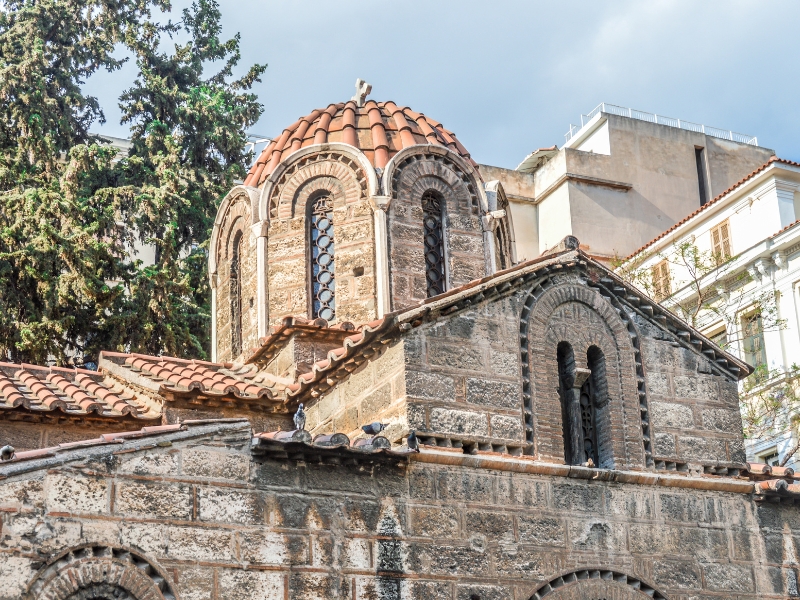
Panagia Kapnikarea is the small Byzantine church that sits in the middle of Ermou Street, the busy shopping street between Syntagma Square and Monastiraki. It was built around 1050, almost eight centuries before modern Athens was laid out around it. When the planners of the new capital wanted a straight street here in the 1830s, the church was due to be demolished; instead, Ermou was split in two and now flows around it.
Kapnikarea at a glance
- Where: in the middle of Ermou Street, at the corner of Kalamiotou Street, roughly halfway between Syntagma Square and Monastiraki Square.
- Built: around 1050, with a side chapel, an outer porch and a small south porch added later, the porch possibly in the 12th century.
- What it is today: a working Orthodox church dedicated to the Presentation of the Virgin in the Temple (feast day 21 November), owned by the University of Athens since the 1930s, which is why it is also called the University church.
- Time needed: 10–15 minutes, longer if a service is on.
- Good to know: it is a place of worship, so dress modestly, keep your voice down and avoid flash photography inside.
From Byzantine parish church to traffic island
The church was built in the middle of the 11th century, when Athens was a small provincial town of the Byzantine Empire. Its builders followed the cross-in-square plan typical of the time: a central dome resting on four columns, three apses on the east side and a narthex on the west. Tradition says it stands on the site of an ancient temple, possibly to Athena or Demeter. Later a domed chapel of Saint Barbara was added on the north side, then an outer narthex with three pitched roofs, originally an open portico.
In 1834, when Athens became the capital of the new Greek state and was replanned under King Otto, Ermou Street was meant to run straight from the royal palace towards the port, and the Kapnikarea stood in the way. It was marked for demolition. King Ludwig I of Bavaria, Otto's father and a great admirer of Greek antiquity, objected, and accounts also credit the Metropolitan of Athens, Neophytos Metaxas, with helping to save it. The street was built around the church instead. In the 1930s it passed to the University of Athens, and between the 1940s and 1950s the painter Fotis Kontoglou and his pupils decorated the interior.
What to look for
- The walls: blocks of stone framed by thin bricks, a Byzantine technique called cloisonné masonry, with brick patterns inspired by Kufic (Arabic) script.
- The dome on its eight-sided drum, rising above the roofs of the shops on Ermou.
- The mosaic of the Virgin and Child above the entrance. It looks old, but it is a 20th-century addition.
- Inside: the frescoes by Fotis Kontoglou, who revived the strict Byzantine style of icon painting in 20th-century Greece. His Virgin Platytera in the sanctuary apse, painted in 1942, was his first large church painting; many of the other scenes are signed 1955.
- The chapel of Saint Barbara on the north side, with its own small dome.
Where does the name come from?
Nobody knows for certain. The most common explanation links it to the kapnikon, a Byzantine hearth tax (kapnos means smoke), perhaps because the founder was a tax collector. Another theory connects it to kamoucha, a gold-woven fabric, as the church also appears in records as Kamoucharea, and a third to a fire that blackened it with smoke. A family named Kapnikaris has also been suggested. All of these are theories rather than established facts.
Tips for your visit
- Step back a little along Ermou towards Syntagma and look at the church: from there you see how the street divides around it.
- Come early in the morning, before the shops open, for photos without crowds; on 21 November the church celebrates its feast day and is full of worshippers.
- The church is small, so if a baptism or service is under way, wait outside until it has finished before going in.
Nearby
- Metropolitan Cathedral and the Little Metropolis: the large 19th-century cathedral of Athens and the tiny medieval church beside it, built with carved ancient marbles in its walls, a few minutes' walk south.
- Monastiraki Square: the busy square at the western end of Ermou, with the flea market streets and a view of the Acropolis.
- Syntagma Square: at the eastern end of Ermou, facing the Parliament, where the Evzones guard the Tomb of the Unknown Soldier.
- Plaka: the old neighbourhood on the slopes below the Acropolis, a short walk south of the church.
See Athens with World City Trail
Our Athens scavenger hunt turns the streets around the Acropolis and the Acropolis Museum into a game you play on your phone. The route links 10 stops and takes around 2 hours, with about 50 minutes of walking. You can play in English, German, French, Italian, Spanish, Dutch and Greek.
If you prefer a different format, there is also a self-guided walking tour and an outdoor escape game in Athens.
Play the Athens scavenger hunt →
Take the self-guided walking tour of Athens →
Play the outdoor escape game in Athens →
Facts checked in October 2026.