
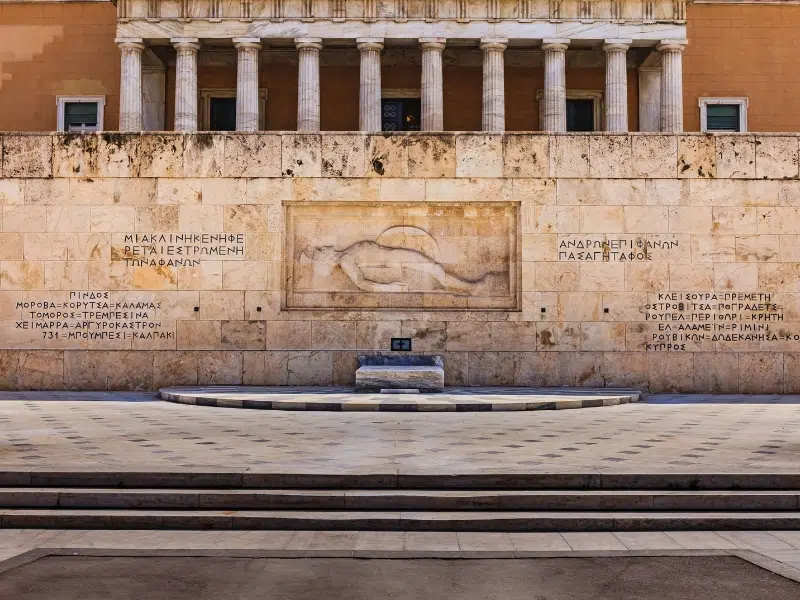
The Tomb of the Unknown Soldier is the war memorial set into the wall below the Hellenic Parliament, facing Syntagma Square in Athens. Unveiled on 25 March 1932, it shows a fallen ancient Greek warrior and honours every Greek soldier who died without a known grave. Evzones of the Presidential Guard stand watch in front of it around the clock.
The Tomb of the Unknown Soldier at a glance
- Where: Syntagma Square, on the terrace below the west front of the Hellenic Parliament (the Old Royal Palace), across Amalias Avenue from the square.
- Built: 1930–1932; unveiled on 25 March 1932, Greek Independence Day.
- By: the architect Emmanouil Lazaridis and the sculptor Fokion Rok.
- What it is today: Greece's national war memorial, where official wreaths are laid on national days and the Evzones keep a permanent guard.
- Time needed: 15–30 minutes; come just before the hour to see the changing of the guard.
A memorial for the soldiers who never came home
The idea took shape after the Balkan Wars, the First World War and the war in Asia Minor, which cost Greece tens of thousands of men between 1912 and 1922. In 1926 the Army Ministry approved a design by the architect Emmanouil Lazaridis. The location was debated for years until Eleftherios Venizelos settled on Syntagma Square in 1929, arguing that the memorial belonged in the centre of the city, like the Arc de Triomphe in Paris.
An earlier design by the sculptor Thomas Thomopoulos, with a battle of gods and giants, was never built for lack of money. Instead, Fokion Rok carved a calm, simple figure between 1930 and 1932, in a style that mixes classical models with the Art Deco of the time. At the unveiling on 25 March 1932, attended by foreign delegations, the flame was lit with a torch brought from the monastery of Agia Lavra, closely linked with the start of the War of Independence in 1821. The building above it was built in 1836–1843 as the palace of King Otto, the first king of modern Greece, and has housed Parliament since the 1930s.
What to look for
- The fallen warrior: a naked hoplite lying on the ground with a round shield and an ancient helmet, carved so that he seems ready to rise at any moment.
- The two quotations from Thucydides' account of the Athenian funeral for the war dead: on the left 'ΜΙΑ ΚΛΙΝΗ ΚΕΝΗ ΦΕΡΕΤΑΙ ΕΣΤΡΩΜΕΝΗ ΤΩΝ ΑΦΑΝΩΝ' ('One empty bier is carried, made up, for the missing'), on the right 'ΑΝΔΡΩΝ ΕΠΙΦΑΝΩΝ ΠΑΣΑ ΓΗ ΤΑΦΟΣ' ('The whole earth is the tomb of famous men'), a line from Pericles' Funeral Oration.
- The dedication above the figure: 'ΕΙΣ ΑΦΑΝΗ ΣΤΡΑΤΙΩΤΗ', 'To an unknown soldier'.
- The battle names: on the walls, places from the Balkan Wars and the First World War (Bizani, Sarantaporo, Skra), from the campaigns in Ukraine and Asia Minor (Sangarios), and from the Second World War and later (Pindus, Crete, El Alamein, Korea, Cyprus).
- The Evzones: two soldiers of the Presidential Guard in traditional uniform, with the white pleated kilt called the fustanella and red clogs with black pompoms, the tsarouchia.
- The changing of the guard: every hour the two guards swap in a slow, high-stepping routine. On Sunday at 11 am a larger ceremony brings a whole Evzone company with a military band.
Who are the Evzones?
The Evzones began as elite light-infantry units of the Greek army, and their uniform recalls the dress of the fighters of the 1821 War of Independence. Today they form the Presidential Guard, a ceremonial unit that also guards the Presidential Mansion. Tradition says the fustanella has 400 pleats, one for each year of Ottoman rule; it is a story every Athenian knows, not a measured fact. The guards stand completely still during their shift and do not react to the crowds, so let them work in peace.
Tips for your visit
- Arrive a few minutes before the hour and stand on the pavement in front of the memorial; on Sunday mornings, come well before 11 am for a good spot.
- Do not touch the guards, pose next to them or step onto the marble area in front of the tomb: other soldiers or the police will warn you if you get too close.
- For a photo with the Parliament behind the memorial, step back to the top of Syntagma Square across the avenue.
Nearby
- Syntagma Square: the square across the avenue, named after the constitution demanded by the uprising of 3 September 1843.
- National Garden: the shady park laid out for Queen Amalia beside the Parliament, a few minutes' walk away and a welcome escape from the summer heat.
- Ermou Street: the pedestrian shopping street that runs from Syntagma towards Monastiraki, with the small Byzantine church of Kapnikarea in the middle of it.
- Plaka: the old neighbourhood below the Acropolis, a short walk south-west, with its lanes, tavernas and views up to the rock.
See Athens with World City Trail
Our Athens scavenger hunt turns the streets around the Acropolis and the Acropolis Museum into a game you play on your phone. The route links 10 stops and takes around 2 hours, with about 50 minutes of walking. You can play in English, German, French, Italian, Spanish, Dutch or Greek.
If you prefer a different format, there is also a self-guided walking tour and an outdoor escape game in Athens.
Play the Athens scavenger hunt →
Take the self-guided walking tour of Athens →
Play the outdoor escape game in Athens →
Facts checked in October 2026.