
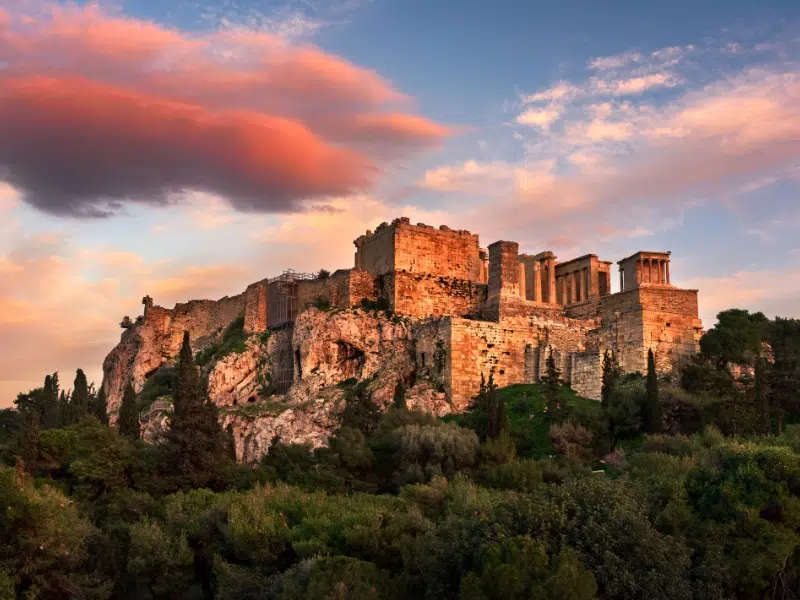
The Areopagus (Areios Pagos, the 'Rock of Ares') is the bare, rocky hill just below the entrance to the Acropolis in Athens. It gave its name to the oldest council of ancient Athens, which tried murder cases here, and around AD 50 the apostle Paul gave one of the best-known speeches in the Bible on or near it. Today it is one of the best free viewpoints in the city, with the Acropolis on one side and the Ancient Agora at your feet.
The Areopagus at a glance
- Where: north-west of the Acropolis, a short walk below the Propylaea entrance, overlooking the Ancient Agora. The summit is about 115 metres above sea level.
- History in brief: meeting place of the Areopagus council of ancient Athens; Paul's speech around AD 50, recorded in Acts 17.
- What it is today: an open rocky hilltop and viewpoint inside the archaeological area of central Athens, free to climb. Greece's Supreme Court is still called Areios Pagos after it.
- Time needed: 20–30 minutes, longer if you stay for the sunset.
Murder trials, Persian archers and an apostle
The name means 'hill of Ares'. In myth, the gods tried Ares here for killing Halirrhothius, a son of Poseidon, and in Aeschylus' play The Eumenides, Orestes is tried on the hill for killing his mother Clytemnestra, with Athena casting the deciding vote. The real Areopagus council was made up of former archons, the city's chief magistrates. It was once the most powerful body in Athens; after the reforms of Ephialtes in 462 BC it kept mainly the trial of homicide and some religious cases. At the foot of the hill, a cleft in the rock held a sanctuary of the Semnai, the 'Venerable Goddesses', identified with the Furies who pursued Orestes.
In 480 BC the Persian army of Xerxes took up position on the Areopagus and, as Herodotus tells it, attacked the Acropolis with arrows wrapped in burning fibre. Around AD 50, Paul arrived in Athens and, according to Acts 17:22–31, addressed the Athenians at the Areopagus, starting from an altar he had seen in the city dedicated 'to an unknown god'. A few listeners were converted, among them Dionysius the Areopagite, who became the patron saint of Athens. Scholars still debate whether Paul spoke on the hill itself or before the council meeting elsewhere, but the hill has been linked with his speech for centuries.
What to look for
- The steps: the old stairs cut into the rock, worn smooth by centuries of feet, next to the modern metal staircase most people now use.
- The bronze plaque at the foot of the steps with the Greek text of Paul's speech.
- The view east to the Acropolis: from the top you look straight at the Propylaea, the monumental gateway, and the small Temple of Athena Nike.
- The view north over the Ancient Agora, with the Temple of Hephaestus, one of the best-preserved Greek temples, and the long rebuilt Stoa of Attalos.
- The cuttings in the rock on the summit: there are no temple ruins up here, but the flat beds and grooves are traces of foundations of buildings that once stood on the hill.
Dionysiou Areopagitou, the street of the convert
Paul's most famous Athenian listener is still part of the city's daily life. The broad pedestrian avenue that runs along the south side of the Acropolis, past the Acropolis Museum and the Theatre of Dionysus, is called Dionysiou Areopagitou, after Dionysius the Areopagite. If you walk from the Acropolis Museum to the Areopagus, you follow his name almost all the way.
Tips for your visit
- Wear shoes with good grip. The rock is polished and slippery, especially after rain, and there are no railings at the edges, so keep a close eye on children.
- Sunset is the busiest time, with crowds gathering for the light on the Acropolis. For a quieter visit, come early in the morning.
- It is an archaeological site: don't take stones or chip the rock, and respect any fenced-off areas.
- Visit right after the Acropolis: the hill is just below its exit, so it is the natural place to sit for a while and look back at what you've seen.
Nearby
- Acropolis: the entrance by the Propylaea is a few minutes' walk uphill.
- Ancient Agora: the marketplace and civic centre of ancient Athens, directly below the hill to the north, with the Temple of Hephaestus and the museum in the Stoa of Attalos.
- Philopappos Hill: the pine-covered hill to the south-west, topped by the 2nd-century AD Monument of Philopappos, with wide views of the Acropolis.
- Acropolis Museum: the modern museum of finds from the Acropolis, about 10–15 minutes' walk along Dionysiou Areopagitou.
See Athens with World City Trail
Our Athens scavenger hunt turns the streets around the Acropolis and the Acropolis Museum into a game you play on your phone. The route links 10 stops and takes around 2 hours, with about 50 minutes of walking. You can play in English, German, French, Italian, Spanish, Dutch and Greek.
If you prefer a different format, there is also a self-guided walking tour and an outdoor escape game in Athens.
Play the Athens scavenger hunt →
Take the self-guided walking tour of Athens →
Play the outdoor escape game in Athens →
Facts checked in October 2026.