
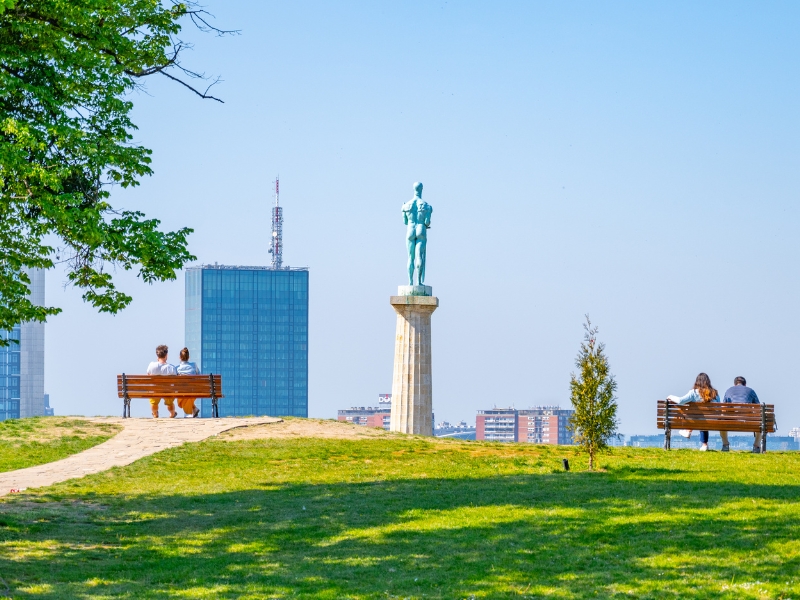
The Victor (Pobednik) is the bronze nude on a tall column at the edge of the Upper Town of Belgrade Fortress, looking out over the meeting of the Sava and the Danube. Ivan Meštrović made it to celebrate Serbia's victories, and it was meant for a fountain in the city centre. Critics found a naked man too much for Terazije, so in 1928 it went up here instead, and it has become one of Belgrade's best-known symbols.
The Victor at a glance
- Where: the Upper Town (Gornji grad) of Belgrade Fortress, inside Kalemegdan Park, on the ridge above the Sava–Danube confluence.
- Unveiled: 7 October 1928, the tenth anniversary of the breakthrough on the Salonika front.
- By: the sculptor Ivan Meštrović; the pedestal was designed by the architect Petar Bajalović.
- What it is today: a protected cultural monument since 1992, about 14 metres tall in all, and one of the most visited spots in the city.
- Time needed: 15–20 minutes, longer if you stay for the sunset over the rivers.
From a Terazije fountain to the fortress ridge
In 1913, after Serbia's victories in the Balkan Wars, Belgrade's city council gave Meštrović the commission without a competition. The monument was to be a fountain on Terazije, the city's main square: a basin resting on four lions and a column in five segments, one for each century of Ottoman rule, with the victor on top. The money only stretched to casting the figure. When the First World War began, the bronze was stored in a house in the Senjak district, which kept it safe from the bombing of the city, and the fountain was never built.
When the project came back in 1927, the nude caused a storm. Critics objected on moral grounds and because the figure had none of the Serbian national symbols, such as the šajkača cap or opanak shoes, that they expected; some academics defended it. The council moved the monument out of the centre, and it was unveiled on the fortress on 7 October 1928. Art historians have suggested that the high, turned-away spot was chosen not so it could be seen better, but so it would be seen less. The statue was taken down for restoration in October 2019 and returned to its column on 14 February 2020.
What to look for
- The falcon in his left hand, which stands for peace.
- The sword in his right hand, which stands for war: together they say that the victor is ready for both.
- The direction he faces: away from the city, towards the confluence of the Sava and the Danube, the Pannonian plain and the hills of Fruška Gora, lands that became part of the new Yugoslav state after 1918.
- The Doric column and its tall base: a concrete core faced with stone, originally from the Tašmajdan quarry in Belgrade, with stone from Fruška Gora used in later repairs.
- The view below: the river confluence, Great War Island in the middle of the water, Zemun on the far bank and the blocks of New Belgrade.
Tips for your visit
- Come for sunset: the terrace beneath the Victor is one of the classic places in Belgrade to watch the sun go down over the rivers. On summer evenings it gets crowded, so arrive early.
- For a quiet visit and soft light, come in the early morning, when joggers and dog walkers have the fortress to themselves.
- Because the statue faces the rivers, you mostly see him from behind or in profile. Walk around the base and along the walls to find the angle you like.
- Wear shoes with grip: the fortress paths and steps are uneven, and the stone can be slippery after rain.
Nearby
- Monument of Gratitude to France: another work by Meštrović in Kalemegdan Park, unveiled in 1930 in thanks for France's help during the First World War.
- Clock Tower and the Upper Town: the 18th-century clock tower over the Clock Gate and the walls, gates and bastions around it.
- Roman Well: a deep well in the Upper Town that, despite its name, was built in the 18th century rather than in Roman times.
- Ružica Church: a small church in the Lower Town below the walls, known for chandeliers made from spent bullet casings and swords.
See Belgrade with World City Trail
Our Belgrade scavenger hunt turns the city centre into a game you play on your phone. It takes around 2 hours, with about 29 minutes of walking, and you can start whenever you like.
If you prefer a different format, there is also a self-guided walking tour and an outdoor escape game in Belgrade.
Play the Belgrade scavenger hunt →
Take the self-guided walking tour of Belgrade →
Play the outdoor escape game in Belgrade →
Facts checked in October 2026.