
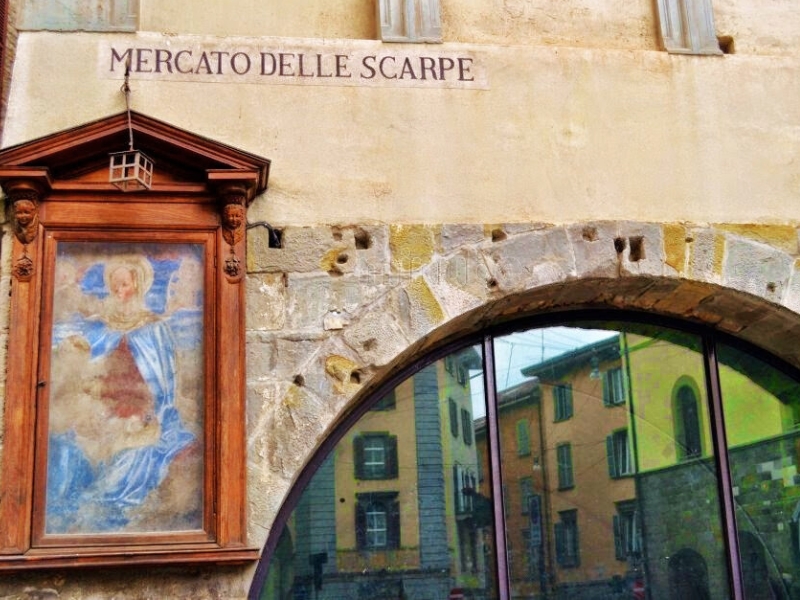
Piazza Mercato delle Scarpe, the Shoe Market Square, is the small, irregular square where most visitors first set foot in Bergamo's Città Alta. The funicular from the lower town ends inside a medieval palace on one side of it. For centuries this was a crossroads where the roads from Venice and Milan met, and it is still the hinge between the upper and lower city.
Piazza Mercato delle Scarpe at a glance
- Where: at the top of the funicular from the lower town, at the junction of Via Gombito, Via Porta Dipinta, Via San Giacomo and Via della Rocca in Città Alta.
- Created: one of the oldest squares in the upper town, already in use as a market in the Middle Ages; the funicular station opened in 1887.
- What it is today: a busy meeting point with cafés and trattorias, the upper station of the Città Alta funicular and the start of most walks through the old town.
- Time needed: 10 to 15 minutes to look around; it is a natural first or last stop on any visit to Città Alta.
From grain market to funicular station
In the Middle Ages the square was known as the grain market or the old market. The shoemakers and the butchers' guild had their seats here, and the leading families built houses around it. The most important of them is Palazzo Rota, later Palazzo Suardi, built in the 14th century by the Suardi family. Water came from a public fountain, the Fonte Secca, fed by a 15th-century cistern beneath the square; the space later housed a lottery office and then shops.
The biggest change came in 1887, when the funicular linking the lower town with Città Alta opened and its upper station was built into the old Suardi palace. The line climbs 85 metres in about two minutes, on gradients of up to 52 percent. From then on the square became the main gateway to the upper town, and the cafés and trattorias that line it today grew around the stream of arriving passengers.
What to look for
- The funicular station: look at the front of Palazzo Rota-Suardi, where the family coat of arms still sits above the central entrance.
- The little balcony: to the left of the entrance, a small terrace rests on three oddly shaped stone corbels, one of the few original features of the palace.
- The painted signs: on the corner with Via Donizetti, the trattoria sign above the low arched doorway is a painting by the Bergamo restorer Andrea Mandelli.
- The fresco in a glass case: on the wall of the next building, a fresco by an unknown artist is protected behind glass. It was restored in 1984 and again in 2008.
- Via Porta Dipinta: the street leaving the square takes its name from a medieval gate, since destroyed, that was covered in paintings.
Why a shoe market?
The name goes back to the rule of the Visconti of Milan over Bergamo in the 14th century. Under their government, the town's squares were named after the goods sold in them, such as the hay market and the fish market. This made it easier to collect and check the duties on each product, and the Visconti duties were famously heavy. The shoe market name stuck, even though shoes have long since given way to coffee and pastries.
Tips for your visit
- Arrive by funicular rather than on foot the first time: stepping out of the station straight into the square is the classic way into Città Alta.
- Come early in the morning, before the day trippers, when the square is quiet and the light falls into the narrow streets.
- Walk up Via Gombito to Piazza Vecchia first, then come back down Via Porta Dipinta to see the quieter side of the upper town.
- Expect queues at the funicular in the afternoon on weekends; walking down via the steps and lanes is a pleasant alternative.
Nearby
- Piazza Vecchia: the main square of Città Alta, with the Palazzo della Ragione and the Contarini Fountain, a few minutes' walk along Via Gombito.
- Torre del Gombito: a 12th-century tower on Via Gombito, 52 metres tall and once even taller, just off the square.
- La Rocca: the medieval fortress at the top of Via della Rocca, with a park and wide views over the lower town and the plain.
- The Venetian Walls: the 16th-century walls around Città Alta, a UNESCO World Heritage Site since 2017, reached by following Via Porta Dipinta towards Porta Sant'Agostino.
See Bergamo with World City Trail
Our Bergamo Old Town scavenger hunt turns Città Alta into a game you play on your phone. The route links 10 stops and takes around two hours, with about 22 minutes of walking. It includes Città Alta and Piazza Vecchia, a short walk from where the funicular drops you off.
If you prefer a different format, there is also a self-guided walking tour and an outdoor escape game in Bergamo.
Play the Bergamo scavenger hunt →
Take the self-guided walking tour of Bergamo →
Play the outdoor escape game in Bergamo →
Facts checked in October 2026.