
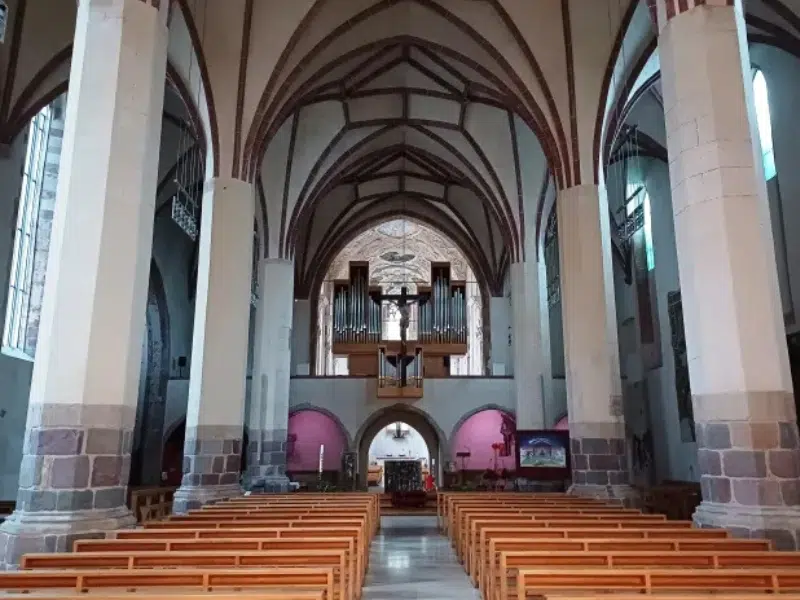
The Chiesa dei Domenicani (Dominikanerkirche) is Bolzano's Dominican church, one of the earliest Gothic buildings in Tyrol, standing on Piazza Domenicani a few steps from Piazza Walther. Its plain exterior hides some of the most important wall paintings in the region: 14th-century frescoes by painters from the school of Giotto, which helped shape the local "Bolzano School" of painting. In a side chapel hangs an altarpiece by Guercino.
The Chiesa dei Domenicani at a glance
- Where: Piazza Domenicani (Dominikanerplatz), just west of Piazza Walther in the centre of Bolzano.
- Built: a first church is recorded in 1272; the present Gothic building dates from the early 14th century, with the polygonal choir finished in 1313.
- By: the Dominican friars who settled in Bolzano in the 13th century, probably coming from Regensburg; the names of the builders are not known.
- What it is today: a church open to visitors, with its cloister and chapels; part of the former monastery now houses the Claudio Monteverdi music conservatory.
- Time needed: 30–45 minutes for the church, the St John's Chapel and the cloister.
From friars' fields to a Fascist-era square
When the Dominicans arrived, their monastery lay outside the town, on land between the Talfer and Eisack rivers, and the friars grew their own food on large fields around it. The church was rebuilt in Gothic style at the start of the 14th century, followed by the side chapels, and in the 15th century the church and cloister received new Gothic vaults. Artists working here combined Italian and German influences, which is why the frescoes inside look so varied.
The monastery was suppressed in 1785. In the early 20th century the new Neustadt district grew up between the church and the Talfer, and in the 1930s the Fascist city government took the remaining land to build today's square, lined with rationalist buildings. Bombs badly damaged the church in the Second World War; it was partly restored afterwards, and the Merchants' Chapel, first built around 1600, was reconstructed in 1971–1972.
What to look for
- St John's Chapel (Johanneskapelle): a cycle of frescoes from the first half of the 14th century by painters of the Giotto school, with scenes from the lives of St John, the Virgin and St Nicholas, including a horseman of the Apocalypse riding above the sinners.
- Guercino's Vision of Soriano (1655) in the Merchants' Chapel, showing the Virgin with Mary Magdalene and St Catherine handing a Dominican friar a picture of St Dominic.
- The hall interior, divided into three naves by octagonal pillars carrying net vaults, and the choir decorated with light Rococo stucco in 1740.
- The fresco of the Madonna among Saints by Hans Stotzinger of Ulm (1404), which blends German and Italian styles.
- The cloister, first mentioned in 1308, with wall paintings of the life of Christ from the 14th to 16th centuries, many shaped by the painter Friedrich Pacher.
A painting with a long journey
Guercino's altarpiece was commissioned by Bolzano's Mercantile Magistrate, the body that ran the city's important trade fairs, and put in place in 1656. When the monastery was closed in 1785, the painting was moved to the parish church. It only came back to the Dominican church in 1970, almost two centuries later, and today hangs again in the chapel the merchants built.
Tips for your visit
- Bring a little patience in St John's Chapel: the frescoes are faded in places, and your eyes need a minute to pick out the scenes.
- Do not skip the cloister: from it you reach St Catherine's Chapel, with more frescoes in the manner of Giotto.
- It is an active church, so keep quiet and avoid visiting during services.
- You may hear music from the conservatory in the former monastery, which hosts the Ferruccio Busoni International Piano Competition.
Nearby
- Piazza Walther: Bolzano's main square with its statue of the medieval poet Walther von der Vogelweide.
- Bolzano Cathedral: the Gothic cathedral with its colourful tiled roof and openwork spire.
- Via dei Portici (Laubengasse): the medieval arcaded street running through the old trading town.
- South Tyrol Museum of Archaeology: home of Ötzi, the 5,300-year-old Iceman found in the Ötztal Alps.
See Bolzano with World City Trail
Our Bolzano scavenger hunt turns the old town into a game you play on your phone. The route links 10 stops and takes around 2 hours, with about 33 minutes of walking. It includes Bolzano Cathedral and the South Tyrol Museum of Archaeology, home of Ötzi.
If you prefer a different format, there is also a self-guided walking tour and an outdoor escape game in Bolzano.
Play the Bolzano scavenger hunt →
Take the self-guided walking tour of Bolzano →
Play the outdoor escape game in Bolzano →
Facts checked in October 2026.