
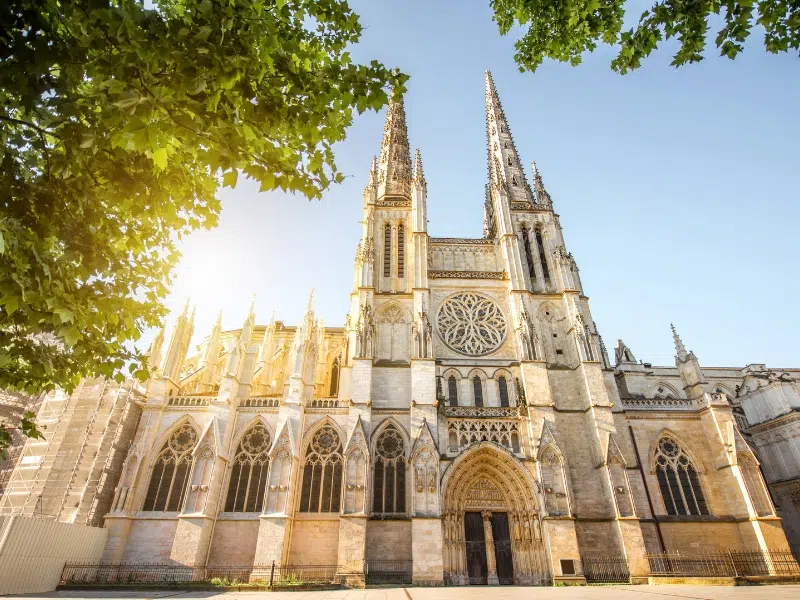
Saint-André Cathedral is the Gothic cathedral of Bordeaux, on Place Pey-Berland in the old town. Pope Urban II consecrated the church in 1096, and two royal weddings took place here: Eleanor of Aquitaine married the future King Louis VII in 1137, and Louis XIII married Anne of Austria in 1615. Its bell tower, the Tour Pey-Berland, stands on its own a few steps away.
Saint-André Cathedral at a glance
- Where: Place Pey-Berland, in the old centre of Bordeaux, opposite the city hall.
- Built: consecrated in 1096; the present Gothic building dates mostly from the 13th to the 15th centuries, with the separate bell tower built from 1440 to 1500.
- What it is today: the cathedral of the Archdiocese of Bordeaux and a working church, listed by UNESCO in 1998 as part of the Routes of Santiago de Compostela in France.
- Time needed: 30–45 minutes for the outside and the interior, plus about an hour if you climb the Tour Pey-Berland.
From Romanesque church to Gothic cathedral
A cathedral stood here long before the present building. Urban II consecrated the church in 1096, while travelling through France to preach the First Crusade. A Romanesque rebuilding followed on older Carolingian foundations, and in the early 13th century the builders switched to the new Gothic style. The choir was still under construction in 1320, and the Hundred Years' War, which began in 1337, cut the plans down: the nave, meant to have three aisles, was built with just one. After an earthquake in 1427 flying buttresses were added to hold it up.
The cathedral's most famous day came earlier. On 25 July 1137 the 13-year-old Eleanor, heiress of the Duchy of Aquitaine, married Louis, heir to the French throne, who became Louis VII a few days later. The marriage was annulled in 1152, and Eleanor soon married Henry Plantagenet, the future Henry II of England, which brought Bordeaux under English rule for three centuries. In 1615 the cathedral saw a second royal wedding, between Louis XIII and Anne of Austria. In the 19th century the architect Paul Abadie restored the building and added stained glass and neo-medieval paintings.
What to look for
- The Porte Royale: the royal portal on the north side, the main entrance until the 1320s. Its sculpted tympanum of the Last Judgement, from around 1200–1250, survived the Revolution.
- The north portal: built around 1325–1350 and topped by two spires, it became the cathedral's grandest entrance, facing Place Pey-Berland.
- The flying buttresses: added after the 1427 earthquake. Look for the Gramont buttress, begun in 1531 and decorated in Renaissance style.
- The single nave: walk in and notice how wide and plain the nave is compared with the tall, richer Gothic choir, the result of the plans cut short by war.
- The organ case: the historic case at the west end is getting a new instrument by the organ builders Rieger and Orglez, due to be completed in 2030.
Why the bell tower stands apart
The Tour Pey-Berland is named after Pey Berland, the archbishop who laid its first stone on 13 October 1440. It was finished in 1500 and stands slightly more than 60 metres tall on an 8-metre square base, a few metres from the cathedral's apse. Its spire was blown down in a hurricane in 1667 and only rebuilt in 1851, and in 1863 the gilded statue of Notre-Dame d'Aquitaine by Alexandre Chertier was placed on top. You can climb the tower for one of the best views over the rooftops of Bordeaux.
Tips for your visit
- Walk all the way round the outside first: the two portals and the buttresses on the north side are the highlights, and they face Place Pey-Berland.
- It is a working cathedral, so keep quiet during services and dress respectfully inside.
- Climb the Tour Pey-Berland on a clear day for the view over the cathedral roof and the city. The stairs are narrow, so it is not for everyone.
Nearby
- Palais Rohan: the 18th-century archbishop's palace across the square, now the city hall, with an elegant classical courtyard.
- Musée des Beaux-Arts: the city's fine arts museum, in two wings beside the gardens behind the Palais Rohan, a few minutes' walk away.
- Musée d'Aquitaine: the regional history museum, a short walk south, from prehistory to Bordeaux's wine and port trade.
- Rue Sainte-Catherine: one of Europe's longest pedestrian shopping streets, starting a few minutes from the cathedral.
See Bordeaux with World City Trail
Our Bordeaux scavenger hunt turns the old town into a game you play on your phone. The route links 10 stops and takes around 3 hours, with about 49 minutes of walking. Saint-André Cathedral is one of the stops, along with the old Saint-Pierre district.
If you prefer a different format, there is also a self-guided walking tour and an outdoor escape game in Bordeaux.
Play the Bordeaux scavenger hunt →
Take the self-guided walking tour of Bordeaux →
Play the outdoor escape game in Bordeaux →
Facts checked in October 2026.