
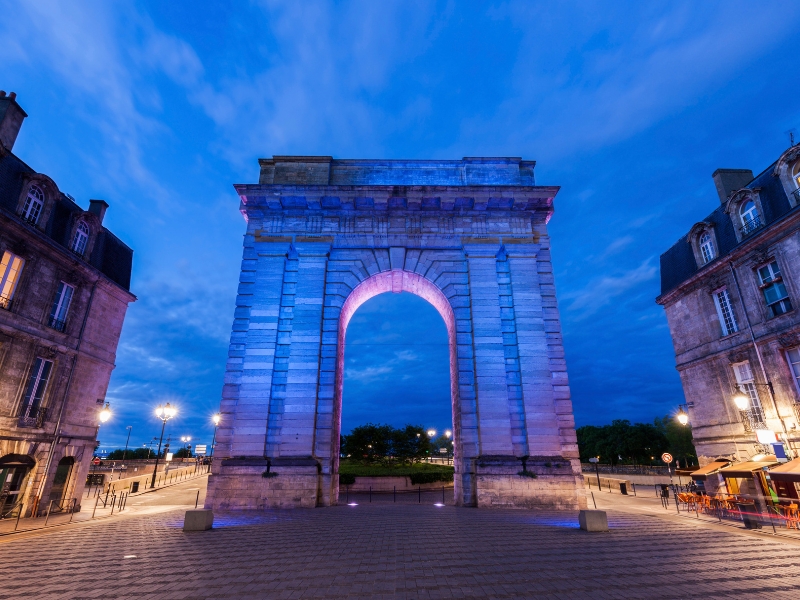
The Porte de Bourgogne is an 18th-century city gate in Bordeaux, shaped like a Roman triumphal arch and standing on Place Bir-Hakeim, right in front of the Pont de Pierre. For travellers arriving on the road from Paris it was the official entrance to the city. It has carried several names: Porte des Salinières, Porte de Bourgogne and, for a while, Porte Napoléon.
The Porte de Bourgogne at a glance
- Where: Place Bir-Hakeim, at the eastern end of Cours Victor-Hugo, facing the Pont de Pierre across the Garonne.
- Built: 1750–1755, as part of Intendant Tourny's plan to give Bordeaux grand classical gates and squares.
- By: the architect André Portier, under the supervision of the royal architect Ange-Jacques Gabriel.
- What it is today: a free-standing monument in the middle of a busy square, listed as a historic monument since 1921.
- Time needed: 10 minutes for the gate itself; add time to cross the Pont de Pierre for the view back.
From medieval gateway to triumphal arch
The gate stands on the site of a medieval entrance to the city on the road to Paris, known as the Porte des Salinières. In the mid-18th century the royal intendant Louis-Urbain-Aubert de Tourny transformed Bordeaux with new squares, avenues and gates, and this was one of them. Tourny also planned the half-moon square in front, lined with uniform facades, and on 24 January 1757 he dedicated the gate to the Duke of Burgundy, the infant grandson of King Louis XV.
Napoleon passed through Bordeaux in 1808, and for a time the gate was renamed Porte Napoléon in honour of the visit. Two small side gates that once linked it to the surrounding buildings were demolished in 1807, leaving the arch standing on its own. When the Pont de Pierre was built in the early 19th century, the ground of the square was raised, which partly buried the base of the gate. Today trams and traffic flow around it, and it marks the start of Cours Victor-Hugo.
What to look for
- The overall shape, modelled on Roman triumphal arches such as the Arch of Titus in Rome.
- The Doric columns that carry a heavy entablature above the arch.
- The plain attic: the royal arms and military trophies first planned for the top were left out for structural reasons, which gives the gate its sober look.
- The base of the columns, which sits lower than you might expect because the square was raised around it.
- The view through the arch towards the Pont de Pierre and the right bank of the Garonne.
Seventeen arches for Napoleon?
The gate's neighbour, the Pont de Pierre, was the first bridge across the Garonne in Bordeaux, ordered by Napoleon but only built between 1819 and 1822. A popular story says it has 17 arches because "Napoléon Bonaparte" has 17 letters. It is a legend that has never been proven, but it is told so often in Bordeaux that it is hard to cross the bridge without hearing it.
Tips for your visit
- Walk a few minutes onto the Pont de Pierre and turn around: you will see the gate framed against the stone facades of the quays.
- At dusk the gate and the quays are lit, and the riverside is pleasant for an evening walk.
- Watch for trams when you cross the square; the gate sits in the middle of a busy junction.
- Combine it with the Saint-Michel and Saint-Pierre districts, both a short walk away.
Nearby
- Pont de Pierre: the 19th-century stone bridge over the Garonne, with wide views of the city's riverfront.
- Grosse Cloche: the medieval belfry gate of the old town hall, a short walk up Cours Victor-Hugo.
- Basilique Saint-Michel: the Gothic church whose separate bell tower is one of the tallest in France.
- Place de la Bourse and the Miroir d'eau: the 18th-century royal square and the huge reflecting pool on the quays.
See Bordeaux with World City Trail
Our Bordeaux scavenger hunt turns the old town into a game you play on your phone. The route links 10 stops and takes around 3 hours, with about 49 minutes of walking. It includes the Saint-Pierre district and the Cathedral of Saint-André.
If you prefer a different format, there is also a self-guided walking tour and an outdoor escape game in Bordeaux.
Play the Bordeaux scavenger hunt →
Take the self-guided walking tour of Bordeaux →
Play the outdoor escape game in Bordeaux →
Facts checked in October 2026.