
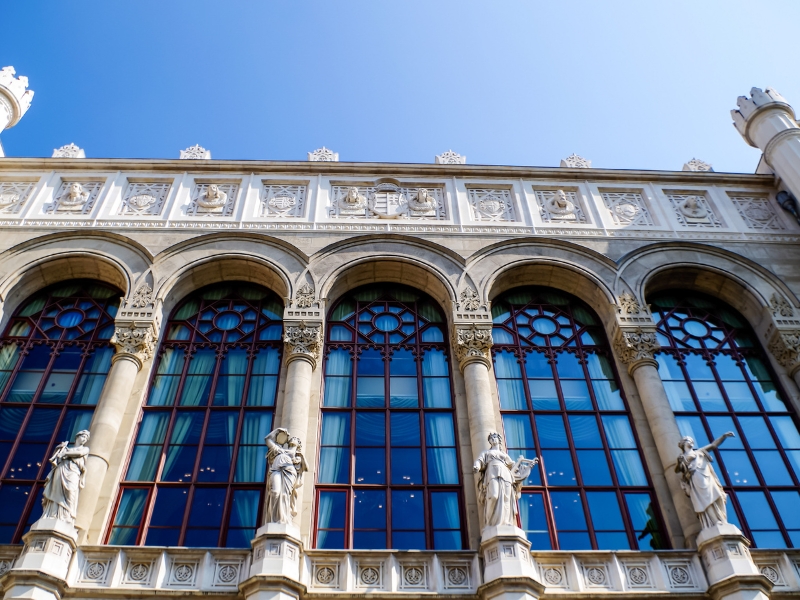
Vigadó Square (Vigadó tér) is a small square on the Pest bank of the Danube, opening straight onto the river and the view of Buda Castle. It takes its name from the Pesti Vigadó, a Romantic concert hall where Liszt, Brahms and Wagner performed. On the riverside railing in front of it sits one of the city's most photographed statues: the Little Princess.
Vigadó Square at a glance
- Where: on the Pest side of the Danube in District V, between the Chain Bridge and Elisabeth Bridge, on the riverside promenade.
- Built: the Pesti Vigadó opened in 1865 on the site of an earlier hall destroyed in 1849.
- By: architect Frigyes Feszl designed the Vigadó; the Little Princess statue is by László Marton.
- What it is today: a pedestrian square with a tram stop and boat landing, and a concert and exhibition venue that reopened in 2014 after a ten-year refurbishment.
- Time needed: 15 minutes for the square, more if you go inside the Vigadó or walk the promenade.
From burned ballroom to Romantic concert hall
In 1833 a ballroom and assembly building called the Redoute opened here, designed by Mihály Pollack. During the 1848–1849 revolution it hosted a session of the new Hungarian parliament, and in 1849 it was destroyed in the fighting with Austrian troops. On the same site Frigyes Feszl built the Pesti Vigadó, which opened in 1865. Its style mixes Romantic, Moorish and Hungarian motifs, and it became one of the city's main venues for concerts and balls. In 1867 it hosted the banquet for Franz Joseph's coronation as King of Hungary.
The list of musicians who played or conducted here is long: Franz Liszt, Johann Strauss, Richard Wagner, Johannes Brahms, Camille Saint-Saëns, Claude Debussy and, in the 20th century, Béla Bartók and Herbert von Karajan. After a long decline, the building closed for a full refurbishment and reopened in 2014. The square in front was redesigned as part of the Danube promenade, and in 1990 László Marton's bronze Little Princess was placed on the railing by the tram tracks.
What to look for
- The Vigadó's façade, with its arcades, carved heads and Moorish-style decoration, best seen from the riverside.
- The Little Princess (Kiskirálylány) sitting on the railing: a small girl in a paper crown and a cloak.
- The view across the Danube to Buda Castle and the Royal Palace, framed by the Chain Bridge to the right.
- The historic yellow tram on line 2, which runs along the river right in front of the square.
- The boat landing below the square, where river cruise and sightseeing boats stop.
The story of the Little Princess
The statue is a portrait of László Marton's daughter, Évi. As a child she played at being a princess in the Tabán district of Buda, wearing a crown folded from newspaper and a bathrobe as her royal mantle. Marton made a small statuette of her in 1972, now in the Hungarian National Gallery, and the larger copy came to the Danube promenade in 1990. It has since become one of Budapest's best-loved sculptures, and many visitors rub her knees, which shine from all the attention.
Tips for your visit
- Come at dusk, when the castle and the Chain Bridge light up across the river.
- For the classic photo, stand behind the Little Princess so she seems to look out at Buda Castle.
- Check the Vigadó's programme: there are concerts and exhibitions, and the building is worth seeing inside.
- Walk north along the promenade towards Parliament for one of the best riverside strolls in the city.
Nearby
- Széchenyi Chain Bridge: the 19th-century suspension bridge with its stone lions, a few minutes' walk north.
- Vörösmarty Square: the square with the Gerbeaud café, a short walk inland.
- Shoes on the Danube Bank: the memorial to Jews shot on the riverbank in 1944–1945, further north towards Parliament.
- Váci utca: the long pedestrian shopping street, a couple of minutes away.
See Budapest with World City Trail
Our Budapest scavenger hunt turns the city centre into a game you play on your phone. The route links 11 stops and takes around 3 hours, with about 64 minutes of walking. It includes the Hungarian Parliament, Liberty Square and St Stephen's Basilica.
If you prefer a different format, there is also a self-guided walking tour and an outdoor escape game in Budapest.
Play the Budapest scavenger hunt →
Take the self-guided walking tour of Budapest →
Play the outdoor escape game in Budapest →
Facts checked in October 2026.