What is the Budapest outdoor escape game?
The Budapest outdoor escape game is an escape room with the city as its set: a puzzle sits at every landmark on the route and you open them one by one on your smartphone. Reckon with about 2 hours, of which 64 minutes are walking, a route of 4.7 km and 11 stops in all. Each puzzle is independent, so nothing is lost if you break off and come back.
The puzzle locations take in Liberty Square, the Castle Garden Bazaar, the Zero Kilometre Stone and the Fountain of King Matthias as well as the landmarks everyone comes for. Budapest hands you good material: seven turrets on Fisherman's Bastion, one per Magyar tribe, the Parliament and the dome of St Stephen's Basilica, both reaching 96 metres, and the old legend about the tongues of the Chain Bridge lions. Three levels of hints are there if a puzzle holds out.
- Durationabout 2 hours
- Walkingabout 64 min · 4.7 km
- Stops11
- LanguagesEnglish, German, French, Italian, Spanish, Dutch
What you do on the escape game
Reason it out
Every stop sets a puzzle you crack from the surroundings, by observation and logic, with no prior knowledge needed.
Count the towers
Turrets, reliefs, inscriptions and the figures on the fountains hold the details you are asked for.
Cross the Danube
Google Maps leads you stop to stop: 64 minutes on foot over 4.7 km, including the climb up Castle Hill.
Time on your side
No countdown runs. Take a hint, pause on the riverbank and continue later or on another day.
See the route and attractions →
How it works
- Book online Choose the number of players. Your booking reference arrives by email straight away.
- Get the app Download the World City Trail app from the App Store or Google Play and enter your booking reference.
- Play when you like Start whenever you are ready, walk at your own pace and pause any time. No guide, no fixed schedule.
Who it suits
Friends
Everyone has a theory at the next puzzle, and nobody needs to have read up on Hungary beforehand.
Couples
Pest, a bridge, Buda and a view over the river, with something to solve together at every stop.
Team building
Teams of up to 5 run the game on their own phones, which makes a company outing easy to organise.
Good to know
- Bring a charged smartphone with mobile data; a power bank helps.
- Best started in daylight, so you can see the details the puzzles ask about.
- No entry tickets needed: everything happens outside the buildings. Going inside is optional and paid separately.
- Family friendly; children must be accompanied by an adult.
- Not suitable for wheelchair users and difficult with strollers.
- Teams of up to 5 work best; bigger groups split into several teams, one ticket per player.
- Every purchase helps support stray cats and dogs in Greece.
Puzzle route: from the Parliament in Pest to Castle Hill in Buda
11 stops · about 64 min walking · start: Hungarian Parliament Building · finish: Matthias Church
The opening puzzle stands at the Hungarian Parliament and the last at Matthias Church on Castle Hill. In between you take on Liberty Square, St Stephen's Basilica, Elizabeth Square, the Széchenyi Chain Bridge, the Zero Kilometre Stone, the Castle Garden Bazaar, Buda Castle, the Fountain of King Matthias and Fisherman's Bastion. Daylight works best, because the puzzles are read off the buildings and the climb to the castle is slower in rain. Google Maps handles the walking, the app lets you start elsewhere or shuffle the order, and no entry tickets are needed.
Open the route map ↗
1Hungarian Parliament BuildingStart
Imre Steindl's neo-Gothic Parliament on the Danube was begun in 1885, inaugurated in 1896, the year Hungary celebrated its millennium, and completed in 1904. It is the largest building in Hungary, 268 metres long and 96 metres high, and the Holy Crown of Hungary has been displayed inside since 2000.
2Liberty Square
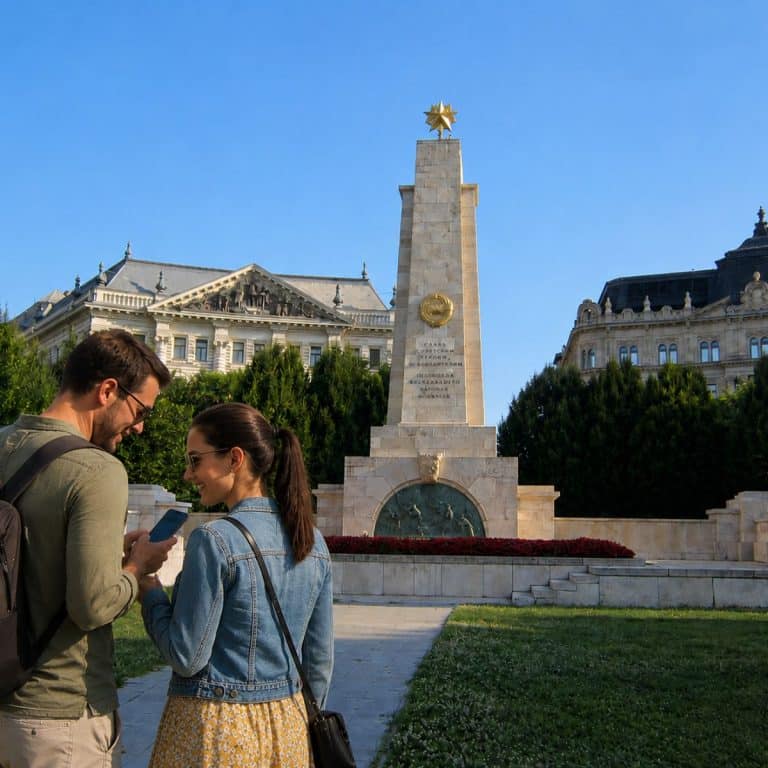
Szabadság tér was laid out around 1900 on the site of a former Austrian barracks. Around it stand the Hungarian National Bank and the former Stock Exchange Palace, both by Ignác Alpár and completed in 1905, a Soviet memorial to Red Army soldiers who died in 1944–1945 and a statue of Ronald Reagan, unveiled in 2011.
Read the full story →
3St Stephen's Basilica
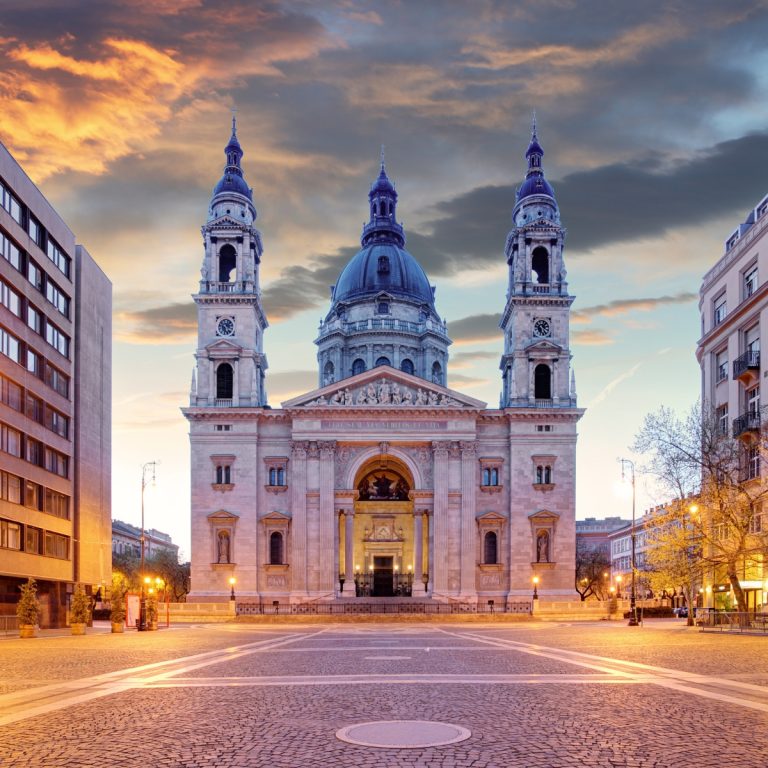
Budapest's great basilica was built from 1851 to 1905 by three architects in turn, József Hild, Miklós Ybl and József Kauser, after the first dome collapsed in 1868. Its dome is 96 metres high, the same as the Parliament, and a chapel holds the Holy Right, the mummified right hand of St Stephen, Hungary's first king.
4Elizabeth Square
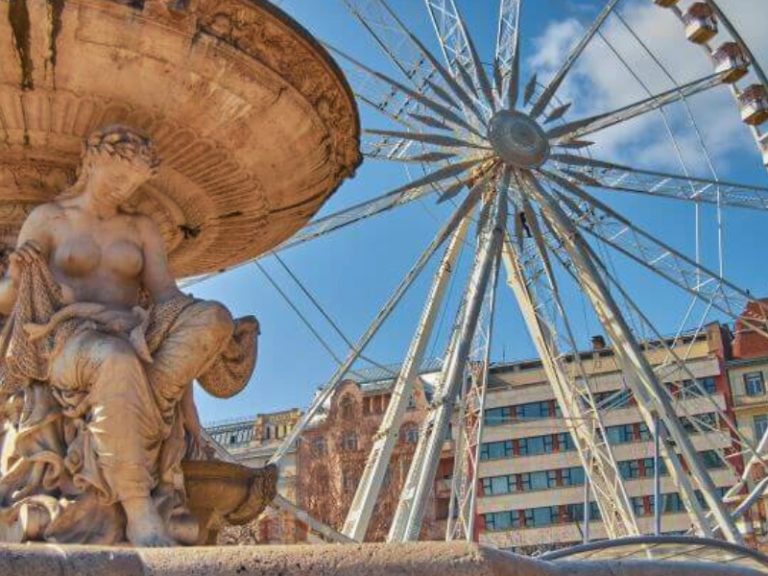
Erzsébet tér, named after Queen Elisabeth, known as Sisi, is one of the largest green spaces in central Pest. Its Danubius Fountain, designed by Miklós Ybl, shows the Danube as a river god above three women who stand for its tributaries, the Tisza, Drava and Sava. A functionalist former bus station from 1949 also stands on the square.
Read the full story →
5Széchenyi Chain Bridge
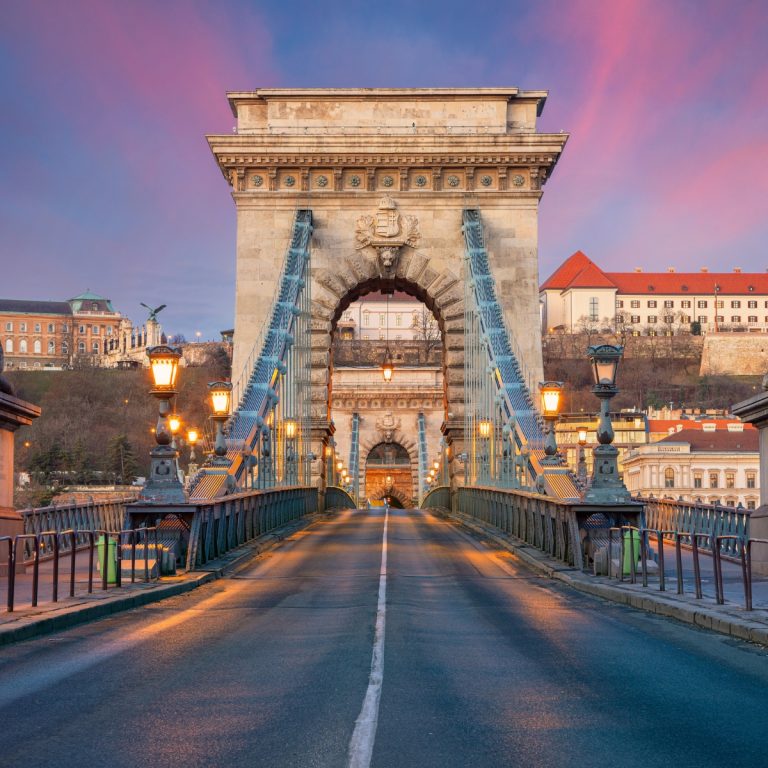
Opened in 1849, the Chain Bridge was the first permanent bridge across the Danube between Buda and Pest. It was initiated by Count István Széchenyi, designed by the English engineer William Tierney Clark and built under the Scot Adam Clark. Legend says its stone lions have no tongues, but the tongues are simply not visible from below.
6Zero Kilometre Stone
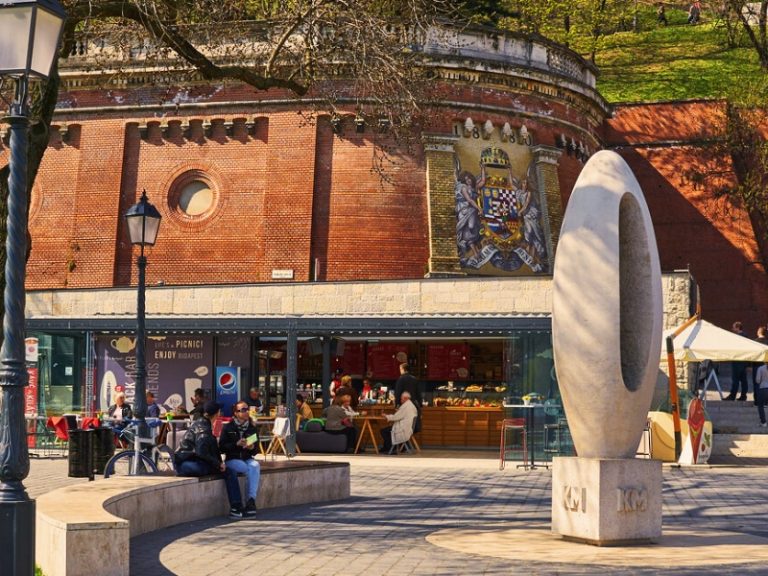
This 3-metre limestone zero, a sculpture by Miklós Borsos unveiled in 1975, stands in Clark Ádám Square at the Buda end of the Chain Bridge. It marks Hungary's Kilometre Zero, the point from which road distances from the capital are measured.
Read the full story →
7Castle Garden Bazaar
Miklós Ybl, architect of the Hungarian State Opera, designed this neo-Renaissance complex of arcades, staircases and pavilions at the foot of Buda Castle, built between 1875 and 1883. After decades of decay it was restored and reopened in 2014, with terraced gardens and a covered escalator up towards the castle.
8Buda Castle
The royal palace on Castle Hill has been destroyed and rebuilt several times since the Middle Ages, most recently after heavy damage in the Second World War. Its long wings now house the Hungarian National Gallery, the Budapest History Museum and the National Széchényi Library, and a bronze Turul, the mythical bird of the Hungarians, watches over the gate.
9Fountain of King Matthias
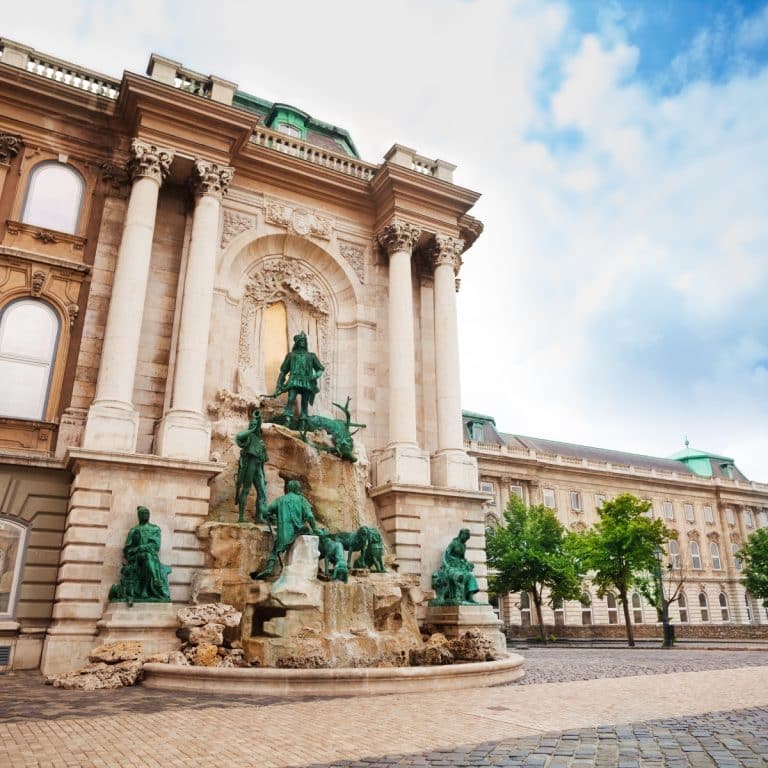
In a courtyard of Buda Castle, Alajos Stróbl's bronze fountain of 1904 shows King Matthias as a hunter with his hunting party and dogs. It illustrates the tale of Beautiful Ilonka, a girl who fell in love with the king without knowing who he was, and tossing a coin into it is said to bring you back to Budapest.
10Fisherman's Bastion
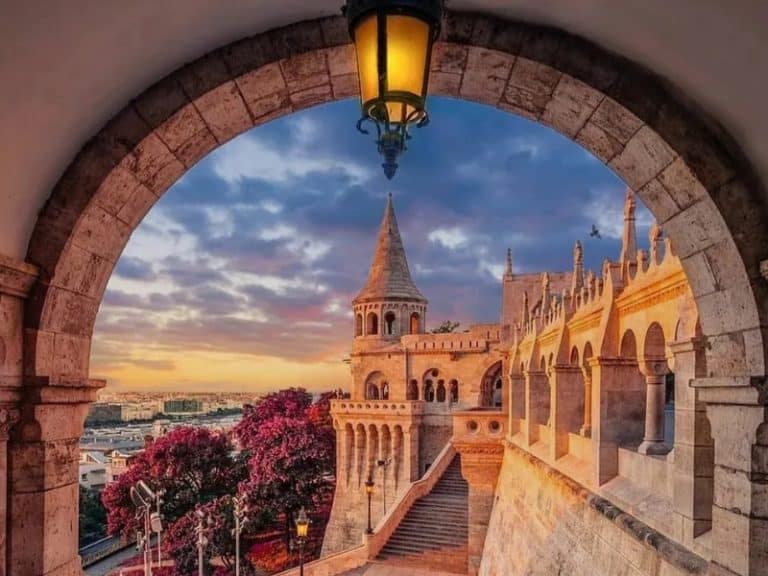
Frigyes Schulek built this neo-Romanesque terrace between 1895 and 1902, with seven towers for the seven Magyar tribes. According to tradition it is named after the fishermen's guild that defended this stretch of the walls in the Middle Ages. In front of it stands an equestrian statue of St Stephen, and its arcades look out over the Danube and Pest.
11Matthias ChurchFinish
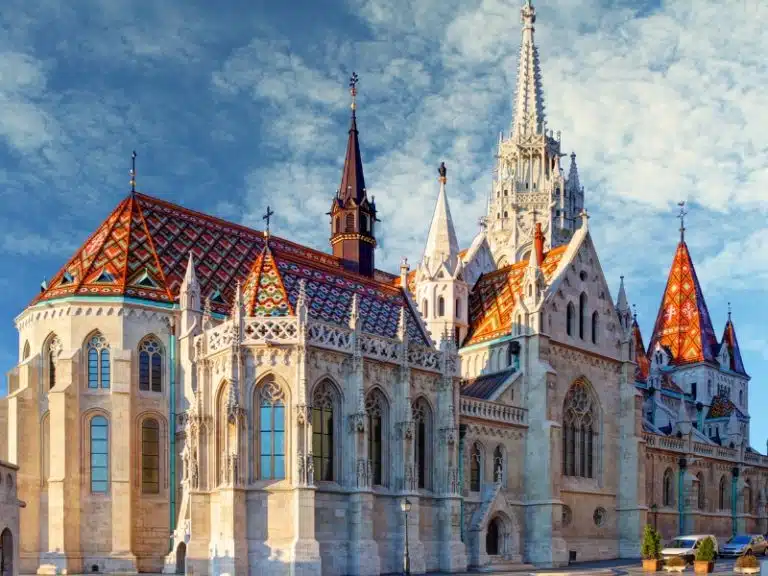
The Gothic Church of Our Lady of Buda is popularly named after King Matthias, who married here. After the Ottomans took Buda in 1541 it became a mosque, and in 1867 Franz Joseph and Elisabeth were crowned King and Queen of Hungary here. Frigyes Schulek restored it in the late 19th century, with a colourful roof of Zsolnay tiles.
Read the full story →
Only logged in customers who have purchased this product may leave a review.









milou– Netherlands –
Collected on GetYourGuide
Een unieke manier om de stad te ontdekken, zonder achter groepen mensen aan te moeten lopen. Dit kan op eigen tempo, er is genoeg te zien en door de info leer je veel over de stad. De opdrachten waren leuk en uitdagend. Ik raad dit zeker aan!
Ronja– Germany –
Collected on GetYourGuide
Super coole App! Schön um unabhängig von anderen die Sehenswürdigkeiten zu betrachten und trotzdem wissenswertes zu erfahren.
Bruno– Italy –
Collected on GetYourGuide
C’è molto da camminare.