
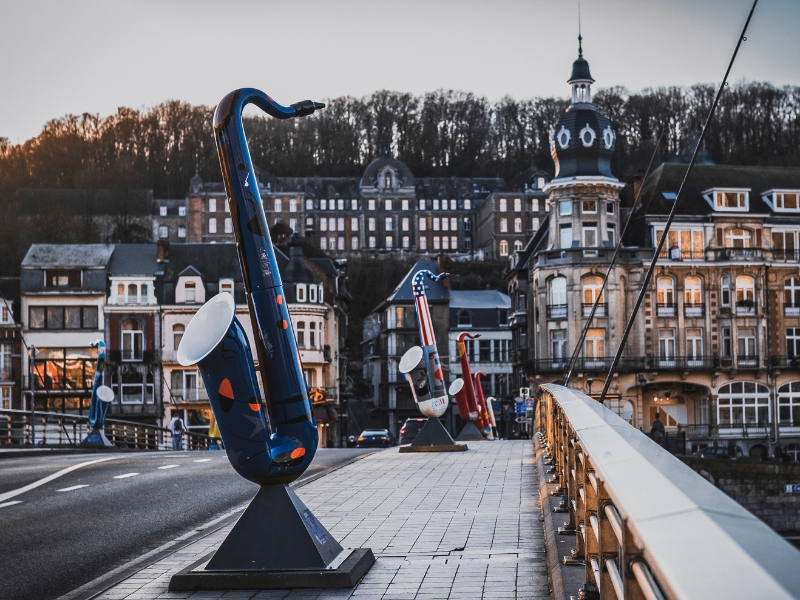
Dinant is squeezed into a narrow strip between the river Meuse and a wall of limestone cliffs, with a citadel on top and an onion-domed church at the bottom. It is a small Belgian town with an outsized story: it gave the world the saxophone, a word for brassware and a biscuit you should never bite. Here are the facts and stories that make the town special.
10 fun facts about Dinant
- The birthplace of the saxophone: Adolphe Sax was born in Dinant in 1814 and patented the saxophone in Paris in 1846.
- A bridge lined with saxophones: since 2010, the Charles de Gaulle Bridge over the Meuse has been decorated with giant saxophones, each painted in the style of a different European country.
- 408 steps to the top: a flight of 408 steps climbs from beside the church to the citadel. Fortified since the Middle Ages and destroyed by the French in 1703, the present citadel was rebuilt in 1821, when Dinant belonged to the United Kingdom of the Netherlands.
- A church with an onion dome: the Gothic Collegiate Church of Notre-Dame stands right against the cliff. Its bulb-shaped bell tower is the town's emblem and has been rebuilt more than once after wars.
- A word for brassware: in the Middle Ages Dinant's metalworkers were so famous for their brass and copper vessels that in French such objects are still called dinanderie.
- Destroyed in 1466: after Dinant rebelled against the Dukes of Burgundy, the army of Philip the Good and his son Charles the Bold sacked the town, burned it and drowned many of its men in the Meuse.
- De Gaulle was wounded here: on 15 August 1914, during the Battle of Dinant, a young French lieutenant named Charles de Gaulle was wounded near the bridge that now carries his name. Eight days later, on 23 August, German troops killed 674 civilians in the town.
- An abbey that gave its name to a beer: the Abbey of Notre-Dame de Leffe was founded in Dinant in the 12th century, and its brewing tradition goes back to 1240.
- A biscuit as hard as wood: the couque de Dinant is made only of wheat flour and honey, pressed into carved wooden moulds of animals, people and town scenes, and baked until rock hard.
- Racing bathtubs: every 15 August, since the early 1980s, crews float down the Meuse in home-made boats built around bathtubs, cheered on by thousands of spectators.
The legend of the horse Bayard
Just south of the centre, a needle of rock about 40 metres high stands apart from the cliff, with the road running through the gap. It is called the Rocher Bayard, after a story told since the Middle Ages. The four sons of Aymon had angered Charlemagne and fled from his army on Bayard, a magical horse that could stretch to carry all four brothers at once. Legend says that when they reached the cliffs at Dinant, Bayard leapt across the valley, and the blow of his hoof split the rock in two.
Adolphe Sax, explained
Antoine-Joseph Sax, known as Adolphe, was born in Dinant on 6 November 1814, the son of an instrument maker, and grew up in Brussels. He wanted an instrument with the power of brass and the agility of woodwind, and the result, patented in Paris in 1846, was a whole family of saxophones in different sizes. Sax spent years fighting lawsuits from rival makers and died in Paris in 1894 without much money. His birthplace on the street now named after him has become the Maison de Monsieur Sax, a small interpretation centre about his life and inventions.
What to eat in Dinant
- Couque de Dinant: don't bite it. Break off a small piece and let it soften in your mouth, or dunk it in coffee. The decorated ones are often bought as souvenirs.
- Flamiche dinantaise: a very rich, hot tart of soft cheese, butter and eggs, best eaten straight from the oven.
- Leffe: the abbey beer is poured all over town, and the Maison Leffe museum in a former monastery building tells its story.
- Ardennes ham: smoked and cured ham from the hills around Dinant, protected by an EU geographical indication.
Good to know before you go
- If you don't want to climb the 408 steps, a cable car runs up to the citadel from near the church.
- Kayaking on the Lesse, a tributary that joins the Meuse just south of Dinant, is the classic day out in summer. The river passes below the clifftop Château de Walzin.
- The Grotte la Merveilleuse, a cave discovered in 1904, is within walking distance of the centre and stays at about 13°C all year, so bring a jacket.
Explore Dinant with World City Trail
Our Dinant scavenger hunt turns these sights into a game you play on your phone. The route links 10 stops and takes around two hours, with about 25 minutes of walking, and its stops include the Adolphe Sax monument and the Maison de Monsieur Sax.
At each stop you solve a puzzle and hear a short story, at your own pace. You can start whenever you like and play in English, German, French, Italian, Spanish or Dutch.
Play the Dinant scavenger hunt →
Facts checked in October 2026.