
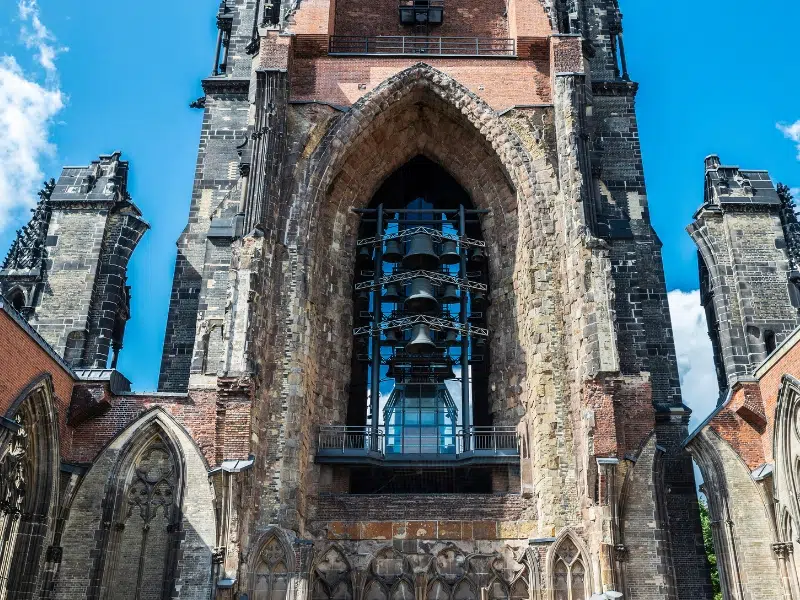
St. Nikolai is the ruined church with the soaring neo-Gothic spire on Willy-Brandt-Straße in Hamburg, between the Rathaus and the Speicherstadt. When its tower was finished in 1874 it was briefly the tallest building in the world; in July 1943 Allied pilots used it as a landmark during the raids that destroyed much of the city. Today the tower and the walls that survived form the Mahnmal St. Nikolai, a memorial to the victims of war and tyranny.
St. Nikolai at a glance
- Where: Willy-Brandt-Straße, near the Hopfenmarkt, a few minutes' walk from the Rathaus and the Speicherstadt.
- Built: from 1846 after the Great Fire of 1842; consecrated in 1863, tower completed in 1874.
- By: the English architect George Gilbert Scott.
- What it is today: a memorial with a documentation centre in the crypt and a glass lift up the tower to a viewing platform at 76 metres.
- Time needed: about an hour for the lift, the ruins and the exhibition.
From the world's tallest building to a memorial
A wooden chapel stood here by 1195, and a brick church followed from 1335. In May 1842 the Great Fire of Hamburg destroyed it along with much of the old town. The congregation chose a design by George Gilbert Scott, the English champion of the Gothic Revival, and the new church was consecrated on 27 September 1863. Its tower, about 147 metres tall, was completed in 1874 and made St. Nikolai the tallest building in the world until Rouen Cathedral overtook it in 1876. It is still Hamburg's tallest church tower.
In the Allied air raids of Operation Gomorrah in July 1943, which killed more than 34,000 people in Hamburg, the tower served as a landmark for the bomber crews. On 28 July bombs hit the church; the roof collapsed and the nave burned out, but the tower, the choir and parts of the walls stayed standing. In 1951 most of the nave was demolished, and the parish built a new St. Nikolai church in the district of Harvestehude. The ruin was dedicated as a memorial in 1977, and since 1987 a citizens' association has worked to preserve it.
What to look for
- The spire: look up from the base to see how much carved sandstone survived on the tower, then compare the scorched stone with the cleaner restored parts.
- The open-air ruin: the remains of the choir and nave walls, with grass and sky where the roof used to be.
- Prüfung (Ordeal): a sculpture in the former south aisle commemorating the prisoners of the Sandbostel camp.
- The Cross of Nails from Coventry, given in 1993 as a sign of reconciliation between two cities bombed in the war.
- The view from 76 metres: the Speicherstadt, the Elbphilharmonie, the port and the Rathaus, with panels showing what the city looked like after 1943.
- The exhibition in the crypt, 'Gomorrah 1943', on the air war against Hamburg, its causes and its consequences, expanded in 2013.
Tips for your visit
- Start in the crypt exhibition and then take the lift: the view means more once you know what lay in ruins below.
- This is a memorial. Keep your voice down in the ruins and be thoughtful about photos and selfies.
- A redesign of the site, with a new pavilion and a step-free path between the north and south entrances, is planned for completion in 2028. Parts may be fenced off during the works, so check before you go.
- The 51-bell carillon in the tower, installed in 1993, plays tunes every day; listen for it as you walk round.
Nearby
- Hamburg Rathaus: the neo-Renaissance city hall of 1897 with its 112-metre tower, a few minutes' walk away.
- Deichstraße: a lane of old merchant houses on the Nikolaifleet canal, where the Great Fire of 1842 broke out.
- Speicherstadt: the red-brick warehouse district across the Zollkanal, a UNESCO World Heritage Site since 2015.
- St. Katharinen: one of Hamburg's five main Lutheran churches, with a Baroque spire, a short walk towards the harbour.
See Hamburg with World City Trail
Our Hamburg scavenger hunt turns the old town into a game you play on your phone. The route links 10 stops and takes around 3 hours, with about 64 minutes of walking. Among the places it includes are the Rathaus, the Elbphilharmonie and St Michael's Church. You can play in English, German, French, Italian, Spanish, Dutch and Polish.
If you prefer a different format, there is also a self-guided walking tour and an outdoor escape game in Hamburg.
Play the Hamburg scavenger hunt →
Take the self-guided walking tour of Hamburg →
Play the outdoor escape game in Hamburg →
Facts checked in October 2026.