
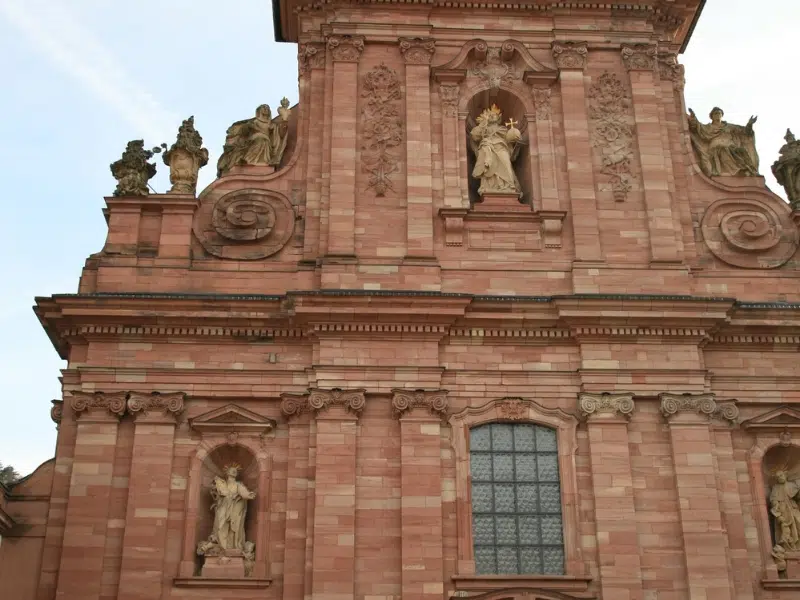
The Jesuitenkirche (Jesuit Church) is the main Catholic church of Heidelberg's old town, a Baroque church in red sandstone on Schulgasse, one block behind the Universitätsplatz. It took almost half a century to build, from 1712 to 1759, and its bell tower was only added more than a hundred years later.
The Jesuitenkirche at a glance
- Where: Schulgasse in the old town, at the centre of the former Jesuit quarter, a short walk south of the Hauptstraße and the Universitätsplatz.
- Built: 1712–1759; the neo-Baroque tower followed between 1868 and 1872.
- By: plans by Johann Adam Breunig; the Mannheim court architect Franz Wilhelm Rabaliatti oversaw the completion.
- What it is today: the Catholic parish church of Heilig Geist, used for services and concerts, with the Museum for Sacred Art and Liturgy attached.
- Time needed: 20–30 minutes for the church, about an hour if you add the museum.
From Jesuit college church to parish church
The church was a project of the Catholic electors of the Palatinate, who ruled a largely Protestant city after 1685 and brought in the Jesuits to strengthen Catholic life. Elector Johann Wilhelm had it begun in 1712 to plans by Breunig, who also designed the Old University nearby. After his death in 1716, his successor Karl Philipp quarrelled with Heidelberg's Protestant church council and moved his court to Mannheim, and work almost stopped. It only picked up again under Elector Karl Theodor in 1749, and the church was finished in 1759 under Rabaliatti.
In 1773 the pope dissolved the Jesuit order, and for a time the building served as a military hospital. In 1809 it became the parish church of Heidelberg's Catholic Heilig Geist parish, which until then had shared the Heiliggeistkirche on the market square with the Protestants. The tower the Baroque builders never finished was added in neo-Baroque style between 1868 and 1872. A renovation in 2001–2004 redesigned the altar area, and new organs followed in 2009 and 2014. The crypt holds the grave of Elector Frederick I, known as Frederick the Victorious, who died in 1476.
What to look for
- The façade: a tall, layered front in red Neckar sandstone with columns, pilasters and sculpted decoration on the gable.
- The tower: compare it with the church below. It copies the Baroque forms, but it is more than a century younger than the nave.
- The interior: a bright hall church with three aisles of the same height, divided by tall pillars. Little of the original Baroque furnishing survived, so the space feels light and calm.
- The organs: the main organ of 2009 and a smaller second organ of 2014, both by the Swiss organ builder Kuhn.
- The treasury: in the Museum for Sacred Art and Liturgy, look for a large silver Madonna by J. Ignaz Saller from 1736, Augsburg silverwork and what the museum calls Heidelberg's oldest bell, from around 1400.
- The Jesuit quarter: around the church stand the former Jesuit grammar school and the Seminarium Carolinum, both now used by the university.
A Catholic quarter in a Protestant city
The church is the centrepiece of the Jesuitenviertel, the Jesuit quarter, built in the 18th century as a Catholic counterweight in a town whose university and citizens were mostly Protestant. The Jesuits ran a grammar school and a seminary here until their order was dissolved. Today the former school houses the university's philosophy department and the Carolinum its administration, so the quarter has quietly become part of the university it once competed with.
Tips for your visit
- It is a working parish church: visit outside services, keep your voice down and don't walk around during Mass.
- Schulgasse is narrow. To fit the façade and tower into one photo, stand on the far side of the street and use a wide angle.
- Check for concerts: the church is one of the venues of the Heidelberger Frühling music festival in spring.
- Combine it with the Universitätsplatz and the Old University, only a minute or two away.
Nearby
- Old University and Student Prison: the Baroque university building, also by Breunig, and the Studentenkarzer behind it, where students were locked up between 1778 and 1914.
- Heiliggeistkirche: the Gothic church on the Marktplatz, a few minutes' walk away, once shared by Catholics and Protestants.
- Kurpfälzisches Museum: the city museum on the Hauptstraße, in the Palais Morass of 1712, another Breunig building.
- Old Bridge and the Bridge Monkey: the bronze monkey at the old-town end of the bridge, about ten minutes' walk away.
See Heidelberg with World City Trail
Our Heidelberg scavenger hunt turns the old town into a game you play on your phone. The route links 10 stops and takes around 2 hours, with about 38 minutes of walking. It includes Bismarckplatz and the Bridge Monkey on the Old Bridge.
If you prefer a different format, there is also a self-guided walking tour and an outdoor escape game in Heidelberg.
Play the Heidelberg scavenger hunt →
Take the self-guided walking tour of Heidelberg →
Play the outdoor escape game in Heidelberg →
Facts checked in October 2026.