
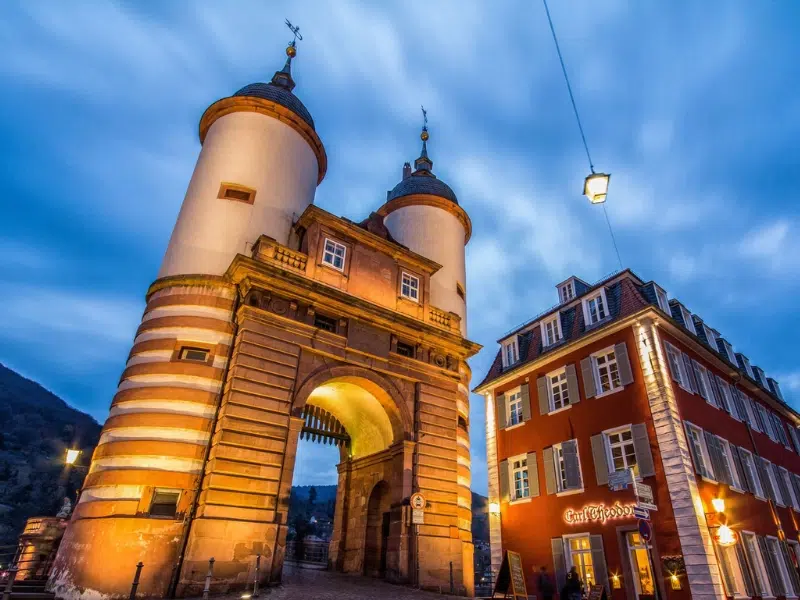
The Old Bridge (Alte Brücke) is the red sandstone bridge that crosses the Neckar from Heidelberg's Old Town to Neuenheim on the north bank. Its official name is the Karl-Theodor-Brücke, after the Elector who had it built in 1786–1788, once an ice flood had wrecked the bridge before it. Many bridges stood on this spot over the centuries; this is the first one built entirely of stone.
The Old Bridge at a glance
- Where: across the Neckar at the bottom of Steingasse, between the Old Town with its Bridge Gate and the Neuenheim bank.
- Built: 1786–1788; three arches were blown up in March 1945, and the rebuilt bridge reopened on 26 July 1947.
- By: commissioned by Elector Karl Theodor of the Palatinate; the two statues on the bridge are by his court sculptor Franz Conrad Linck.
- What it is today: Heidelberg's best-known bridge, about 200 metres long, with nine arches of red Neckar valley sandstone resting on eight piers.
- Time needed: 20–30 minutes to cross, look at the statues and take in the views.
Ice floods, an Elector and a bridge blown up
A bridge here is first recorded in 1284, and for centuries the crossings had wooden roadways, sometimes on stone piers. Ice floes smashed them again and again: in 1288, 1308, 1340, around 1400 and 1470. French troops demolished the bridge in 1689 during the War of the Palatine Succession, and the wooden bridge built later was destroyed by the ice flood of 1784. Elector Karl Theodor then ordered a bridge made entirely of stone. It was finished in 1788, and it only became the 'Old' Bridge in 1877, when a second bridge, today's Theodor-Heuss-Brücke, was built downstream.
On 29 March 1945, in the last days of the war in Heidelberg, retreating German troops blew up all of the city's Neckar bridges. On the Old Bridge three arches and two piers were destroyed. Heidelberg's citizens raised donations, and the rebuilt bridge was reopened on 26 July 1947. The soft sandstone needs constant care: in recent years the city has repaired the piers below the water line and has been restoring the small balconies above them.
What to look for
- The statue of Karl Theodor on the pier nearest the Old Town: the Elector in armour and an ermine cloak, holding a marshal's baton, with four river gods lying at his feet and a Latin dedication dated 1788.
- The statue of Minerva near the Neuenheim bank: the goddess of wisdom leans on her shield above figures of Piety, Justice, Ceres (agriculture) and Mercury (trade), praising the Elector as a patron of all four. Its inscription is dated 1790.
- The Bridge Gate (Brückentor): two round white towers with Baroque helmet roofs, once part of the medieval town wall. The western tower was used as a prison, the other as the home of the bridge keeper.
- The Brückenaffe: the bronze monkey by Gernot Rumpf, set up in 1979 beside the gate. He holds a mirror, and visitors rub it for luck.
- The flood marks on the south-western side of the bridge, recording the Neckar's great floods; the highest one is from the ice flood of 1784.
- The small balconies that jut out above the piers, where you can step aside from the flow of walkers and look along the river.
Why rivers at the Elector's feet?
Karl Theodor ruled the Electoral Palatinate from 1742, and in 1777 he also inherited Bavaria; the next year he moved his court to Munich. So the bridge that carries his name was built while he lived far away. The four river gods on his statue reflect that wider realm: the art historian Helmut Prückner identified them in 1981 as the Rhine, the Danube, the Moselle and the Isar, the river of Munich. Earlier writers had assumed one of them was the Neckar, the river right below. Linck's model of the statue, made of plaster and oak, is kept in the Kurpfälzisches Museum.
Tips for your visit
- Come early in the morning or around sunset, when the bridge is quieter and the low light warms the red sandstone and the castle above.
- For the classic photo of the bridge, the gate and the castle together, walk to the Neuenheim bank and look back, or climb to the Philosophers' Walk.
- The bridge is busy with walkers and cyclists, so step into one of the balconies or to the side before stopping for photos.
- Cross the whole bridge and back: the views upriver and downriver are quite different.
Nearby
- Heidelberg Castle: the red sandstone ruin on the hill above the Old Town, reached on foot or by funicular from Kornmarkt.
- Church of the Holy Spirit (Heiliggeistkirche): the big Gothic church on Marktplatz, a few minutes' walk up Steingasse.
- Philosophers' Walk (Philosophenweg): the hillside path on the north bank, reached by the steep Schlangenweg, with wide views over the river and the Old Town.
- Kornmarkt: the square below the castle, with a Baroque statue of the Virgin Mary and one of the best views up to the ruins.
See Heidelberg with World City Trail
Our Heidelberg scavenger hunt turns the old town into a game you play on your phone. The route links 10 stops and takes around 2 hours, with about 38 minutes of walking. The Bridge Monkey on the Old Bridge is one of the stops, and the route also takes in Bismarckplatz.
If you prefer a different format, there is also a self-guided walking tour and an outdoor escape game in Heidelberg.
Play the Heidelberg scavenger hunt →
Take the self-guided walking tour of Heidelberg →
Play the outdoor escape game in Heidelberg →
Facts checked in October 2026.