
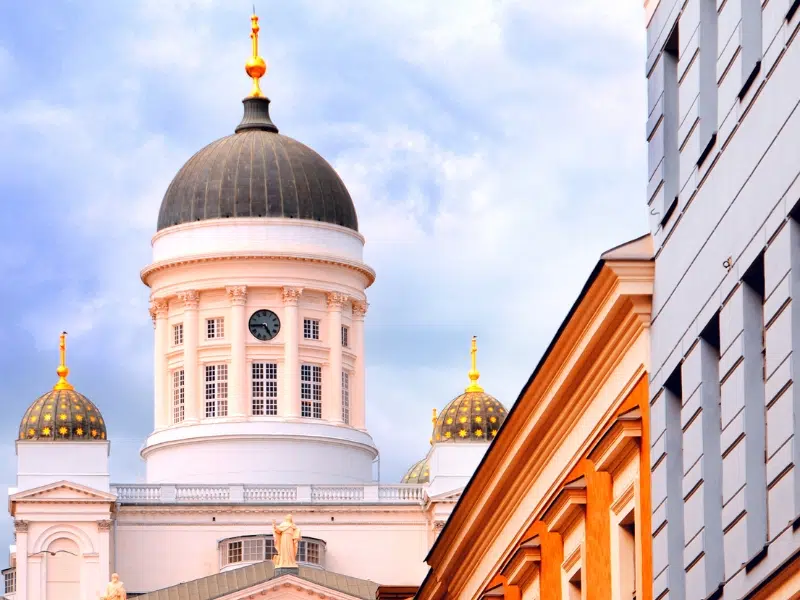
Helsinki Cathedral is the white neoclassical church with the green dome that towers over Senate Square, the city's best-known landmark. It was built as St Nicholas' Church in honour of the Russian emperor Nicholas I, then Grand Duke of Finland, and only took its present name after Finland became independent in 1917.
Helsinki Cathedral at a glance
- Where: on the north side of Senate Square in the Kruununhaka district, at the top of a broad flight of steps.
- Built: 1830–1852, consecrated on 15 February 1852; the exterior was renovated over two years and unveiled again in November 2025.
- By: designed by Carl Ludvig Engel and completed after his death in 1840 by Ernst Lohrmann.
- What it is today: the Evangelical Lutheran cathedral of the Diocese of Helsinki, used for services, concerts and state occasions, with a crypt for exhibitions.
- Time needed: 20 to 30 minutes for the steps, the square and the interior.
From St Nicholas' Church to Helsinki Cathedral
When Helsinki became the capital of the Grand Duchy of Finland in 1812, the Russian rulers set out to give it a monumental centre. In 1814 Alexander I ordered that part of the salt import tax be saved to build two churches, one Lutheran and one Orthodox. The German-born architect Carl Ludvig Engel planned Senate Square as a whole, with the church as its crowning point, on the site of the small 18th-century Ulrika Eleonora Church. Work began in 1830 and the church was consecrated in 1852, twelve years after Engel's death.
Engel's successor Ernst Lohrmann changed the design: he added the four small domes around the main one, echoing St Isaac's and Kazan cathedrals in St Petersburg, built the bell tower and chapel pavilions beside the steps, and placed zinc statues of the Twelve Apostles on the roof in 1849. In June 1917, in the unrest before independence, followers of the anarchist Jean Boldt occupied the church for about 18 hours. After independence it became the Great Church, and in 1959 it was named Helsinki Cathedral.
What to look for
- The twelve zinc apostles on the roofline, larger than life, cast in Berlin in the 1840s; they are easiest to spot from the far side of the square.
- The four identical façades with columns and pediments: the church is a Greek cross, symmetrical in every direction.
- The colour: the so-called White Cathedral is actually painted in three slightly different shades of light grey.
- Inside, the plain Lutheran interior with statues of the Reformers Martin Luther, Philipp Melanchthon and Mikael Agricola, the father of written Finnish.
- The altarpiece of the burial of Christ by Timoleon von Neff, a gift from Emperor Nicholas I, and Engel's pulpit of 1849.
The steps and the square
The broad steps in front of the cathedral are Helsinki's favourite place to sit in summer, and Senate Square below them is the stage for concerts, the New Year's celebrations and the Christmas market. In the middle of the square stands a statue of Emperor Alexander II, put up in 1894; he is still remembered in Finland for restoring the Diet and supporting the Finnish language. Together with the Government Palace on the east side and the University's main building on the west, both by Engel, the cathedral forms one of Europe's most complete neoclassical ensembles.
Tips for your visit
- Climb to the top of the steps for the view down over Senate Square towards the harbour.
- Visit outside service times and keep quiet inside; concerts are a good way to hear the organ.
- Photograph the front from the far side of the square in the morning, when the sun lights the façade.
- Combine it with Uspenski Cathedral and the Market Square, a few minutes' walk east and south.
Nearby
- Senate Square: Engel's neoclassical square with the Government Palace, the University and the statue of Alexander II.
- Uspenski Cathedral: the red-brick Orthodox cathedral on a rock above the harbour, about ten minutes' walk.
- Market Square: the harbourfront market with ferries to Suomenlinna, a few minutes south.
- Esplanadi: the tree-lined park and boulevard leading west from the harbour, with cafés and design shops.
See Helsinki with World City Trail
Our Helsinki scavenger hunt turns the city centre into a game you play on your phone. The route links 11 stops and takes around three hours, with about 53 minutes of walking. Helsinki Cathedral is one of the stops, along with the Finnish National Theatre, the Ateneum and Market Square.
If you prefer a different format, Helsinki also has a self-guided walking tour and an outdoor escape game.
Play the Helsinki scavenger hunt →
Take the self-guided walking tour of Helsinki →
Play the outdoor escape game in Helsinki →
Facts checked in October 2026.