
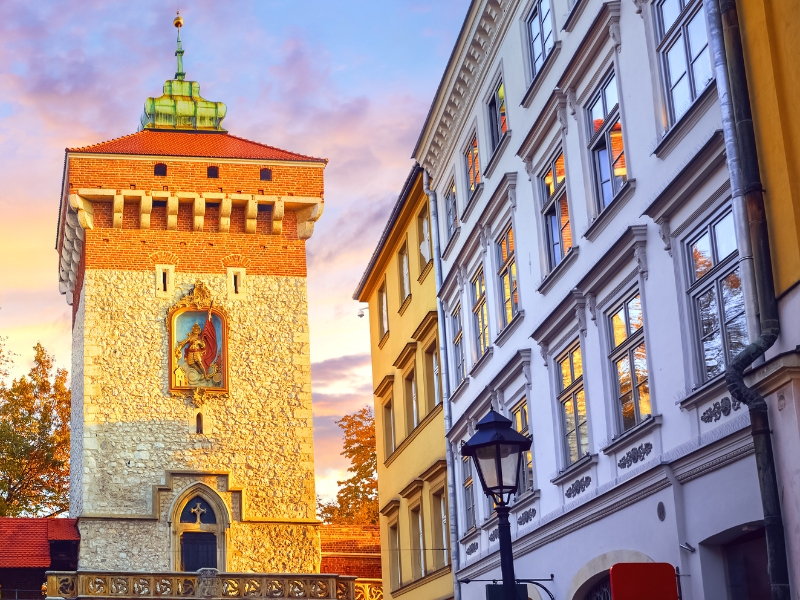
St Florian's Gate is the Gothic tower gate at the northern end of Kraków's Old Town, where Floriańska Street begins its run to the Main Market Square. Kraków once had eight city gates; this is the only one still standing, saved in 1817 when the rest of the walls were pulled down.
St Florian's Gate at a glance
- Where: at the north end of ulica Floriańska, between the Old Town and the Planty park, facing the Barbican.
- Built: first mentioned in 1307, as part of the walls raised after the Tatar attack of 1241; the Baroque roof dates from 1660.
- Height: about 33.5 metres, plus roughly another metre for the metal roof.
- What it is today: a city gate you walk through, part of the Defensive Walls route of the Museum of Kraków, with surviving towers and a stretch of wall on either side.
- Time needed: 10 minutes to walk through and look at both faces, around an hour if you visit the walls and the Barbican.
From city defence to saved monument
After the Tatars devastated Kraków in 1241, the city was rebuilt and fortified. In 1285 Prince Leszek the Black allowed the townspeople to build stone walls with towers, gates and a moat, and St Florian's Gate became the main entrance into the Old Town. Defending it was the duty of the furriers' guild, and at the height of the system Kraków's walls had 47 towers and 8 gates. Around 1498 the round brick Barbican was added in front of the gate, linked to it by a passage across the moat.
By the early 19th century the walls were crumbling and the moat had become a stinking ditch, and the Austrian authorities ordered the fortifications to be demolished. On 13 January 1817 Professor Feliks Radwański of the Jagiellonian University persuaded the Senate of the Free City of Kraków to keep St Florian's Gate, a short section of wall and the Barbican. The moat was filled in and turned into the Planty, the green belt that now rings the Old Town.
What to look for
- The bas-relief of St Florian on the side facing Floriańska Street, from the 18th century. Florian is the patron saint of firefighters and is often shown pouring water on a burning building.
- The stone eagle on the outer face towards the Barbican, carved in 1882 by Zygmunt Langman to a design by the painter Jan Matejko.
- The small altar inside the passage with a copy of a painting of the Virgin Mary; people still stop here for a moment of prayer.
- The surviving towers on either side, including the Haberdashers', Joiners' and Carpenters' Towers, each named after the guild that defended it.
- The open-air gallery along the wall, where artists hang paintings and prints of Kraków for sale.
The start of the Royal Route
St Florian's Gate is the starting point of the Royal Route. Kings, foreign envoys and coronation processions entered the city here, rode down Floriańska Street to the Main Market Square and continued along Grodzka Street to Wawel Castle. The route is still the classic walk through Kraków, and standing in the gate you can see straight down Floriańska towards the towers of St Mary's Basilica.
Tips for your visit
- Look back from inside the Old Town: the view of the gate closing the end of Floriańska Street is the best one.
- Come early in the morning if you want photos without crowds; Floriańska Street fills up quickly during the day.
- Visit the walls, the Barbican and the gate as one stop; the Defensive Walls route lets you walk along the top of the surviving stretch.
- Keep walking straight on along Floriańska to reach the Main Market Square in a few minutes.
Nearby
- The Barbican: the round brick fortress just outside the gate, one of the best-preserved barbicans in Europe.
- Church of St Florian: the Baroque church a short walk north, on Plac Matejki, from which the gate takes its name.
- Jan Matejko House: the painter's birthplace on Floriańska Street, now a museum.
See Kraków with World City Trail
Our Kraków scavenger hunt turns the old town into a game you play on your phone. The route links 11 stops and takes around 3 hours, with about 47 minutes of walking. St Florian's Gate is one of the stops, together with the Town Hall Tower, the Cloth Hall and St Mary's Basilica. You can play in English, German, French, Italian, Spanish, Dutch and Polish.
If you prefer a different format, Kraków also has a self-guided walking tour and an outdoor escape game.
Play the Kraków scavenger hunt →
Take the self-guided walking tour of Kraków →
Play the outdoor escape game in Kraków →
Facts checked in October 2026.