
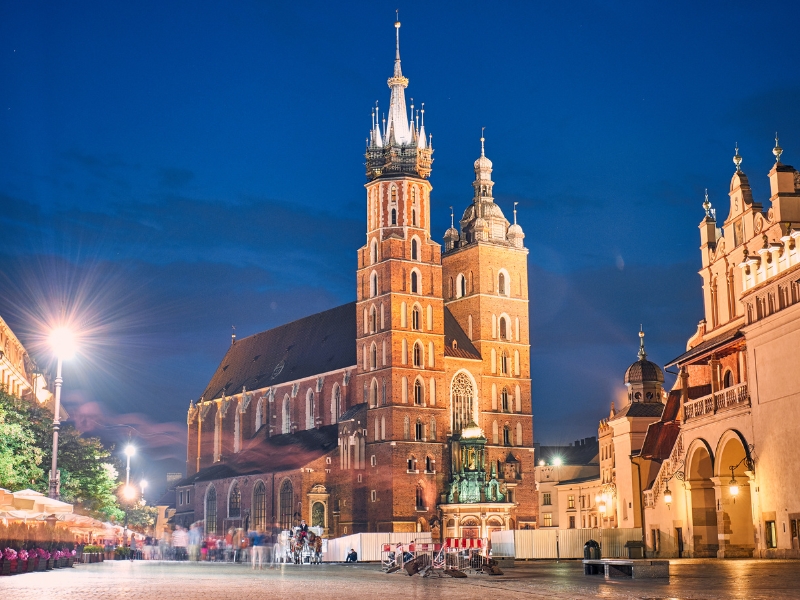
St Mary's Basilica is the brick Gothic church at the north-eastern corner of Kraków's Main Market Square, the one with two unequal towers. Every hour a trumpeter plays the hejnał from the taller tower and stops abruptly in the middle of the tune. Inside is the largest Gothic altarpiece in the world, carved by Veit Stoss.
St Mary's Basilica at a glance
- Where: Plac Mariacki, at the north-eastern corner of the Main Market Square in the Old Town.
- Built: the present church mainly between about 1290 and 1400, on the foundations of a church founded in 1221–22; the main altar dates from 1477–1489.
- By: the altarpiece is by the sculptor Veit Stoss (Wit Stwosz); the 19th-century wall paintings were designed by Jan Matejko.
- What it is today: a working Catholic parish church and minor basilica, part of the Historic Centre of Kraków UNESCO World Heritage Site since 1978.
- Time needed: 30 to 45 minutes inside, plus about an hour if you climb the tower.
From burghers' church to national symbol
According to the chronicler Jan Długosz, Bishop Iwo Odrowąż founded the first stone church here in 1221–22. It was destroyed during the Mongol invasions, and a new Gothic church rose on its foundations at the end of the 13th century. Under King Casimir the Great the presbytery was rebuilt with money from the wealthy burgher Mikołaj Wierzynek, and side chapels were added in the 15th century. The northern tower was raised to serve as the city's watchtower, and in 1478 it received its pointed Gothic spire; the gilded crown on top was added in 1666.
For a long time this was the church of Kraków's German-speaking merchants, until a royal edict of 1537 pushed sermons towards Polish. The interior was redone in the Baroque style in the 18th century and then restyled again in 1887–1891, when Jan Matejko designed the painted walls and his students Stanisław Wyspiański and Józef Mehoffer made stained glass for the presbytery. During the Second World War the Germans dismantled Veit Stoss's altar and shipped it to the Reich; it was found in Nuremberg, returned in 1946 and reassembled in 1957.
What to look for
- The two towers: the taller Hejnalica is 82 metres high and topped by the 1666 gilded crown; the lower bell tower, 69 metres, has a late-Renaissance dome from 1592.
- The trumpeter's window: the hejnał is played from a height of about 54 metres, four times each hour, once towards each side of the world. Look up and you may see the trumpeter wave.
- The Veit Stoss altarpiece: about 13 metres high and 11 metres wide when open, with figures 2.7 metres tall carved from lime wood. The centre shows the Dormition of Mary among the twelve apostles.
- The ceiling and walls: a deep blue vault scattered with gold stars, and the dense painted patterns of Matejko's 1890s scheme.
- The stained glass in the presbytery behind the altar, partly by Wyspiański and Mehoffer, two of the leading artists of Young Poland.
The trumpeter and the two brothers
Legend says a watchman on the tower spotted invading Mongols in the 13th century and sounded the alarm until an arrow pierced his throat, which is why the hejnał still breaks off mid-note. The story is not documented in old sources; it was popularised by a 1928 American novel, The Trumpeter of Krakow. Another legend explains the unequal towers: two brothers each built one, and the elder, jealous of his younger brother's taller tower, stabbed him. The knife is said to hang in the passage of the Cloth Hall across the square.
Tips for your visit
- Stand on the square just before the full hour to hear the hejnał; the noon call is also broadcast live on Polish Radio.
- Visitors enter through the side door on Plac Mariacki; the main door is reserved for people coming to pray.
- Dress modestly, keep your voice down and stay out of the way during Mass.
- The tower is usually open for climbs in the warmer months; the stairs are steep, so check before you go.
Nearby
- Cloth Hall: the long Renaissance market hall in the middle of the square, with its souvenir stalls and the legendary knife.
- Town Hall Tower: the only surviving part of the old town hall, a short walk across the square.
- St Barbara's Church: the small church right on Plac Mariacki, where the German community moved its services in the 16th century.
- St Florian's Gate: the medieval city gate at the end of Floriańska Street, a few minutes' walk north.
See Kraków with World City Trail
Our Kraków scavenger hunt turns the old town into a game you play on your phone. The route links 11 stops and takes around three hours, with about 47 minutes of walking. St Mary's Basilica is one of the stops, along with the Town Hall Tower, the Cloth Hall and St Florian's Gate. You can play in English, German, French, Italian, Spanish, Dutch or Polish.
If you prefer a different format, Kraków also has a self-guided walking tour and an outdoor escape game.
Play the Kraków scavenger hunt →
Take the self-guided walking tour of Kraków →
Play the outdoor escape game in Kraków →
Facts checked in October 2026.