
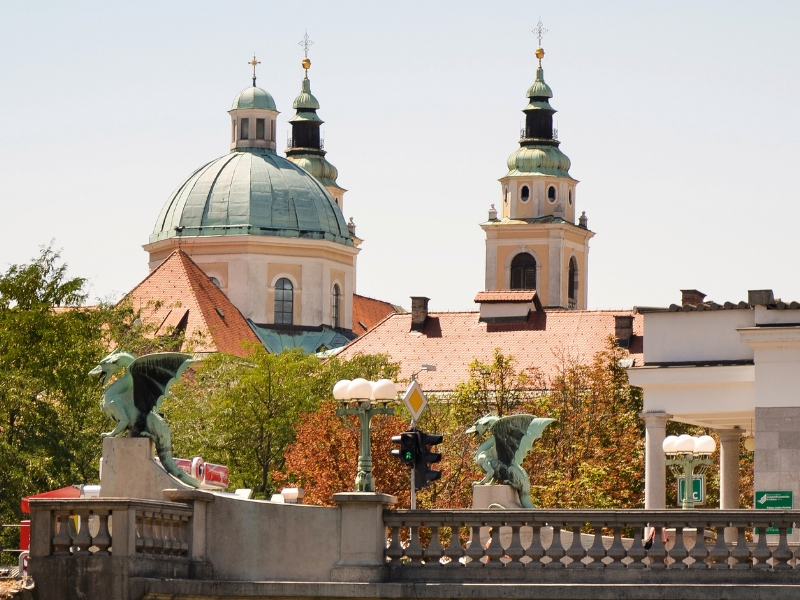
Ljubljana Cathedral, officially the Cathedral of St Nicholas, is the Baroque church with two towers and a green dome on Ciril-Metodov trg, beside the Central Market. It was rebuilt between 1701 and 1706 to a plan revised by the Jesuit architect Andrea Pozzo, and its interior is covered in frescoes by Giulio Quaglio. Before you even step inside, the two bronze doors added in 1996 tell the history of the Slovenes in relief.
Ljubljana Cathedral at a glance
- Where: Ciril-Metodov trg, on the east bank of the Ljubljanica in the Old Town, between the Central Market and the Town Hall.
- Built: 1701–1706 in its present Baroque form; consecrated on 8 May 1707. The dome was added in 1841.
- By: a plan revised by Andrea Pozzo, adapted by the builders on site; frescoes by Giulio Quaglio.
- What it is today: the cathedral of the Archdiocese of Ljubljana and a working parish church.
- Time needed: 20–30 minutes inside and around the outside.
From a Romanesque church to a Baroque cathedral
A church has stood here since at least 1262, when a Romanesque church on the site is first mentioned. After a fire in 1361 it was rebuilt in Gothic style, and when the Diocese of Ljubljana was founded in 1461 it became a cathedral. It burned again in 1469. In 1700 a Capuchin friar drew up plans for a new Baroque church, at the initiative of the dean Johann Gregor Thalnitscher and the city's learned society, the Academia Operosorum.
In 1701 Andrea Pozzo, the Jesuit painter and architect famous in Rome, revised the plan into a basilica with a dome. He never supervised the work, and the builders changed his design considerably. The church was finished in 1706 and consecrated in 1707. Giulio Quaglio painted the frescoes in two campaigns, in 1703–1706 and 1721–1723, and the sculptor Francesco Robba added angels to the altars in the 1740s. In 1996, for the 1,250th anniversary of Christianity in Slovenia and a visit by Pope John Paul II, the church received its two bronze doors.
What to look for
- The Slovene Door: the main bronze door, with reliefs by Tone Demšar showing scenes from Slovene history.
- The Ljubljana Door: the side door, by Mirsad Begić, with the faces of 20th-century bishops of Ljubljana emerging from the bronze.
- The frescoes: Quaglio's paintings cover the vaults of the nave and the chapels; look up as soon as you come in.
- The dome: the octagonal dome over the crossing, painted inside by Matevž Langus in 1843–1844.
- Robba's angels: the marble angels by Francesco Robba on the altars to the left of the nave.
- The south façade: a sundial of 1826 with the Latin motto 'Nescitis diem neque horam' ('You know neither the day nor the hour'), a copy of a Gothic pietà from the older cathedral, and Roman tombstones set into the walls.
A dome that was only painted
For more than a century the cathedral had no real dome. Pozzo's plan included one, but until 1841 the crossing was covered by a painted dome, an illusion on a flat ceiling. That is a fitting twist: Pozzo himself was famous for exactly this trick, having painted a fake dome on the flat ceiling of the church of Sant'Ignazio in Rome. The real cupola you see today, and Langus's paintings inside it, date from the 1840s.
Tips for your visit
- Come in the morning, when the Central Market next door is busy and the light falls on the south façade with the sundial.
- Walk around the outside before going in: the doors, the sundial and the Roman stones are easy to miss from the front.
- It is a working church: dress respectfully, avoid visiting during Mass and keep your voice down.
- Combine the visit with the market and the river: the Dragon Bridge and the Butchers' Bridge are only a few minutes away.
Nearby
- Central Market: the open-air market and the long riverside colonnade designed by Jože Plečnik, right next to the cathedral.
- Dragon Bridge: the 1901 bridge over the Ljubljanica guarded by four bronze dragons, the symbol of the city, a short walk east.
- Town Hall and Robba Fountain: the Town Hall on Mestni trg and, in front of it, a copy of Robba's Fountain of the Three Carniolan Rivers; the original is in the National Gallery.
- Ljubljana Castle funicular: the funicular from Krekov trg, a few minutes' walk away, takes you up to the castle for views over the old town.
See Ljubljana with World City Trail
Our Ljubljana scavenger hunt turns the old town into a game you play on your phone. The route links 10 stops and takes around 2 hours, with about 27 minutes of walking. It includes the Dragon Bridge, a few minutes from the cathedral, as well as the Franciscan Church and the Ursuline Church.
If you prefer a different format, there is also a self-guided walking tour and an outdoor escape game in Ljubljana.
Play the Ljubljana scavenger hunt →
Take the self-guided walking tour of Ljubljana →
Play the outdoor escape game in Ljubljana →
Facts checked in October 2026.