
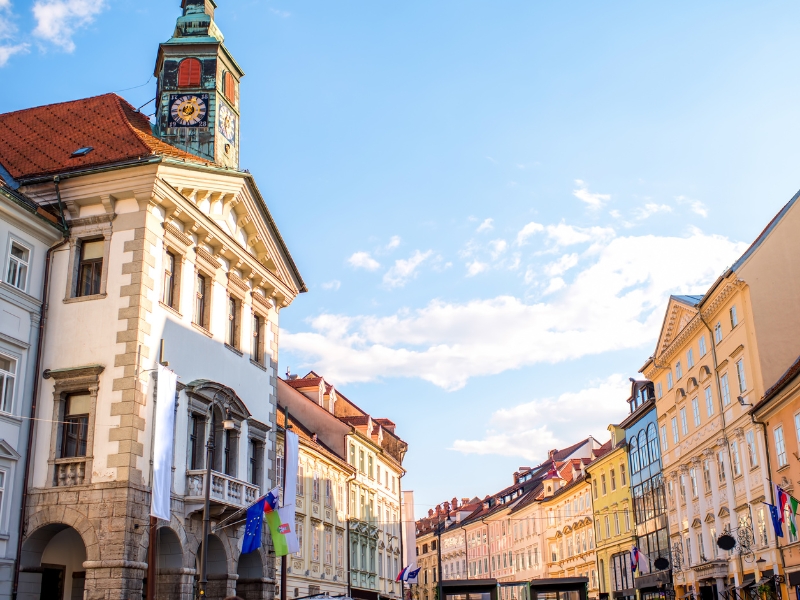
Ljubljana Town Hall, known locally as the Magistrat or Rotovž, stands on Mestni trg, the Town Square at the foot of the castle hill, and is still the seat of the city government. Its Baroque front, with an arcaded loggia and a small clock tower, dates from a rebuilding in 1717–1719 inspired by Venetian architecture. Look up at the tower: the weather vane on top is a dragon, the symbol of Ljubljana.
Ljubljana Town Hall at a glance
- Where: Mestni trg 1, in the old town between the Triple Bridge and the cathedral, below Ljubljana Castle.
- Built: first in 1484 in Gothic style; rebuilt in Baroque style between 1717 and 1719.
- By: the builder Gregor Maček the Elder, partly following plans by the Italian architect Carlo Martinuzzi.
- What it is today: the seat of the City Municipality of Ljubljana, with the Robba Fountain in front.
- Time needed: 15–20 minutes for the façade, the fountain and a look into the courtyard.
From Gothic Rotovž to Baroque Magistrat
Medieval Ljubljana was run by a council of twelve citizens, and its meeting house was called the Rathaus in German, which became Rotovž in Slovene. A new town hall was built on this site in 1484, probably to plans by the Carniolan builder Peter Bezlaj. It was a long, narrow building leaning against the castle hill, with an open ground floor for public gatherings and a council and court room upstairs. Two statues of Adam and Eve that once decorated its front are now kept in the City Museum of Ljubljana.
In 1717 the council decided to replace it. Gregor Maček the Elder built the new town hall, combining his own design for the gable front, the loggia and the three-flight staircase with plans by Carlo Martinuzzi, and the council held its first meeting there on 22 February 1719. Two neighbouring houses were added later and joined to the town hall in 1895, and a new council chamber opened in 1898 for Emperor Franz Joseph's 50 years on the throne. In the 1920s a monument by Jože Plečnik to King Peter I stood at the entrance; the Italian occupation authorities destroyed it in 1941.
What to look for
- The Baroque façade with its arcaded loggia at street level, in a style inspired by Venetian palaces.
- The small five-sided clock tower on massive pillars, with a clock bearing the years 1718 and 1928.
- The gilded globe in the tower that shows the phases of the moon, and the dragon weather vane on top.
- The arcaded inner courtyard with sgraffito decoration and Francesco Robba's Narcissus Fountain, brought here from Bokalce Castle.
- The Robba Fountain in front of the building, a copy of the 1751 original that is now kept in the National Gallery.
Pillory and fool's cage
In the Middle Ages, justice was done in public in front of the town hall. A pillory and a cage for drunkards and troublemakers stood here, and a wooden donkey that disobedient night watchmen had to ride. Bakers caught cheating on the weight of their bread were dunked in the water. Today the square is calm, lined with cafés and shops, but the town hall is still where the city's decisions are made.
Tips for your visit
- If the main door is open, step into the courtyard: the arcades and the Narcissus Fountain are easy to miss from the street.
- Stand by the Robba Fountain for the best view of the façade and the clock tower together.
- Come in the early morning, before the tour groups gather on Mestni trg, for a quiet photo.
- Combine the town hall with a walk along the river and up to the castle, which you can reach on foot or by funicular from nearby.
Nearby
- Robba Fountain: the Fountain of the Three Carniolan Rivers, right in front of the town hall.
- Ljubljana Cathedral: St Nicholas's Cathedral with its bronze doors, a couple of minutes' walk along the square.
- Triple Bridge: Plečnik's three bridges over the Ljubljanica, a few minutes north.
- Ljubljana Castle: the hilltop castle above the old town, with views over the city and, on clear days, the Alps.
See Ljubljana with World City Trail
Our Ljubljana scavenger hunt turns the old town into a game you play on your phone. The route links 10 stops and takes around 2 hours, with about 27 minutes of walking. It includes the Ursuline Church, the Dragon Bridge and the Franciscan Church.
If you prefer a different format, there is also a self-guided walking tour and an outdoor escape game in Ljubljana.
Play the Ljubljana scavenger hunt →
Take the self-guided walking tour of Ljubljana →
Play the outdoor escape game in Ljubljana →
Facts checked in October 2026.