
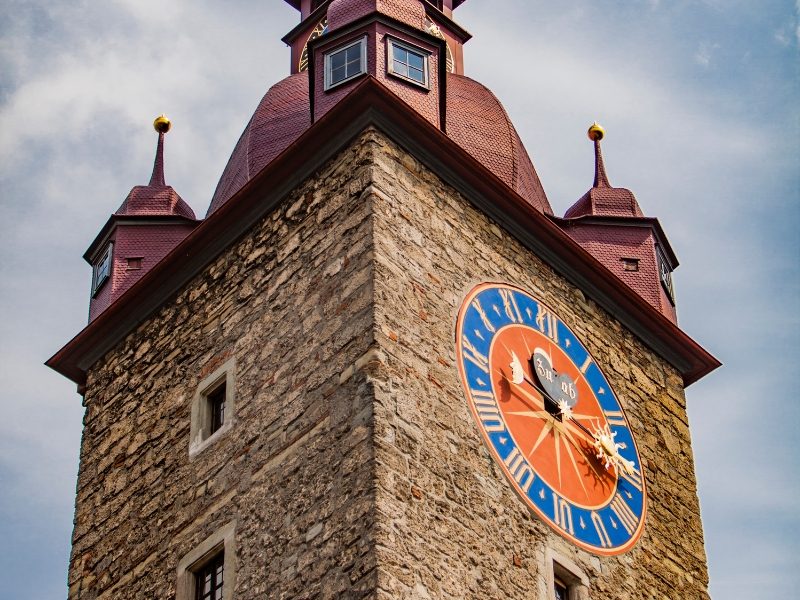
Lucerne's Rathaus, the town hall on the Kornmarkt, rises straight from the bank of the River Reuss in the old town. It was built between 1602 and 1606 as a Renaissance palace in the Italian style, yet it wears a broad, low roof of the kind you would expect on a Bernese farmhouse. That odd pairing of southern stonework and Swiss country roof is the first thing to look for.
Lucerne Town Hall at a glance
- Where: on the Kornmarkt, the old grain market square, on the old-town bank of the Reuss, a few minutes from the Chapel Bridge.
- Built: 1602 to 1606, joined to an older medieval tower.
- By: the Italian master builder Anton Isenmann, who designed and built it.
- What it is today: a protected monument that still houses the city parliament's chamber, while the ground-floor hall is used for exhibitions and concerts.
- Time needed: 10 to 15 minutes outside, longer if there is an exhibition in the ground-floor hall or a market on the quay.
From grain hall to council chamber
The town hall went up at the beginning of the 17th century, when Lucerne was one of the leading Catholic cities of the Swiss Confederation and wanted a seat of government to match. Anton Isenmann gave it stone walls and window frames in the manner of an Italian Renaissance palace, but he chose a wide, overhanging roof of the Bernese farmhouse type, which protects the building from wind and weather. The result looks both southern and very Swiss at the same time.
The ground floor, called the Kornschütte, began as a trading hall for grain, which is why the square outside is still the Kornmarkt. Upstairs, the council chamber keeps its coffered ceiling, wood panelling, an 18th-century stove and two large paintings by Melchior Wyrsch and Josef Reinhart. The Tagsatzung Room, fitted out by Josef Singer in Empire style, is now used mainly for civil weddings. The medieval tower next to the hall was once a family tower; its top floor holds the old chancellery of Renward Cysat, the town clerk and chronicler, and a baroque New Chancellery links tower and hall.
What to look for
- The roof: compare the dressed stone of the Renaissance walls with the wide, low farmhouse-style roof sitting on top of them.
- The tower: the older medieval tower attached to the hall, with the old chancellery on its top floor.
- The river front: from the footbridge across the Reuss you see the whole building rising directly from the water's edge.
- The dovecote: two small openings in the roof lead to a dovecote set up in the attic in 2003 as a home for the city's pigeons; you can spot them from the footbridge.
- The Kornschütte: if the doors are open, step into the former grain hall on the ground floor, which now hosts exhibitions and concerts.
Market mornings by the river
The town hall is also the anchor of Lucerne's weekly market. On Tuesday and Saturday mornings, stalls with vegetables, cheese, bread and flowers line the Rathausquai along the river in front of the building and spread into the surrounding streets and squares. It is the best time to see the riverside the way locals use it, and a good moment to buy a picnic before heading to the lake.
Tips for your visit
- Come on a Tuesday or Saturday morning to see the market at its liveliest in front of the building.
- For the classic photo of the town hall and the old-town riverfront, cross to the opposite bank or stand on the Chapel Bridge.
- The council chamber and wedding room are working rooms and usually closed to visitors, so enjoy the building from outside and the Kornschütte when an event is on.
- Walk round behind the town hall to the Weinmarkt and Hirschenplatz, two squares lined with painted house fronts.
Nearby
- Chapel Bridge: the 14th-century covered wooden bridge with its octagonal Water Tower, a few minutes' walk along the river.
- Jesuit Church: one of the first large baroque churches in Switzerland, directly across the Reuss.
- Spreuer Bridge: Lucerne's second covered wooden bridge, with a cycle of dance-of-death paintings under its roof.
- Weinmarkt: a small square of painted guild houses with a fountain, just behind the town hall.
See Lucerne with World City Trail
Our Lucerne scavenger hunt turns the old town into a game you play on your phone. The route links 10 stops and takes around 3 hours, with about 59 minutes of walking, and it includes places such as the Jesuit Church, the Spreuer Bridge and the Nölli Tower on the Musegg Wall. You can play in English, German, French, Italian, Spanish, Dutch and Chinese.
If you prefer a different format, Lucerne also has a self-guided walking tour and an outdoor escape game.
Play the Lucerne scavenger hunt →
Take the self-guided walking tour of Lucerne →
Play the outdoor escape game in Lucerne →
Facts checked in October 2026.