
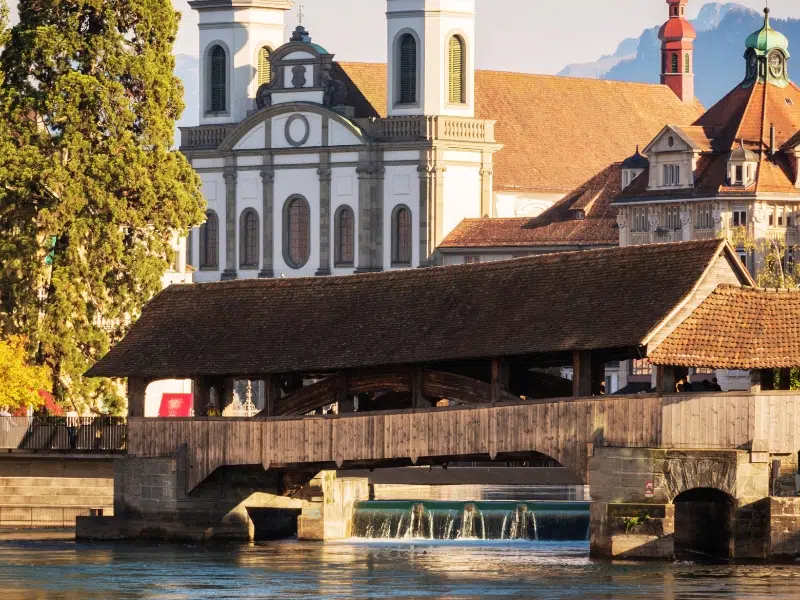
The Spreuer Bridge (Spreuerbrücke) is the smaller and quieter of Lucerne's two surviving covered wooden bridges, crossing the river Reuss at the western edge of the old town. Under its roof hangs a cycle of 17th-century paintings of the Dance of Death, in which a skeleton visits people of every rank. Its name comes from Spreu, chaff: this was the only bridge from which the millers were allowed to throw chaff into the river.
The Spreuer Bridge at a glance
- Where: across the Reuss between Mühlenplatz in the old town and the Kasernenplatz side, downstream from the Chapel Bridge.
- Built: a first bridge in the 13th century, completed to the left bank around 1408; largely rebuilt after a flood in 1566, with further rebuilding of the northern part in 1591 and 1803.
- What it is today: a covered footbridge and protected monument of national importance, with 45 of its original 67 painted panels still in place.
- Time needed: 15 to 20 minutes to cross slowly and look at the paintings.
From the mill bridge to a painted gallery
In the Middle Ages, mills stood in the middle of the Reuss, and the first bridge here led from Mühlenplatz, the mill square, out to them. Around 1408 it was extended to the opposite bank. Because it was the furthest bridge downstream, it was the only one where chaff and leaves could be thrown into the river without drifting past the rest of the town; hence the name, which replaced the older Mühlenbrücke, mill bridge.
A flood in 1566 destroyed most of the bridge. It was rebuilt together with a granary at its southern end, known as the Herrenkeller, and the northern section followed in 1591. Between about 1616 and 1637 the painter Kaspar Meglinger and his workshop created the Dance of Death cycle for the triangular gables under the roof, paid for by Lucerne families. In 1803 the carpenter Joseph Ritter built a new northern section on wooden arches, where the Mühlenplatz power station stands today.
What to look for
- The painted triangular panels under the roof, each showing death as a skeleton calling on someone: a pope, a merchant, a farmer, a child.
- The coats of arms on each panel, usually the donor's at lower left and his wife's at lower right, and the verses on the black frames.
- The small chapel in the middle of the bridge, dedicated to the Virgin Mary.
- The wooden structure itself, with its trusses and the change of style between the older southern part and the 1803 northern section.
- The needle dam just upstream, a 19th-century weir of wooden needles used to regulate the level of the lake.
Why a Dance of Death on a bridge?
The Dance of Death was a popular theme in late medieval and early modern Europe: death comes for everyone, rich or poor, and no one knows the hour. Meglinger's painters knew the famous woodcuts of Hans Holbein the Younger, but filled their scenes with Lucerne people and places, so many panels are also portraits of the city's leading families. With 67 panels originally, it is considered the largest Dance of Death cycle known. Crossing the bridge was meant as a daily reminder to live well.
Tips for your visit
- Walk across slowly and look up: the paintings are above your head and easy to miss if you hurry.
- Come early in the morning for a quiet bridge, or in late afternoon when the light comes in low from the side.
- Combine it with the Chapel Bridge for a short loop along the Reuss on both banks.
- For a view of the whole bridge with the Musegg Wall behind it, stand on the riverbank downstream.
Nearby
- Musegg Wall and the Nölli tower: the medieval town wall with nine towers, a few minutes uphill from the north end of the bridge.
- Historical Museum and Nature Museum: two city museums right by the southern end of the bridge.
- Jesuit Church: the Baroque church on the left bank of the Reuss, a short walk upstream.
- Chapel Bridge and the Water Tower: Lucerne's longer and more famous covered bridge, further upstream.
See Lucerne with World City Trail
Our Lucerne scavenger hunt turns the city into a game you play on your phone. The route links 10 stops and takes around three hours, with about 59 minutes of walking. The Spreuer Bridge is one of the stops, and the route also includes the Jesuit Church and the Nölli tower on the Musegg Wall. You can play in English, German, French, Italian, Spanish, Dutch and Chinese.
If you prefer a different format, Lucerne also has a self-guided walking tour and an outdoor escape game.
Play the Lucerne scavenger hunt →
Take the self-guided walking tour of Lucerne →
Play the outdoor escape game in Lucerne →
Facts checked in October 2026.