
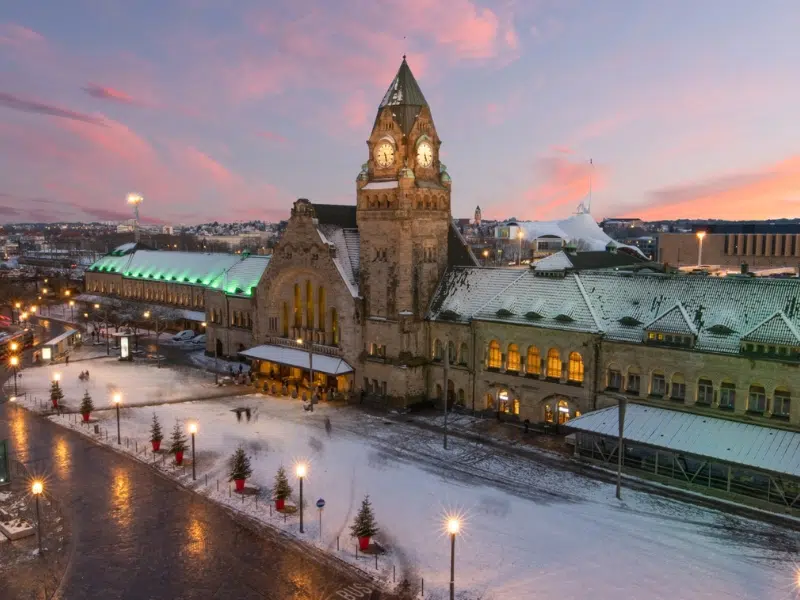
Metz-Ville station is not what most people expect from a French railway station: a 350-metre-long grey stone building that looks like a cross between a Romanesque church and an imperial palace. It was built between 1905 and 1908, when Metz belonged to the German Empire, as the centrepiece of a new German district meant to stamp the Kaiser's mark on the city. It still works as the main station, and it is also a protected historic monument.
Gare de Metz at a glance
- Where: Place du Général de Gaulle, at the southern edge of the city centre, in the Imperial Quarter (Quartier Impérial).
- Built: 1905 to 1908, opened in 1908; listed as a historic monument since 1975.
- By: the German architect Jürgen Kröger, with the architects Jürgensen and Bachmann and the sculptor Schirmer.
- What it is today: the main station of Metz, served by TGV and regional trains, with its facade, departure hall, honour lounge and former restaurant protected.
- Time needed: 15 to 20 minutes to look at the outside and the departure hall.
A station built to make a point
After the Franco-Prussian War of 1870–71, Metz and the Moselle were annexed to the German Empire. Around 1900 the old fortifications were pulled down, and the authorities planned a new district south of the old town, with wide avenues and grand public buildings in German styles. The station was its cornerstone. Kaiser Wilhelm II took a close interest, and the story goes that he sketched the clock tower himself. The building was also designed with troop movements in mind, with long platforms and large halls that could handle soldiers and horses.
Kröger chose a neo-Romanesque style that recalls the churches and palaces of the medieval Holy Roman Empire, and built it in pale grey sandstone from Niderviller, which stands out against the yellow Jaumont limestone of old Metz. Because the ground was marshy, the station and its water tower stand on more than 3,000 reinforced-concrete piles. The departure hall is shaped like a church, with a 40-metre clock tower, while the arrivals side resembles a palace, a deliberate image of spiritual and worldly power. The Kaiser's private apartments in the building were later turned into railway offices.
What to look for
- The clock tower: about 40 metres high, rising over the departure hall like a church bell tower.
- The Roland statue: a stone knight at the corner of the clock tower, a traditional symbol of imperial protection over a city.
- The Charlemagne window: inside the main hall, a stained-glass window shows the emperor Charlemagne on his throne.
- The carved details: capitals, grotesque heads and animals around the doors and windows, in the style of Romanesque church sculpture.
- The grey stone: compare the cool grey of the station with the warm yellow stone of the cathedral and old town.
The Imperial Quarter
The station is the best starting point for exploring the Imperial Quarter, one of the largest ensembles of early 20th-century German architecture in France. Walk along Avenue Foch to see grand villas and apartment blocks in a mix of neo-Romanesque, neo-Renaissance and Art Nouveau styles, and look for the former imperial post office just north of the station, built in the same grey sandstone. Together with the medieval centre, the district is on France's tentative list for UNESCO World Heritage status.
Tips for your visit
- Look at the facade from the far side of the square to see the full 350-metre length and the clock tower together.
- Step into the departure hall, which is open to everyone, to see the vaulted interior and the stained glass.
- Late afternoon light brings out the carved details on the grey stone best.
Nearby
- Centre Pompidou-Metz: the modern art museum with its striking woven roof, a few minutes' walk behind the station.
- Avenue Foch: the broad avenue of the Imperial Quarter, lined with villas from the German period.
- Porte Serpenoise: a reconstructed city gate in a park on the way from the station to the old town.
See Metz with World City Trail
Our Metz scavenger hunt turns the old town into a game you play on your phone. The route links 10 stops and takes around 2 hours, with about 47 minutes of walking, and it includes places such as the Cathedral of Saint-Étienne, the Temple Neuf and the Porte des Allemands.
If you prefer a different format, Metz also has a self-guided walking tour and an outdoor escape game.
Play the Metz scavenger hunt →
Take the self-guided walking tour of Metz →
Play the outdoor escape game in Metz →
Facts checked in October 2026.