
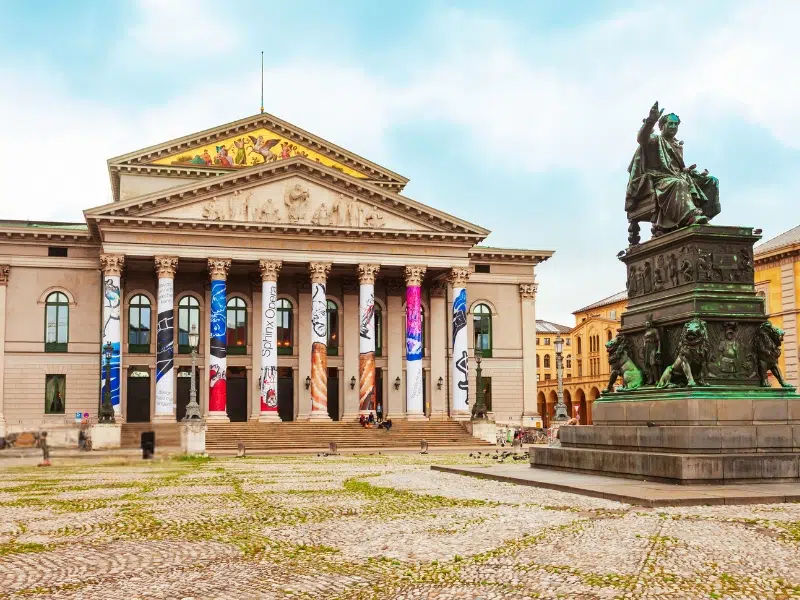
Max-Joseph-Platz is the grand square in front of Munich's National Theatre, home of the Bavarian State Opera, with the long Königsbau wing of the Residenz palace along its north side. It was laid out in the early 19th century by Leo von Klenze, who took inspiration from squares in Rome and Florence. In the middle sits a bronze of King Maximilian I Joseph, the first king of Bavaria, who famously did not want to be shown sitting down.
Max-Joseph-Platz at a glance
- Where: in the north-east of Munich's old town, just south of the Residenz and at the western end of Maximilianstraße.
- Created: from 1802, when a Franciscan monastery was demolished to make room for the National Theatre (opened 1818); the Königsbau followed in 1825–1842.
- By: the square's design is by Leo von Klenze; the theatre was begun by Karl von Fischer; the king's statue is by Christian Daniel Rauch.
- What it is today: Munich's most formal square, used for opera-goers, events and art installations, redesigned in 2025 with lawns around the monument.
- Time needed: 15 to 20 minutes for the square; much longer if you visit the Residenz or see a performance.
From a monastery to a royal stage
The square owes its existence to the theatre. In 1802 the Franciscan monastery on the site was pulled down, and in 1811 Karl von Fischer began the National Theatre, modelled on the Odéon in Paris, which opened in 1818. Under King Ludwig I, Leo von Klenze gave the square its final shape: between 1825 and 1842 he built the Königsbau of the Residenz on the north side, inspired by the Palazzo Pitti and Palazzo Rucellai in Florence, and gave the Rococo Palais Toerring-Jettenbach on the south side a Florentine arcade modelled on the Ospedale degli Innocenti.
The Second World War left the theatre burned out and the surrounding buildings badly damaged. The theatre was rebuilt, and a modern Residenz Theatre replaced the old Cuvilliés Theatre, whose Rococo interior had been saved and was later reinstalled elsewhere in the Residenz. In 1963–1964 an underground car park was built beneath the square, removing the last remains of the old monastery and its cemetery. In 2025 the bumpy cobbles were replaced by lawns and gravel paths radiating from the statue, based on a plan from 1825.
What to look for
- The National Theatre's portico of Corinthian columns, the classic image of the Bavarian State Opera.
- The Königsbau of the Residenz, with its long Renaissance-style façade inspired by Florentine palaces.
- The arcades of the Palais Toerring-Jettenbach on the south side, copied from Brunelleschi's Ospedale degli Innocenti in Florence.
- The Max Joseph monument: the king on his throne, by Christian Daniel Rauch, on a base designed by Klenze.
- The Renaissance arcaded courtyard at Residenzstraße 13 on the west side, built around 1560 and the best-preserved of its kind in old Munich.
The king who would not sit
Maximilian I Joseph became the first king of Bavaria in 1806. A seated statue was planned during his lifetime, but the king refused to be immortalised sitting down, so the monument was only put up in 1835, ten years after his death. Today he sits on his throne after all, in the middle of the square named after him, a few steps from the Residenz where he lived.
Tips for your visit
- Come in the early evening before a performance, when opera-goers gather on the theatre steps and the façades are lit up.
- Climb the theatre steps for the best overview of the square and the Königsbau.
- Walk east along Maximilianstraße afterwards to see Munich's grand 19th-century boulevard and its luxury shops.
Nearby
- Residenz: the former royal palace of the Wittelsbachs, with its museum, treasury and the Cuvilliés Theatre, entered from the square's north side.
- Marienplatz: Munich's main square with the New Town Hall and its glockenspiel, a few minutes' walk south-west.
- Odeonsplatz and the Feldherrnhalle: Ludwig I's grand square and loggia, a short walk north along Residenzstraße.
See Munich with World City Trail
Our Munich scavenger hunt turns the old town into a game you play on your phone. The route links 10 stops and takes around three hours, with about 55 minutes of walking. It includes places such as Marienplatz, the Frauenkirche and the Residenz. You can play in English, German, French, Italian, Spanish, Dutch or Polish.
If you prefer a different format, Munich also has a self-guided walking tour and an outdoor escape game.
Play the Munich scavenger hunt →
Take the self-guided walking tour of Munich →
Play the outdoor escape game in Munich →
Facts checked in October 2026.