
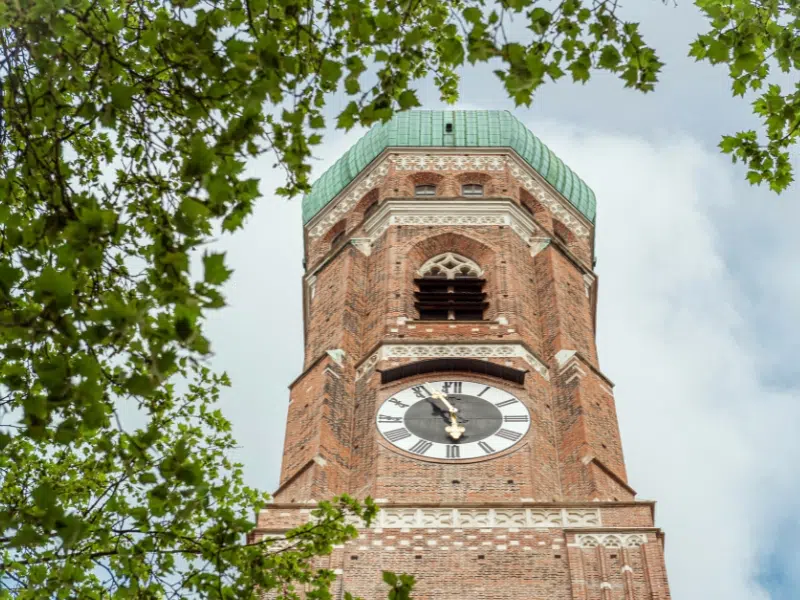
The Frauenkirche, officially the Cathedral of Our Dear Lady, is Munich's cathedral and its best-known skyline feature: two brick towers almost 99 metres high, each capped with a rounded green dome. It was built in just twenty years in the late 15th century, one of the largest brick churches north of the Alps. Inside, a dark footprint in the floor at the entrance carries the city's favourite legend.
The Frauenkirche at a glance
- Where: Frauenplatz in the old town, a two-minute walk north-west of Marienplatz.
- Built: 1468 to 1488, consecrated in 1494; the domes were added to the towers in 1525.
- By: the master builder Jörg von Halsbach (also written Halspach).
- What it is today: the cathedral of the Archdiocese of Munich and Freising and still a working parish church with regular Mass.
- Time needed: 30 minutes for the interior, an hour if you climb the south tower.
A church far too big for its town
A Romanesque church stood here from the 13th century, at what was then the edge of the walled town. In 1468 Duke Sigismund and the citizens of Munich began replacing it with something far grander. With no stone quarry nearby and little money to spare, Jörg von Halsbach built in red brick, and the work went so quickly that the towers stood by 1488. The scale was extraordinary: the church could hold around 20,000 standing people at a time when Munich had perhaps 13,000 inhabitants and already had a parish church, St Peter's.
Money ran out before the planned Gothic spires could be built, and the towers stayed flat-topped until 1525, when they received the rounded domes that may have been inspired by drawings of the Dome of the Rock in Jerusalem. The church became a cathedral in 1821. Allied air raids in the Second World War brought down the roof and destroyed most of the furnishings; restoration went on in stages for decades and was finally completed in 1994.
What to look for
- The Devil's Footprint: a dark footprint-shaped mark in a floor tile just inside the main entrance, known as the Teufelstritt.
- The 'windowless' view: from the same spot near the entrance, the rows of pillars hide the side windows, so the nave seems to have no windows at all.
- The pillars: 22 slender octagonal pillars, each about 22 metres high, carry the vault of a hall church whose three aisles are all the same height.
- The tomb of Emperor Louis IV: the large black marble monument to Ludwig the Bavarian, Holy Roman Emperor, made by Hans Krumpper in the early 17th century.
- The towers from outside: compare them closely; contrary to a popular story they are almost exactly the same height, only about 12 centimetres apart.
The Devil's Footprint legend
The best-known version of the story says the devil agreed to help pay for the church on condition that it had no windows. When the building was finished, the master builder led him to a spot in the entrance hall from which the pillars hide every window. The devil laughed at what he thought was a dark, windowless church, then stepped forward, saw the light pouring in and stamped his foot in fury, leaving the print in the floor. Another part of the legend says that he rushed out and turned into the wind that often swirls around the church. It's a legend, of course, but the optical trick it describes is real: try it yourself.
Tips for your visit
- Stand on the Devil's Footprint first, then walk forward a few steps and watch the windows appear between the pillars.
- The south tower is open to visitors: a spiral staircase of 86 steps leads to a lift, and the view on a clear day reaches the Alps. Check before you go, as access can change.
- This is an active cathedral: dress respectfully and keep quiet during services; avoid sightseeing in the middle of Mass.
- For the classic photo of both domes, walk round to the narrow lanes on the west side or look across the rooftops from the tower of St Peter's.
Nearby
- Marienplatz: Munich's central square, with the New Town Hall and its Glockenspiel, a couple of minutes away.
- St Michael's Church: the large Renaissance Jesuit church on the pedestrian street Neuhauser Straße, with the tomb of King Ludwig II in its crypt.
- Viktualienmarkt: the open-air food market behind St Peter's, good for a beer garden break and Bavarian snacks.
See Munich with World City Trail
Our Munich scavenger hunt turns the old town into a game you play on your phone. The route links 10 stops and takes around 3 hours, with about 55 minutes of walking. The Frauenkirche is one of the stops, along with Marienplatz and the Residenz. You can play in English, German, French, Italian, Spanish, Dutch and Polish.
If you prefer a different format, Munich also has a self-guided walking tour and an outdoor escape game.
Play the Munich scavenger hunt →
Take the self-guided walking tour of Munich →
Play the outdoor escape game in Munich →
Facts checked in October 2026.