
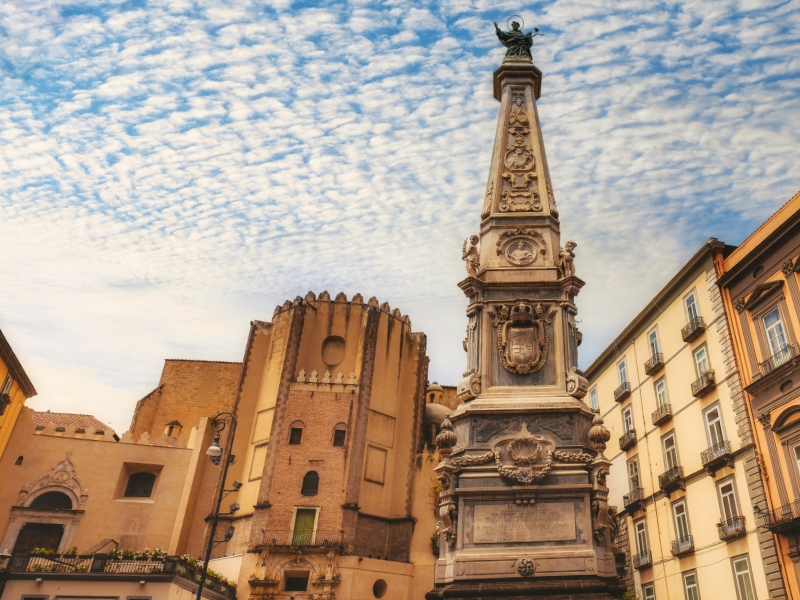
San Domenico Maggiore is the great Gothic church of the Dominican friars in the old centre of Naples, on the square of the same name along Spaccanapoli. Thomas Aquinas taught theology in its monastery, and its sacristy is lined with the coffins of the Aragonese kings and nobles of Naples. From the square you see only its apse and side, which is part of its charm: you go in by climbing a stair rather than through a grand front door.
San Domenico Maggiore at a glance
- Where: Piazza San Domenico Maggiore, on the stretch of Spaccanapoli called Via Benedetto Croce, in the historic centre of Naples.
- Built: 1283 to 1324, on the site of a 10th-century church, with Baroque changes in the 17th century and a Gothic restoration in the 19th.
- By: commissioned by King Charles II of Anjou; the Brancaccio Chapel frescoes are by Pietro Cavallini.
- What it is today: a working Dominican church; the sacristy and the treasure chamber can also be visited.
- Time needed: 30 to 45 minutes for the church and sacristy, longer with the treasure chamber.
An Angevin church and a famous monastery
The Angevin king Charles II began the present church in 1283, absorbing an older church dedicated to Saint Michael the Archangel. It was finished in 1324 in the Gothic style the French dynasty brought to Naples. Later centuries added Baroque marble and stucco, but in the 19th century much of the interior was returned to a Gothic look, which is why the nave today has pointed arches and a gilded coffered ceiling side by side.
The adjoining monastery was one of the most important places of learning in southern Italy. It was an early seat of the University of Naples, and Thomas Aquinas, who had joined the Dominicans here as a young man, came back in 1272 to teach theology. The philosopher Giordano Bruno, later burned for heresy in Rome, also spent time here as a young friar. In the 15th and 16th centuries the church became the burial place of the Aragonese kings of Naples, whose coffins still line the sacristy.
What to look for
- The Brancaccio Chapel: frescoes by the Roman painter Pietro Cavallini from around 1309, with stories of Saint John the Evangelist and Mary Magdalene.
- The sacristy: a long Baroque room with 45 coffins of members of the Aragonese royal family and court in a gallery above the cupboards, including King Ferdinand I.
- The Chapel of the Crucifix: home of the painted crucifix that, according to tradition, spoke to Thomas Aquinas.
- The Caravaggio connection: the Flagellation of Christ was painted for this church in 1607; the original is now in the Capodimonte museum, but a copy hangs in the chapel it was made for.
- The Guglia di San Domenico: the tall Baroque spire in the middle of the square, begun after the plague of 1656 and finished in 1737, topped by a statue of Saint Dominic.
The speaking crucifix
According to the account of a sacristan, one night in December 1273 Thomas Aquinas was praying before a crucifix in the church when he was seen rising off the ground, and a voice from the cross said: 'You have written well of me, Thomas. What reward would you have?' Thomas is said to have answered: 'Nothing but you, Lord.' Soon afterwards he stopped writing his great Summa Theologiae, never to finish it. Take it as a legend, but the crucifix is still shown in the church, and the story is part of why Neapolitans hold this church so dear.
Tips for your visit
- Look at the church from the square first, then walk up the stairs at the side to enter; the contrast between the plain exterior and the gilded interior is part of the experience.
- It is an active church: dress modestly, keep your voice down and avoid visiting during Mass.
- In the evening the square fills with students and café tables; it is a good place to sit and watch the old town.
Nearby
- Sansevero Chapel: home of Giuseppe Sanmartino's Veiled Christ, a minute's walk away; book ahead, as entry is limited.
- Spaccanapoli: the straight street that cuts through the old Greek grid of Naples, lined with churches, shops and pastry bars.
- Santa Chiara: the Franciscan church and monastery with its cloister of majolica tiles, a few minutes west along Spaccanapoli.
See Naples with World City Trail
Our Naples scavenger hunt turns the old centre into a game you play on your phone. The route links 10 stops and takes around 2 hours, with about 46 minutes of walking, and it includes places such as the National Archaeological Museum and the Sansevero Chapel with the Veiled Christ.
If you prefer a different format, Naples also has a self-guided walking tour and an outdoor escape game.
Play the Naples scavenger hunt →
Take the self-guided walking tour of Naples →
Play the outdoor escape game in Naples →
Facts checked in October 2026.