
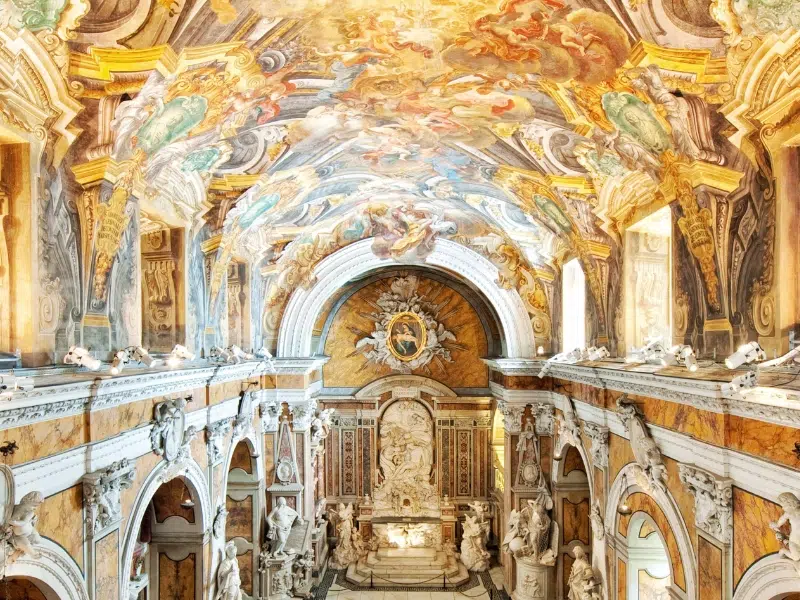
The Sansevero Chapel is a small private chapel in the historic centre of Naples, a few steps from Piazza San Domenico Maggiore, and today a museum. Its fame rests on one sculpture: the Veiled Christ by Giuseppe Sanmartino, a dead Christ under a veil so thin it seems you could lift it, carved in 1753 from the same block of marble as the body beneath it.
The Sansevero Chapel at a glance
- Where: Via Francesco De Sanctis 19/21, in the historic centre, just off Piazza San Domenico Maggiore and the street known as Spaccanapoli.
- Built: as a family chapel of the di Sangro princes in the early 17th century; transformed from the 1740s into the chapel you see today.
- By: Raimondo di Sangro, Prince of Sansevero, who planned the decoration; the main sculptures are by Antonio Corradini, Francesco Queirolo and Giuseppe Sanmartino.
- What it is today: a private museum, the Museo Cappella Sansevero, also known as the church of Santa Maria della Pietà.
- Time needed: 30–45 minutes, plus any wait at the entrance.
A prince's chapel and its programme
The chapel began as the burial chapel of the di Sangro family, dedicated to Santa Maria della Pietà. Tradition links its origin to an image of the Virgin that appeared miraculously on a garden wall here, and little of that first building survives. What visitors come for is the work of Raimondo di Sangro (1710–1771), seventh Prince of Sansevero: inventor, scientist, writer and Freemason, who in the 1740s reorganised the whole chapel around his own set of symbols, with statues of the virtues placed around the walls beside the family tombs.
He brought in the Venetian sculptor Antonio Corradini, who carved Modesty for the prince's mother and was also given the Veiled Christ. Corradini died in 1752, and the commission passed to a young Neapolitan, Giuseppe Sanmartino, who finished the statue in 1753. Francesco Queirolo from Genoa carved Disillusion for the prince's father. Since the 18th century travellers have treated these three statues as the chapel's high points; the sculptor Antonio Canova is said to have admired the Veiled Christ greatly.
What to look for
- The Veiled Christ in the centre of the nave: look at the veil where it crosses the face and the feet, then at the pillow, the crown of thorns and the pincers at Christ's feet.
- Modesty (Pudicizia), to the left of the high altar: a woman wrapped in a clinging veil and a garland of roses, made in 1752 in memory of the prince's mother, Cecilia Gaetani dell'Aquila d'Aragona, who died when he was not yet one year old.
- Disillusion (Disinganno), opposite: a man freeing himself from a carved marble net with the help of a winged figure, made for the prince's father, Antonio di Sangro. The net is cut free of the stone in many places.
- The ceiling fresco, the Glory of Heaven, painted by Francesco Maria Russo in 1749, still bright after more than 270 years.
- The floor: the chapel once had a labyrinth-patterned floor, a symbol of the path to knowledge. Most of it was lost in the late 19th century after water damage, but a section survives.
- The anatomical machines in the underground room: two human skeletons, a man and a woman, with their whole network of blood vessels reconstructed around them, made by the Palermo doctor Giuseppe Salerno.
Legends of the Prince of Sansevero
Raimondo di Sangro's reputation as an alchemist produced some of Naples' best-known legends, and the guides here are happy to tell them. One says the veil over Christ was a real cloth that the prince turned into marble by a secret chemical process. Another says he had Sanmartino blinded so that he could never make anything like it again. A third claims that the anatomical machines were made from the bodies of two servants whose blood the prince had turned to metal. All three are legends: the veil was carved from the same block as the body, and research has shown that the blood vessels of the machines are made of wire, wax and silk.
Tips for your visit
- Book your ticket online in advance. The chapel is small, entry is timed and queues on Via De Sanctis can be long, especially at weekends.
- Photography is not allowed inside, so take your time and look rather than shoot.
- Walk all the way around the Veiled Christ: the veil reads differently from the head, the side and the feet.
- Go down to the underground room last; the anatomical machines are disturbing for some visitors and young children.
Nearby
- Piazza San Domenico Maggiore: the square at the end of the street, with the Gothic church of San Domenico Maggiore and a tall Baroque spire, a minute's walk away.
- Via San Gregorio Armeno: the narrow street of workshops selling nativity figures all year round, a few minutes' walk east.
- Gesù Nuovo: the church with the faceted stone façade on Piazza del Gesù, a short walk west along Spaccanapoli.
- The cloister of Santa Chiara: a garden cloister lined with 18th-century majolica tiles, next to Piazza del Gesù.
See Naples with World City Trail
Our Naples scavenger hunt turns the old town into a game you play on your phone. The route links 10 stops and takes around 2 hours, with about 46 minutes of walking. The Sansevero Chapel is one of the stops, along with the National Archaeological Museum.
If you prefer a different format, there is also a self-guided walking tour and an outdoor escape game in Naples.
Play the Naples scavenger hunt →
Take the self-guided walking tour of Naples →
Play the outdoor escape game in Naples →
Facts checked in October 2026.