
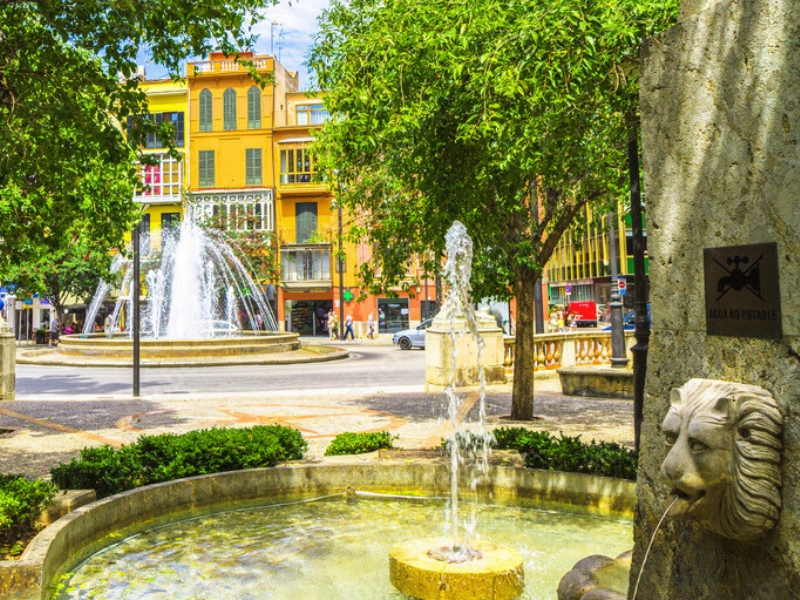
Plaça de la Reina is the small, busy square at the bottom of the Passeig del Born in Palma, where the old town's grand promenade meets the road down to the sea, just below the Almudaina Palace and the cathedral. Today traffic circles a round fountain, but for five years in the 1860s the square held a marble monument to Queen Isabel II, until a revolutionary crowd pulled it down.
Plaça de la Reina at a glance
- Where: at the southern end of the Passeig del Born, where it meets Avinguda d'Antoni Maura, below the Almudaina Palace and the S'Hort del Rei gardens.
- Named: after Queen Isabel II of Spain, in memory of her visit to Mallorca in September 1860; her statue stood here from 1863 to 1868.
- What it is today: a traffic square with a round fountain, renovated in 2016 with a ring of ceramic tiles, and a crossroads between the Born, the cathedral and the seafront.
- Time needed: 5–10 minutes; most people pass through on the way between the Born and the cathedral.
A riverbed, a promenade and a queen
The square sits on a line that once carried water. The Riera stream used to run through the centre of Palma along today's Rambla and the Born to the sea. After a catastrophic flood in October 1403 the city decided to divert it, and the dry bed slowly became a street. In 1833 Tomàs Abrines designed the Born as a fashionable promenade, and it became the route that people took between the harbour and the city when arriving or leaving by boat.
When Isabel II came to Mallorca in 1860, the city planned a monument to mark the visit. Building it took longer than planned, and the white marble statue of the queen, about eight metres tall with its pedestal and surrounded by four allegorical figures, was only put up in 1863. It did not last. In the revolution of 1868 that drove Isabel II into exile, a crowd in Palma tore the statue from its pedestal and smashed it in October that year. The monument was gone, but the name stayed.
What to look for
- The fountain: its outer ring was covered in 2016 with around 1,400 blue, yellow and white tiles by the ceramicist Joan Pere Català, the last project planned by the city architect Frederic Climent.
- The site of the monument: the traffic circle around the fountain is roughly where Isabel II's marble statue stood.
- The view up the Born: the long avenue of plane trees and stone benches leading north to the obelisk fountain with turtles at the top.
- The palace walls: look up to the old walls of the Almudaina Palace and the green terraces of the S'Hort del Rei gardens beside the square.
- The old riverbed: Avinguda d'Antoni Maura, running down from the square towards the sea, continues the line of the old Riera stream.
Where is the queen's head?
After the statue was destroyed, a local monarchist noble is said to have taken the remains to his estate near Sineu, in the centre of the island. According to a 2010 report in the local press, the marble head of the queen is still there, cemented to a gate pillar, its nose broken off and covered in lichen. Oddly, the other end of the Born also honours Isabel II: the turtle fountain at the top was first put up for her as a young princess.
Tips for your visit
- The square is surrounded by traffic. Cross at the lights and enjoy the fountain from the edges rather than from the road.
- Start here and walk up the Born in the shade of the plane trees, or go the other way to the cathedral and the seafront.
- In the evening the Born fills with people out for a stroll, and the fountain and palace walls are lit.
- For a view down onto the square, climb the steps of S'Hort del Rei towards the Almudaina Palace.
Nearby
- Almudaina Palace: the royal palace above the square, built on the site of the Islamic citadel and still used by the Spanish royal family for official events.
- S'Hort del Rei: the gardens with fountains and pools between the square and the palace, with a sculpture by Joan Miró.
- Palma Cathedral (La Seu): the Gothic cathedral overlooking the sea, a few minutes' walk up past the palace.
- Passeig del Born: the promenade leading north from the square, lined with mansions, shops and café terraces.
See Palma de Mallorca with World City Trail
Our Palma de Mallorca scavenger hunt turns the old town into a game you play on your phone. The route links 10 stops and takes around 2 hours, with about 38 minutes of walking, and includes the Sóller train station, Plaça d'Espanya and Plaça Major. You can play in English, German, French, Italian, Spanish or Dutch.
If you prefer a different format, there is also a self-guided walking tour and an outdoor escape game in Palma de Mallorca.
Play the Palma de Mallorca scavenger hunt →
Take the self-guided walking tour of Palma de Mallorca →
Play the outdoor escape game in Palma de Mallorca →
Facts checked in October 2026.