
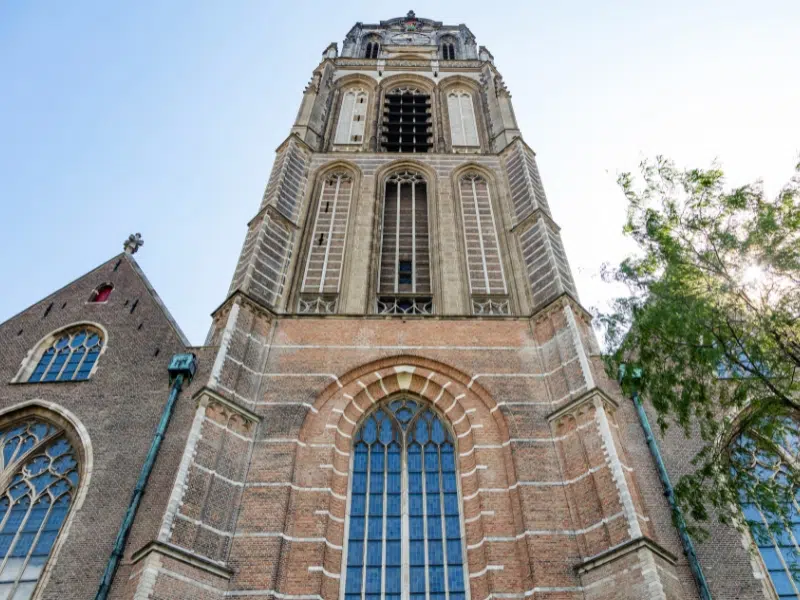
The Grote of Sint-Laurenskerk (Great or St Lawrence Church) is the late-Gothic stone church on Grotekerkplein in central Rotterdam. It was built between 1449 and 1525, and it is one of the very few buildings left from medieval Rotterdam: the German bombing of 14 May 1940 burnt it out, but its tower and walls stayed standing while the old city around it disappeared.
The Laurenskerk at a glance
- Where: Grotekerkplein, in the city centre, a few minutes' walk from the Markthal and the Binnenrotte market square.
- Built: 1449–1525 as a Roman Catholic church; Protestant since 1572; restored between 1952 and 1968 after the 1940 bombing.
- What it is today: a Protestant church still used for services, and also a venue for concerts, exhibitions and events. Its tower is about 65 metres high.
- Time needed: 30–45 minutes inside; 10 minutes for the outside and the Erasmus statue in front of it.
From Catholic church to symbol of the rebuilt city
The church was the first building in Rotterdam made entirely of stone. It became Protestant after the Reformation reached the city in 1572. The tower gave its builders a lot of trouble: a wooden spire designed by Hendrick de Keyser was added in 1621 but had to come down in 1645 because the timber was poor, and the heavy stone top added in the 1650s proved too much for the foundations. New piles were driven under the tower, and by 1655 it stood straight again.
On 14 May 1940 the German air raid on Rotterdam destroyed the medieval city centre. The Laurenskerk burnt out, and only the tower and the outer walls were left. There were calls to pull the ruin down, which Queen Wilhelmina stopped, and in 1950 a proposal by the architect J. J. P. Oud to keep only the tower and build a smaller church beside it was turned down. Restoring the whole church became a symbol of the city's recovery: Queen Juliana laid the foundation stone for the restoration in 1952, and the work was finished in 1968.
What to look for
- The bronze doors by the Italian sculptor Giacomo Manzù, installed in 1968 as a gift from a Rotterdam company. Closed, they show scenes of war; when they are opened, the war images disappear and the tympanum above shows peace.
- The tower, about 65 metres high, which came through the 1940 fire. Compare the old stone with the restored parts of the church.
- The main organ, built by the Danish firm Marcussen & Søn and completed in 1973, with about 7,600 pipes and a case 23 metres high. It is one of the largest mechanical church organs in Europe, and one of five organs in the church.
- The monuments to three admirals of the Dutch navy: Witte de With, Egbert Kortenaer and Johan van Brakel. Near Kortenaer's grave hangs a model of the ship De Liefde.
- The copper choir screen of 1712–1715 in the style of Louis XIV, and the three apse windows by Gunhild Kristensen, which tell the story of Pentecost.
- A replica of the Cross of Nails from Coventry Cathedral, given to the church in the 1970s as a sign of peace and reconciliation between cities bombed in the war.
Erasmus, who never turns the page
In front of the church stands the bronze statue of Erasmus, the humanist scholar who was born in Rotterdam in the 1460s. It was made by Hendrick de Keyser and put up in 1622, which makes it the oldest statue in the Netherlands. Erasmus is reading a book, and an old Rotterdam joke says he turns a page every time the church clock strikes. Nobody has ever seen him do it.
Tips for your visit
- The church is used for services, concerts and events, so check its website before you go if you want to see the interior.
- For a photo of the whole tower, stand at the far end of Grotekerkplein, or walk towards the Markthal and look back: the medieval tower and the modern arch side by side sum up Rotterdam.
- Bach's St Matthew Passion is performed here every year on Palm Sunday, a good reason to plan a spring visit around it.
Nearby
- Markthal: the horseshoe-shaped market hall with homes in its arch and a huge painted ceiling, a few minutes' walk away.
- Cube Houses (Kubuswoningen): Piet Blom's tilted yellow cube houses near Blaak station, a short walk east, one of which you can visit.
- Oude Haven: Rotterdam's oldest harbour, with historic ships and café terraces, right beside the Cube Houses.
- Rotterdam City Hall (Stadhuis): the grand city hall on the Coolsingel, built in 1914–1920 and one of the few large buildings in the centre that survived the 1940 bombing.
See Rotterdam with World City Trail
Our Rotterdam scavenger hunt turns the city centre into a game you play on your phone. The route links 10 stops and takes around 2 hours, with about 54 minutes of walking. The Laurenskerk is one of the stops, along with Rotterdam City Hall.
If you prefer a different format, there is also a self-guided walking tour and an outdoor escape game in Rotterdam.
Play the Rotterdam scavenger hunt →
Take the self-guided walking tour of Rotterdam →
Play the outdoor escape game in Rotterdam →
Facts checked in October 2026.