
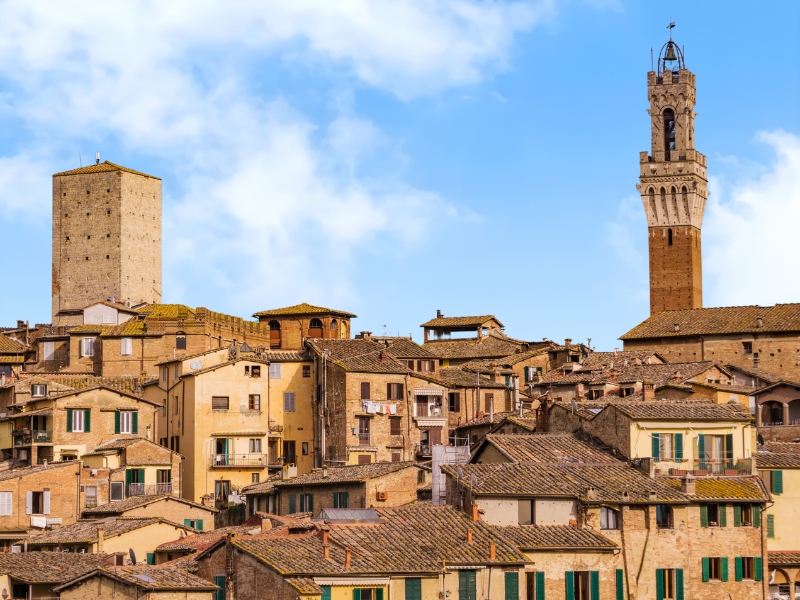
The Facciatone, 'the big facade', is the tall, empty wall that stands beside Siena Cathedral, with great open arches through which you can see the sky. It is the unfinished front of the Duomo Nuovo, the New Cathedral, a 14th-century extension so ambitious that the existing cathedral would have become little more than its transept. Building stopped after the Black Death of 1348, and today you can climb 131 steps to the top of the wall for one of the best views in Siena.
The Facciatone at a glance
- Where: Piazza Jacopo della Quercia, beside Siena Cathedral; the climb starts inside the Museo dell'Opera del Duomo.
- Built: from 1339, when the city council approved the New Cathedral; work slowed after 1348 and the project was abandoned in 1357.
- By: the goldsmith and engineer Lando di Pietro, who took charge in 1339, followed by the Sienese sculptor Giovanni d'Agostino as master builder.
- What it is today: the largest surviving piece of the New Cathedral, with a viewing terrace on top known as the Panorama dal Facciatone.
- Time needed: 15 minutes from the square; one to two hours if you visit the museum and climb to the top.
A cathedral too big to finish
On 23 August 1339 Siena's Great General Council approved a vast enlargement of the cathedral. The plan was to build a new, much longer nave at right angles to the old church, running across what is now Piazza Jacopo della Quercia, so that the existing cathedral would become the transept of the new building. Lando di Pietro took charge in December 1339 but died the following summer. His successor, Giovanni d'Agostino, led the works until his own death in 1348, probably from the plague.
The Black Death of 1348 killed a large part of Siena's population and plunged the city into an economic crisis. At the same time, cracks and stability problems appeared in the parts already built. Work dragged on for a few more years, until in 1357 the city's governors ordered the unsound sections to be pulled down and the project was given up. What survived is the facade, the side walls and the north aisle. The arches of that aisle now carry the roof of the Museo dell'Opera del Duomo, which fills the space where the aisle of the great church should have been.
What to look for
- The Facciatone from the square: a huge wall with empty arches and windows, finished on one side only, standing against the sky.
- The black and white marble bands on the side facing the square. This side was meant to be the inside of the facade, and the stripes match the interior of the cathedral next door.
- The arches of the north aisle running from the Facciatone towards the cathedral, with their striped piers and two-light windows: the outline of a church that was never finished.
- The square itself: Piazza Jacopo della Quercia covers the area of the planned nave. Stand in the middle and imagine a vaulted roof over your head.
- The climb: 131 steps up a narrow spiral staircase from the museum's upper floor to a small terrace on top of the wall.
- The view from the top: the dome and striped bell tower of the cathedral right beside you, the Torre del Mangia, the red rooftops of the city and the Tuscan hills beyond.
Tips for your visit
- The staircase is narrow and the terrace small, so it is not ideal if you dislike tight spaces or heights.
- The Facciatone can only be climbed through the Museo dell'Opera, so plan the two together. On the way up, don't miss Duccio's Maestà, the great altarpiece finished in 1311 for the cathedral's high altar.
- Go early in the morning or late in the afternoon for softer light over the rooftops and fewer people on the terrace.
- Look at the Facciatone from Piazza Jacopo della Quercia before or after the climb: the scale of the unbuilt church only makes sense from the ground.
Nearby
- Siena Cathedral: the black-and-white striped cathedral next door, with its inlaid marble floor and the frescoed Piccolomini Library.
- Baptistery of San Giovanni: below the cathedral apse, with a baptismal font decorated by Jacopo della Quercia, Donatello and Ghiberti.
- Santa Maria della Scala: the former hospital opposite the cathedral, now a museum, with frescoed wards from the 15th century.
- Piazza del Campo: the shell-shaped main square with the Palazzo Pubblico and the Torre del Mangia, a few minutes' walk downhill.
See Siena with World City Trail
Our Siena scavenger hunt turns the old town into a game you play on your phone. The route links 10 stops and takes around 2 hours, with about 24 minutes of walking. It includes Siena Cathedral, Santa Maria della Scala and the Pinacoteca Nazionale, all a short walk from the Facciatone.
If you prefer a different format, there is also a self-guided walking tour and an outdoor escape game in Siena.
Play the Siena scavenger hunt →
Take the self-guided walking tour of Siena →
Play the outdoor escape game in Siena →
Facts checked in October 2026.