
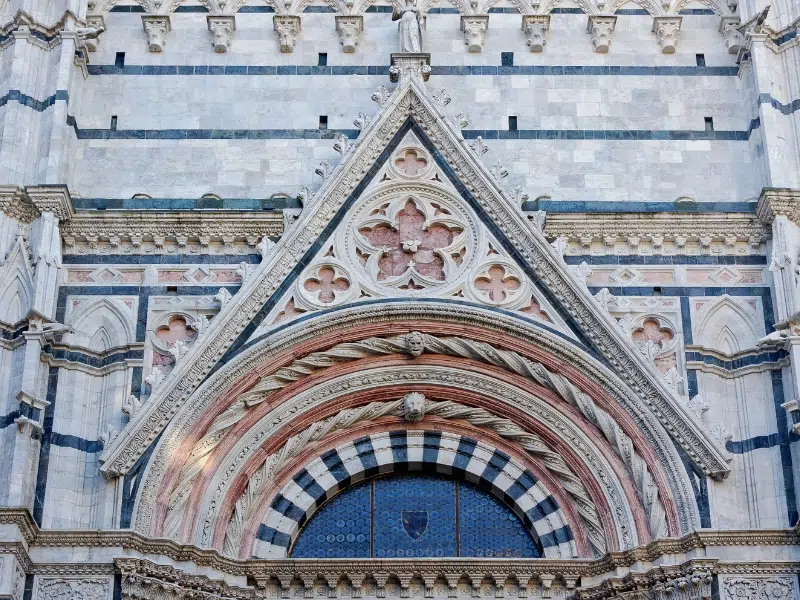
Siena's Baptistery of San Giovanni sits underneath the cathedral: its vaults literally hold up the floor of the Duomo's choir above. Most visitors walking the cathedral square never realise it is there. Go down the steps behind the cathedral and you find a small, fully frescoed hall with one of the finest early Renaissance fonts in Italy, made by Donatello, Ghiberti and Jacopo della Quercia.
The Baptistery of San Giovanni at a glance
- Where: on Piazza San Giovanni, below the east end of Siena Cathedral, reached by a flight of steps.
- Built: 1317–1325; the marble façade was added between 1355 and 1382 and never finished.
- By: Camaino di Crescentino, master builder of the cathedral works and father of the sculptor Tino di Camaino; the façade is by Domenico di Agostino.
- What it is today: part of the cathedral complex, open to visitors with a ticket for the Duomo sites.
- Time needed: 20–30 minutes.
A baptistery built to carry a cathedral
In 1317 the cathedral works decided to lengthen the Duomo's choir by two bays. The problem was that the east end already stood at the edge of a steep slope. The solution was to build a new structure below, whose ceiling would carry the floor of the extended choir, and to make it the city's new baptistery. Camaino di Crescentino led the work, which was finished in 1325. Between 1355 and 1382 Domenico di Agostino gave it a white marble Gothic façade, but work stopped in 1382, leaving the upper part unfinished and the lower part without its final details.
The 15th century filled the interior. Between 1417 and 1431 the hexagonal font was made in marble, gilded bronze and enamel by the leading sculptors of the day. From around 1450 the painter Lorenzo di Pietro, known as Vecchietta, and his workshop covered the vaults with frescoes. In 2024 the font returned to full view after a three-year restoration by Florence's Opificio delle Pietre Dure.
What to look for
- The six gilded bronze panels on the font, telling the life of John the Baptist: Donatello's Feast of Herod, often cited as one of the earliest reliefs to use linear perspective; Ghiberti's Baptism of Christ and Arrest of the Baptist; Giovanni di Turino's Birth and Preaching of the Baptist; and Jacopo della Quercia's Annunciation to Zacharias.
- The small bronze statues of Faith and Hope by Donatello at the corners of the font, and the dancing bronze angels on the marble tabernacle above.
- The marble tabernacle by Jacopo della Quercia, with five prophets in niches and a statuette of John the Baptist at the very top.
- The ceiling: Vecchietta's frescoes of the Articles of the Creed, from God the Father and the Annunciation to the Last Judgement and Paradise, spread over the vaults.
- Outside, the worn marble inlays in the pavement in front of the three doors, designed around 1450–1451 on the theme of baptism.
Why the façade stops halfway
Look up at the front of the baptistery and you will see that the marble ends abruptly, with plain brick above. It belongs to the same story as Siena's other unfinished project, the vast new cathedral that the city began in the 14th century and abandoned. Ambition was high, money and stability were not, and the Black Death of 1348 hit Siena hard. The half-built façade is a reminder of how much the city wanted to build, and how much it had to leave undone.
Tips for your visit
- Look at the façade from the bottom of the steps first, then go inside: the light is low, so give your eyes a minute to adjust before studying the font.
- Walk all the way around the font: each side has a different panel, and the best are easy to miss if you stay in one spot.
- Come early in the day or late in the afternoon, when the cathedral square is quieter.
- The baptistery is a church space: keep your voice down and dress with shoulders covered.
Nearby
- Siena Cathedral: the striped Duomo directly above, with its inlaid marble floor and the Piccolomini Library.
- Museo dell'Opera del Duomo: Duccio's Maestà and a climb onto the unfinished façade of the new cathedral for a view over the city.
- Santa Maria della Scala: a former hospital opposite the cathedral, now a museum with frescoed halls.
- Piazza del Campo: Siena's shell-shaped main square, a short walk downhill.
See Siena with World City Trail
Our Siena scavenger hunt turns the old town into a game you play on your phone. The route links 10 stops and takes around 2 hours, with about 24 minutes of walking. It includes Siena Cathedral, Santa Maria della Scala and the Pinacoteca Nazionale.
If you prefer a different format, there is also a self-guided walking tour and an outdoor escape game in Siena.
Play the Siena scavenger hunt →
Take the self-guided walking tour of Siena →
Play the outdoor escape game in Siena →
Facts checked in October 2026.