
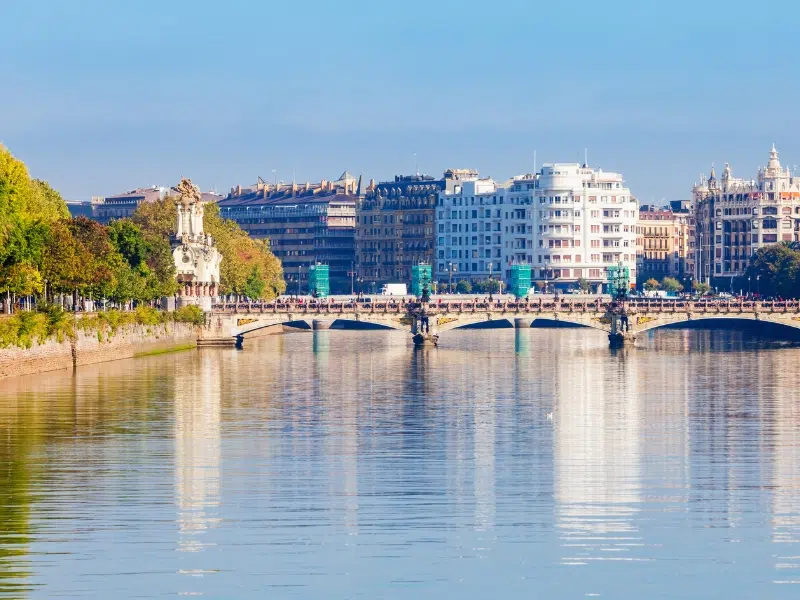
The María Cristina Bridge, Maria Kristina zubia in Basque, crosses the Urumea river in the centre of San Sebastián, linking the city centre with the Estación del Norte railway station. Opened in 1905, it is the most ornate of the city's bridges, marked at each end by a pair of tall obelisks topped with sculptures. Its model was the Pont Alexandre III in Paris.
The María Cristina Bridge at a glance
- Where: over the Urumea between the city centre, near the Buen Pastor Cathedral, and the Estación del Norte on the east bank.
- Opened: 20 January 1905, the feast day of Saint Sebastian, the city's patron.
- By: the engineer José Eugenio Ribera with the architect Julio Martínez-Zapata; the equestrian sculptures are by Ángel García Díaz.
- What it is today: a busy road and pedestrian bridge, and one of the classic photo views along the river.
- Time needed: 10–15 minutes to cross and look at the details; longer if you walk along the river.
From a wooden footbridge to a royal bridge
In the 1890s San Sebastián was a fashionable summer resort, and people needed a direct way from the centre to the railway station on the far side of the Urumea. In 1893 a temporary wooden walkway was put up, which also served the bullring and the velodrome on that side. Its replacement was designed by José Eugenio Ribera, one of the pioneers of reinforced concrete in Spain, with the architect Julio Martínez-Zapata. Building in reinforced concrete was still a novelty, and the works were finished in about nine months. The bridge was named after Queen María Cristina of Habsburg-Lorraine, the queen mother, who spent her summers in the city.
The opening on 20 January 1905 was a full city festival: bands paraded, the Orfeón Donostiarra sang a hymn composed for the day, and in the evening there were fireworks and a toro de fuego, a mock bull carrying fireworks, near the station. In the 1980s the bridge had deteriorated and the city had it rehabilitated. The structure was changed inside, but the decoration was kept, so it still looks as it did in 1905.
What to look for
- The four obelisks at the ends of the bridge, about 18 metres high, each topped by a sculptural group with horses.
- The polychrome coats of arms on the obelisks and the coloured ceramic decoration on the arches.
- The three arches, each spanning about 24 metres, best seen from the riverside promenade.
- The reddish artificial stone that covers the concrete, chosen to give the bridge a more monumental look.
- The ornate lamp posts and balustrades along the deck, which make the bridge feel like part of a Parisian boulevard.
The Paris connection
The design deliberately echoes the Pont Alexandre III in Paris, opened a few years earlier for the 1900 World's Fair, with its tall pillars crowned by gilded figures. San Sebastián, then at the height of its Belle Époque as a royal seaside resort, wanted a bridge with the same elegance. The result is smaller and built in concrete rather than steel, but on a sunny afternoon, with the river low and the obelisks lit by the sun, the resemblance is easy to see.
Tips for your visit
- For the classic photo, stand on the riverside promenade a little upstream or downstream, so you see all three arches and the obelisks together.
- Come in the early evening, when the low sun lights the sculptures, or after dark when the bridge is illuminated.
- Walk along the Urumea promenade towards the sea: you pass several other bridges, ending with the Zurriola Bridge by the Kursaal.
- The bridge carries traffic, so cross at the lights and keep to the pavements when you stop for photos.
Nearby
- Buen Pastor Cathedral: the Neo-Gothic cathedral of the city, a few minutes' walk into the centre.
- Estación del Norte: the railway station on the east bank, which the bridge was built to reach.
- Tabakalera: the former tobacco factory next to the station, now a contemporary culture centre with a rooftop viewpoint.
- Urumea promenade: the riverside walk lined with trees and grand buildings, leading north to the Kursaal and Zurriola Beach.
See San Sebastián with World City Trail
Our San Sebastián scavenger hunt turns the city centre into a game you play on your phone. The route links 10 stops and takes around 3 hours, with about 38 minutes of walking. The María Cristina Bridge is one of the stops, along with the Good Shepherd Cathedral and the City Hall. You can play in English, German, French, Italian or Spanish.
If you prefer a different format, there is also a self-guided walking tour and an outdoor escape game in San Sebastián.
Play the San Sebastián scavenger hunt →
Take the self-guided walking tour of San Sebastián →
Play the outdoor escape game in San Sebastián →
Facts checked in October 2026.