
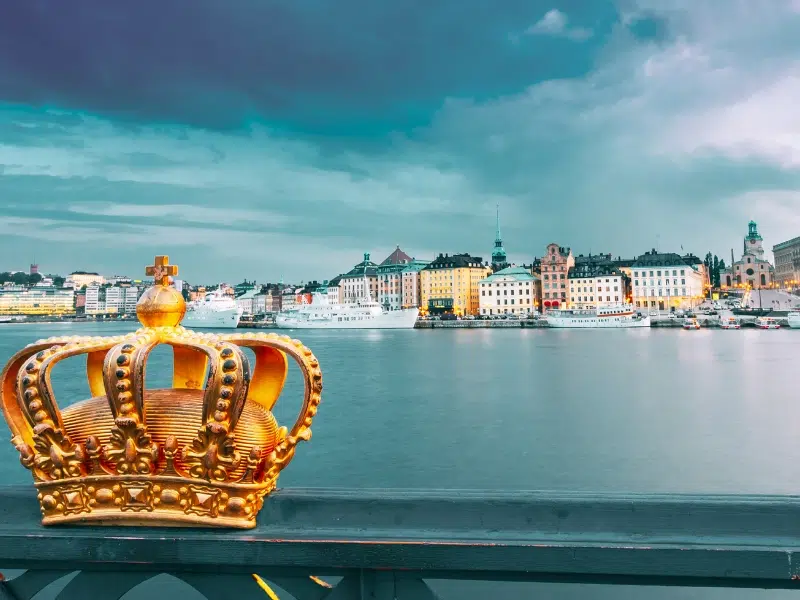
Skeppsholmsbron is the low iron bridge that links Blasieholmen, beside the Nationalmuseum, with the island of Skeppsholmen in central Stockholm. Opened in 1861, it is described as the first wrought-iron bridge built in Sweden. Halfway across, a gilded royal crown sits on each railing, and it has become one of the city's favourite photo spots.
Skeppsholmsbron at a glance
- Where: between Blasieholmen, next to the Nationalmuseum, and Skeppsholmen, a short walk from Kungsträdgården.
- Built: 1859–1861; the bridge was inaugurated in 1861.
- By: the Motala Verkstad engineering works, which made the ironwork.
- What it is today: a protected, state-owned bridge, 165 metres long, with footpaths on both sides and a single lane for vehicles controlled by traffic lights.
- Time needed: 10–15 minutes to cross and take photos; an hour or more if you continue around Skeppsholmen.
From a naval drawbridge to Sweden's first iron bridge
Skeppsholmen, the 'ship island', was the base of the Swedish navy for centuries, and the first link to it was paid for by the admiralty. That bridge, called Holmbron, was a wooden structure on piles with a drawbridge, built in 1638–1640. A toll was introduced in 1789 to pay for repairs, and in 1822 a fire destroyed the bridge. A temporary pontoon bridge took its place.
The present bridge was built in 1859–1861, funded by the state, which still owns it. Its five iron spans were made by Motala Verkstad, one of Sweden's leading engineering works. Within its first fifteen years it shifted out of line and had to be straightened and reinforced. In 1935 it was protected as a state-listed monument. By the 1990s the ironwork was badly corroded and replacement was proposed, but protests led to a restoration instead, so the bridge you cross today keeps its 19th-century look.
What to look for
- The crowns: two gilded royal crowns, one on each railing at the midpoint of the bridge. The crown is the symbol of Sweden and its monarchy, the same one that appears on the Swedish coat of arms.
- The ironwork: the five shallow arches under the deck are best seen from the quay on the Skeppsholmen side.
- The view east: across the bay of Nybroviken to the grand 19th-century façades along Strandvägen.
- The view west: the water of Strömmen, with Gamla Stan and the Royal Palace across the channel.
- The af Chapman: the white three-masted sailing ship moored along the west shore of Skeppsholmen, built in Whitehaven, England, in 1888.
Why crowns on a bridge?
No plaque on the bridge explains the crowns, and we found no record of exactly when they were first put there. The most likely reading is the simplest: the bridge belongs to the state, it led to the navy's island, and the crown is the national symbol of Sweden. You will often see Stockholmers on the bridge as well as visitors, because it is the main way onto Skeppsholmen and its museums.
Tips for your visit
- Come early in the morning or around sunset, when low sunlight makes the gilding glow and the bridge is quiet.
- For the classic photo, crouch slightly so the crown lines up with Strandvägen or the af Chapman's masts behind it.
- The footpaths are only about two metres wide and used by cyclists and runners, so step aside before you stop to take pictures.
- Combine the bridge with a loop around Skeppsholmen: museums, lawns, old naval buildings and views across the water to Djurgården.
Nearby
- Nationalmuseum: Sweden's national museum of art and design, right at the Blasieholmen end of the bridge.
- Moderna Museet: modern and contemporary art on Skeppsholmen, a few minutes' walk from the bridge.
- Kastellholmen: the small island beyond Skeppsholmen, reached by another short bridge, with the little red-brick citadel known as Kastellet.
- Kungsträdgården: the park and square a short walk west, lively all year and full of cherry blossom in spring.
See Stockholm with World City Trail
Our Stockholm scavenger hunt turns the old town into a game you play on your phone. The route links 10 stops and takes around 3 hours, with about 40 minutes of walking. It includes places such as the City Hall, Riddarholmen Church, the Nobel Prize Museum and Gamla Stan. You can play in English, German, French, Italian, Spanish or Dutch.
If you prefer a different format, there is also a self-guided walking tour and an outdoor escape game in Stockholm.
Play the Stockholm scavenger hunt →
Take the self-guided walking tour of Stockholm →
Play the outdoor escape game in Stockholm →
Facts checked in October 2026.