
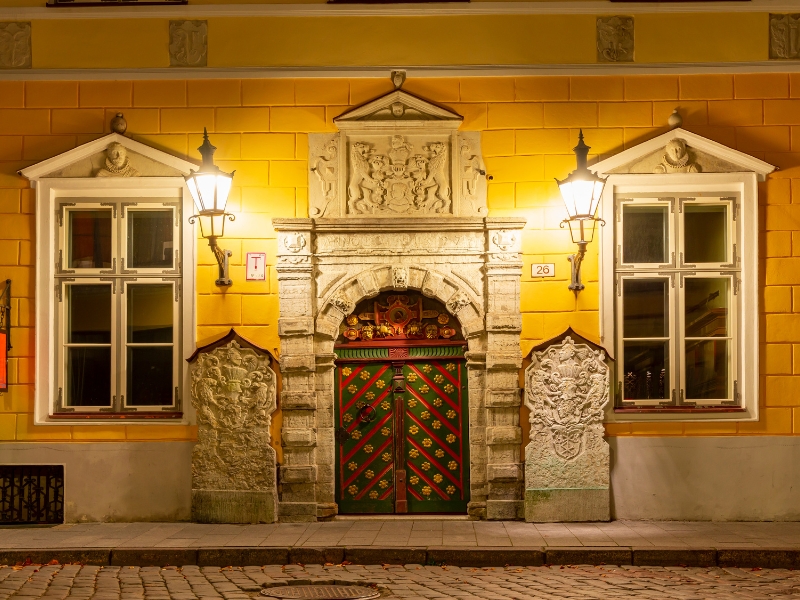
The House of the Blackheads at Pikk 26 is the former clubhouse of the Brotherhood of Blackheads, an association of young unmarried merchants and foreign traders in Tallinn's Old Town. Its tall Renaissance facade from 1597 is one of the few of that style left in the city. Above the richly painted door, look for the dark-skinned head of Saint Maurice, the brotherhood's patron.
The House of the Blackheads at a glance
- Where: Pikk 26, on the long street that runs from Town Hall Square down towards the harbour.
- Built: a house stood here by the 14th century; the brotherhood bought it in the early 16th century, and the facade dates from 1597.
- By: the facade was designed by Arent Passer, a stonemason and architect of Dutch origin who worked in Tallinn.
- What it is today: a city-owned venue with four halls used for concerts, receptions and other events.
- Time needed: 10 minutes for the facade; an hour or more if you attend a concert inside.
A merchants' brotherhood and its house
The Brotherhood of Blackheads is first mentioned in Tallinn in 1400. Its members were young unmarried merchants and foreign traders who were not yet allowed into the powerful Great Guild; once they married, most moved on to it. The brotherhood existed only in today's Estonia and Latvia, in Tallinn, Riga and Tartu. It also had a military role: it supplied a cavalry unit to defend the town and its members fought in the Livonian War. The name comes from its patron, Saint Maurice, a Christian saint described as an African soldier.
The brotherhood bought the house in the first half of the 16th century and in 1597 gave it the Netherlandish Renaissance facade you see today. Later it also acquired the neighbouring St Olaf's Guild building, whose two-aisled vaulted hall dates from the 15th century. In 1940, after the Soviet occupation, the brotherhood was dissolved and its members left for Germany, where it was registered again in Hamburg in 1961. The house became a culture centre in Soviet times and, after a long ownership dispute, remains the property of the city.
What to look for
- The door: the painted and carved main door dates from the 1640s and is one of the most photographed doors in the Old Town.
- Saint Maurice: the brotherhood's emblem, the head of the saint, appears above the entrance both in carved wood and in stone.
- The Renaissance facade: a tall, narrow gable with stone ornament and reliefs, a style that came to Tallinn from the Low Countries.
- The slope: the building stands on a natural step between Pikk and Pühavaimu streets, so its lower floors face Pühavaimu and the upper ones face Pikk.
- The halls: if you get inside for an event, the White Hall was remodelled in neoclassical style in the early 20th century, while St Olaf's Hall keeps its 15th-century vaults.
An early Christmas tree
Brotherhood records mention a tree set up at Christmas in 1441, 1442 and 1514. Tallinn cites these entries in its claim to one of the first Christmas trees in Europe, a claim Riga, home of the other great Blackhead house, contests with its own records. Either way, Christmas trees still stand on Town Hall Square every winter, a few minutes' walk from the house.
Tips for your visit
- Pikk Street is narrow: stand on the opposite pavement, a few steps up or down the street, to fit the whole gable into a photo.
- Check the programme of concerts: hearing music in one of the halls is the easiest way to see the interior.
- Walk the whole of Pikk Street from Town Hall Square to Fat Margaret tower to see the house in the context of the old merchant street.
Nearby
- Great Guild Hall: the hall of the wealthy married merchants on the same street, now home to the Estonian History Museum.
- Church of the Holy Spirit: a small medieval church just behind the house, with a carved and painted clock on its facade.
- St Olaf's Church: the tall-spired church at the northern end of Pikk Street, once among the tallest buildings in the world.
- Town Hall Square: the medieval market square with its Gothic town hall, a few minutes' walk away.
See Tallinn with World City Trail
Our Tallinn scavenger hunt turns the old town into a game you play on your phone. The route links 10 stops and takes around 2 hours, with about 38 minutes of walking. It includes Town Hall Square, Viru Gate and the Alexander Nevsky Cathedral.
If you prefer a different format, there is also a self-guided walking tour and an outdoor escape game in Tallinn.
Play the Tallinn scavenger hunt →
Take the self-guided walking tour of Tallinn →
Play the outdoor escape game in Tallinn →
Facts checked in October 2026.