
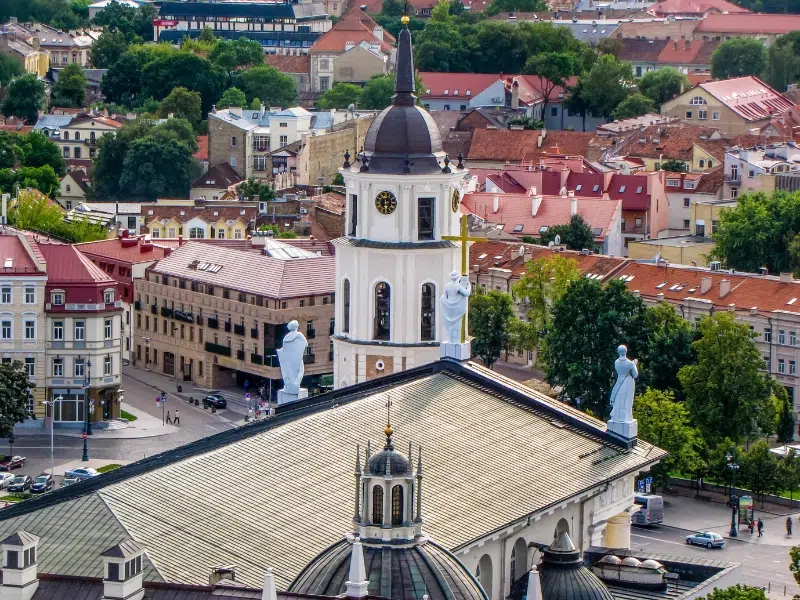
Vilnius Cathedral, officially the Cathedral Basilica of St Stanislaus and St Ladislaus, is the white neoclassical temple with six columns on Cathedral Square, at the foot of Gediminas Hill. It is the main Catholic church of Lithuania and the burial place of grand dukes and queens. Under Soviet rule it was closed and used as a warehouse and then an art gallery, and it was handed back to the Church only in 1988.
Vilnius Cathedral at a glance
- Where: Cathedral Square (Katedros aikštė), at the northern edge of the Old Town, below Gediminas Hill and next to the Palace of the Grand Dukes.
- Built: a cathedral has stood here since 1387; the present neoclassical building dates from a reconstruction begun in the early 1780s and finished in 1801.
- By: the architect Laurynas Gucevičius; after his death the work was completed by Michał Szulc.
- What it is today: the cathedral of the Archdiocese of Vilnius, open for Mass and visits, with crypt tours and a separate bell tower you can climb.
- Time needed: 30–45 minutes for the church and St Casimir's Chapel, another hour if you add the crypts or the bell tower.
From pagan shrine to Soviet gallery
Legend says a temple to the thunder god Perkūnas once stood here, and an old tradition links an early church to King Mindaugas in the 13th century, which historians now doubt. What is certain is that after Lithuania accepted Christianity in 1387, Grand Duke Jogaila founded a cathedral here, consecrated in 1388. It burned in 1419, 1530 and 1610 and was rebuilt each time. In 1769 the southern tower collapsed and killed six people, and Bishop Ignacy Massalski commissioned Laurynas Gucevičius to rebuild the whole church in the new neoclassical style. The three statues on the roof, by Karol Jelski, were placed between 1786 and 1792.
After the Second World War the Soviet authorities closed the cathedral. In 1950 the statues on the roof were taken down and destroyed, and the building served as a warehouse before becoming a picture gallery. As the independence movement grew, the cathedral was returned to the Catholic Church on 22 October 1988 and reconsecrated on 5 February 1989. The sculptor Stanislovas Kuzma made new versions of the three roof statues, put back in 1997.
What to look for
- The three roof statues: St Helena holding a large cross in the centre, St Stanislaus on the north side and St Casimir on the south, holding the cap of the grand dukes.
- The portico: six Doric columns, a pediment showing Noah's sacrifice after the Flood, and statues of the Four Evangelists by the Italian sculptor Tommaso Righi.
- St Casimir's Chapel: the Baroque chapel off the right-hand aisle, finished in the 1630s, with the silver sarcophagus of Lithuania's patron saint, eight silver-plated statues of monarchs and murals by Michelangelo Palloni.
- The bell tower: the free-standing white tower in front of the cathedral, about 57 metres high with its cross. Its lower part was once a tower of the castle's defensive wall, and it holds the oldest clock in the city.
- The royal tombs: Alexander Jagiellon, Elisabeth of Austria and Barbara Radziwiłł are buried here. Grand Duke Vytautas was buried in the cathedral too, but his grave has never been found.
- The 'Stebuklas' tile: a paving tile with the word 'stebuklas' (miracle) between the cathedral and the bell tower. It marks the end of the Baltic Way, the human chain of about two million people that linked Vilnius, Riga and Tallinn on 23 August 1989.
Legends: the three-handed saint and the miracle tile
Under St Casimir's silver coffin hangs a small painting of the saint with three hands, two of them right hands holding lilies. The legend, first written down in 1689, says the painter tried to paint over the extra hand, but it kept coming back. A study in the 1980s found that both right hands were painted at the same time, with no attempt to cover one. Outside, a newer tradition says that if you stand on the Stebuklas tile, turn round clockwise and make a wish, it will come true.
Tips for your visit
- Visit outside Mass times and keep your voice down in St Casimir's Chapel, which is used for prayer.
- Climb the bell tower for a view over Cathedral Square and the Old Town roofs; then cross the square for a photo of the cathedral and tower together.
- Book a crypt tour to see the remains of the earlier churches underground.
Nearby
- Palace of the Grand Dukes of Lithuania: the rebuilt royal palace directly behind the cathedral, now a museum.
- Gediminas Tower: the red-brick castle tower on the hill above, with the best view over Vilnius; walk up or take the funicular.
- Monument to Grand Duke Gediminas: the statue on the square of the ruler who, according to legend, founded Vilnius after dreaming of an iron wolf.
- St Anne's Church: the Gothic brick church that Napoleon is said to have admired, about ten minutes' walk east.
See Vilnius with World City Trail
Our Vilnius scavenger hunt turns the old town into a game you play on your phone. The route links 10 stops and takes around 3 hours, with about 58 minutes of walking. It includes the Gate of Dawn, Town Hall Square and Literatų Street. You can play in English, German, French, Italian, Spanish and Dutch.
If you prefer a different format, there is also a self-guided walking tour and an outdoor escape game in Vilnius.
Play the Vilnius scavenger hunt →
Take the self-guided walking tour of Vilnius →
Play the outdoor escape game in Vilnius →
Facts checked in October 2026.